

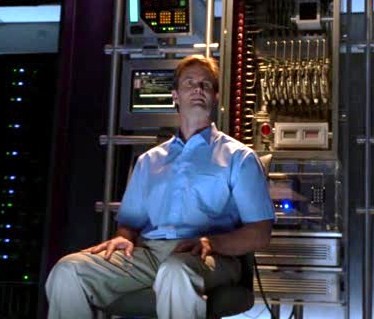
 Recent episodes of science fiction television have converged on the theme of androids named John coming up with questions for God. And what interesting questions they are!
On the episode that marked the return of Terminator: The Sarah Connor Chronicles, robot John Henry continues his education by playing with Bionicle action figures, as well as searching the internet, listening in on unsecured phone lines, and talking with Miss Weaver and Agent Ellison. John, noting the difference between the toys’ ball socket joints and his own, he begins to ponder the fact. Ellison says that John’s body was made in the image of that of humans. When asked whose image human bodies are made it, Ellison says “God’s”. John then comes up with a question for God: why didn’t he make humans with more ball socket joints?
 This isn’t just a silly question. Our bodily forms are not optimum, and without evolution as an intermediary and part of the explanation, the notion of our bodily forms being in God’s image becomes borderline inexplicable. Interestingly, on Battlestar Galactica we find a Cylon named John (he prefers to be called “Cavil”) interrogating his maker, known to us as Ellen Tigh. In this fantastic episode, we learn how five Cylons on Earth foresaw a coming apocalypse and escaped, and later helped create the human-like models of Cylons. John complains that he is forced to view wondrous things like supernovas through “ridiculous gelatinous orbs” that can only see part of the spectrum. Unlike Data who wants to be human, John resents having human limitations rather than more extensive machine capabilities.
Some have complained that BSG is bad (or at least “not as good as LOST”) because the writers didn’t know where they were going ahead of time. Neither did evolution. That’s why we don’t have more ball and socket joints. But that doesn’t mean that human existence is not something splendid and wonderful, that our nature with its limitations doesn’t give us a gift that the theoretical infinite possibilities John desires might not.
But that’s the point that came up on the pilot of Dollhouse: no matter what we have, we always want something we don’t. Yet it seems to be precisely our imperfection and the long evolutionary history that gave rise to us that have endowed us with free will and creativity, those very things that historically have been referred to as “the image of God” in humankind.












 Ad-Free & Subscriber Log-In