

A lively conversation has been taking place in the comments section of a recent post about what Christian or Judeo-Christian principles may be relevant to the approaches to economics and social justice in one’s nation. It seems like an appropriate conversation to have in the period leading up to Labor Day.
The U.S. Secretary of Labor has released this video (there’s a transcript of the text on the Department of Labor’s website):
I had an opportunity to live in a post-communist society. Communism was a disaster. It guaranteed employment (just let that sink in: 0% unemployment) but it also undermined any motivation to work, leading to a lack of productivity and economic decline. As the Romanians sometimes said about their system, “People pretended to work, and the government pretended to pay.”
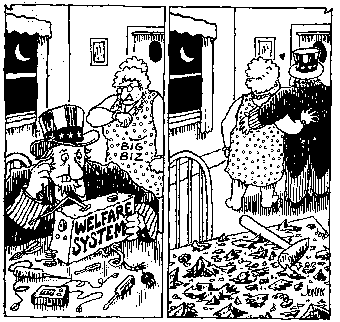
Nevertheless, I’m not happy when people talk about capitalism as “the lesser of two evils” since I don’t think we should assume that there are only two options.
I also had the opportunity to live in the UK, where socialist influences are greater than in the US, and there is a national health care system in place which is certainly far from perfect, but it allows one to live without fear of not being able to afford necessary medical care – or not being able to afford the ever more costly insurance coverage.
Christian principles include selling all one has and giving to the poor. Judeo-Christian principles include the legislation about the year of Jubilee. And so while I think one can argue that the Bible does not offer one consistent teaching on economics, and doesn’t offer a system that can be directly transplanted into our own time, it never ceases to shock me that there are people who seem to think that the Bible actually is at odds with social justice concerns. It is as though they’ve never read the Book of Amos.

















 Ad-Free & Subscriber Log-In