

… but I don’t know that Christopher Nolan’s Odyssey will be it.
That said, all we have at this point is the trailer, a handful of stills, and a couple of interviews. So let’s hold off on judgment and exercise some cautious optimism. After all, Nolan is the guy who gave us Batman Begins, The Dark Knight, Inception, and Memento (the last of which I’ve not seen, but which I am assured is excellent). Of course he also gave us Insomnia, The Prestige, and The Dark Knight Rises. So, you know, not a perfect track record…
With that said, there are reasons for optimism and reasons for pessimism. First, the trailer:
In brief, the reasons for optimism are: Nolan can do epic-scale films; his eye for spectacle is excellent; and he can tell the kind of fragmented narrative that we find in the text of the Odyssey. The reasons for pessimism are: some of his casting choices; the language the trailer seems to suggest he is going to use; and the choice of translation he is basing his film on. All of these have been talked to death on the internet, so I’m going to only focus on two things.
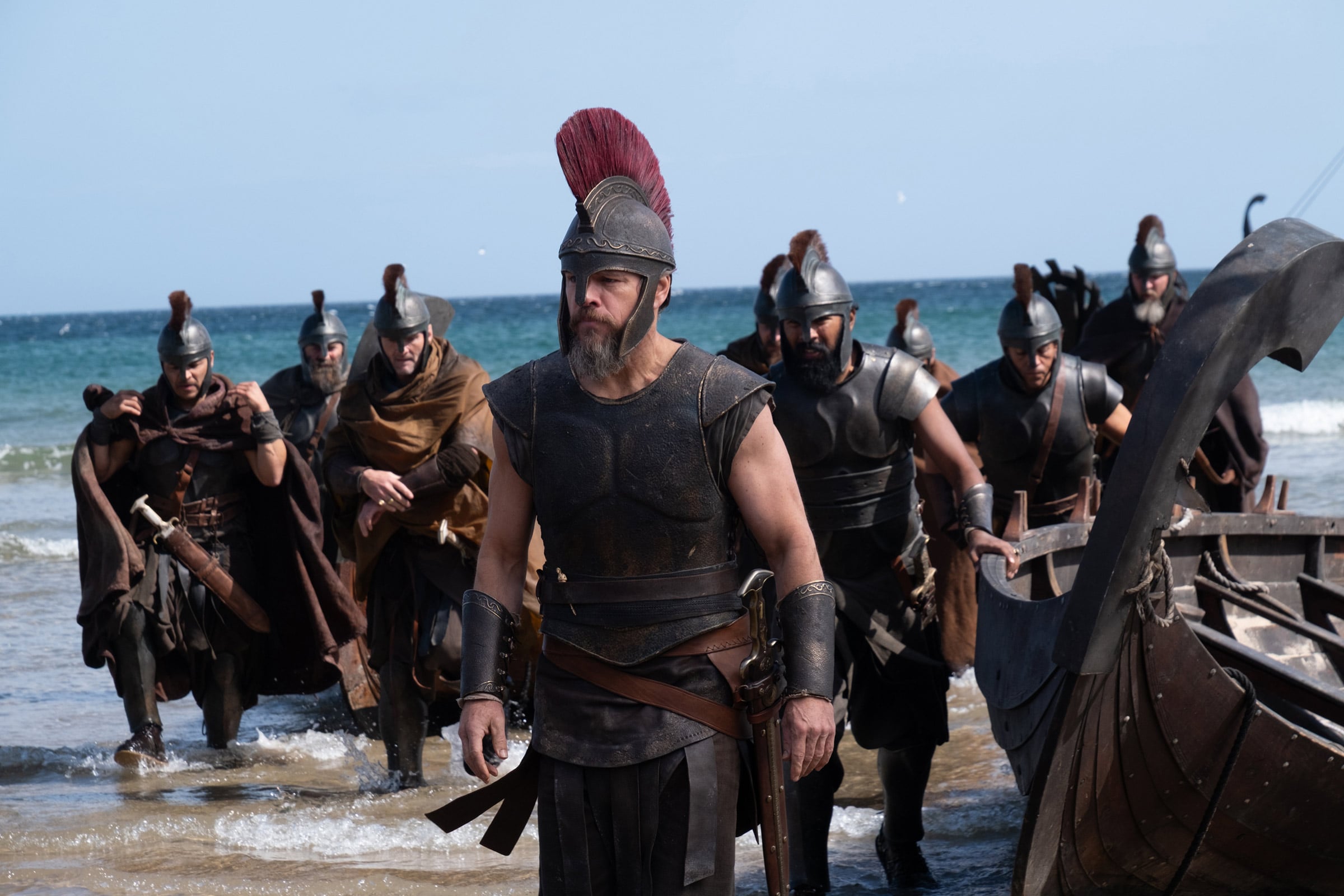
Before that: if you’ve not read it, The Odyssey is the tale of Odysseus trying to get home after the Trojan War. Because he irks the gods, it takes him ten years (the other survivors get home quickly) and what we have in the poem is a combination of the narrative of his journey home, the story of his wife and son trying to deal with the suitors attempting to take Odysseus’ place during the 20 years he has been gone (10 for the war; 10 for the journey), and flashbacks to the Trojan War itself. In other words, there is a jumble of narratives here that should work well for Nolan’s style of filmmaking. If you’ve not read the book you should, and you should read the Robert Fagles translation because it is superb.
Okay, the two things I promised to focus on. First, the language. If the trailer is typical, Nolan’s Odyssey uses modern, 21st century dialect. As the internet has pointed out, this is jarring. Whether it will be jarring-good or jarring-bad we won’t know until we see the movie, but I am not optimistic on this point. To help understand this, let’s remember a movie that did modern dialect in a historical setting that was jarring-good. I’m talking of course about A Knight’s Tale.
If you haven’t seen it, get off your duff and go watch it now. It is fantastic. It is also full of modern idioms and trope that work very, very well. But they work well because the movie is not serious. It is first and foremost intended to be fun, not gritty and dark. As a result the language (and music!) that starts of jarring quickly becomes part of the immersive process.
Now, there’s no reason a master filmmaker like Nolan couldn’t do the same thing. I mean, I don’t know that I’ve ever seen it done. But The Odyssey is a chance that we might have to see how modern language can be put in a historic setting in a way that enhances the experience rather than reminding us of Meet the Spartans.
The second thing we need to keep in mind is that we really, really, need a good version of the Odyssey. And a good version the Iliad (though I did enjoy Troy–it’s a good movie; it’s just not a good Iliad). And a good version of the Aeneid, and Beowulf (please stop making terrible versions of that), and Paradise Lost, and, well you get the point.
But to focus on the Odyssey. We have one terrible version, one okay-ish version, and one phenomenal adaptation. The terrible version is the old Kirk Douglas film Ulysses. It is… not his best work. That said, the scene with the sirens is absolutely fantastic–so well done that in the next film they left the sirens out completely, I assume out of respect for the quality of the Kirk Douglas scene.
The okay-ish version is a made-for-TV miniseries from the late 90s starring Armand Assante. It was… okay. Not great, but also not terrible, well-acted, and largely faithful to the text.
The superb adaptation is of course O Brother Where Art Thou? This is another one you should immediately go an watch if you’ve not seen it already. It should be on everyone’s to-have-watched list. That said, it is not the Odyssey. It is a very, very good movie; but it is not the epic poem.
All this to say, this would be a great moment for Christopher Nolan to give us a faithful and quality adaptation of one of the greatest stories ever told.
And hey, we as Christians know something about how difficult it can be for Hollywood to be faithful to ancient sources. Whether Nolan can rise above the temptation to adjust for the times in favor of telling the timeless, well, we’ll see soon.
Dr. Coyle Neal co-hosts the City of Man Podcast and is an Amazon Associate (which is linked in this blog). He teaches Political Science, Philosophy, and History in Southwest Missouri.











 Ad-Free & Subscriber Log-In