

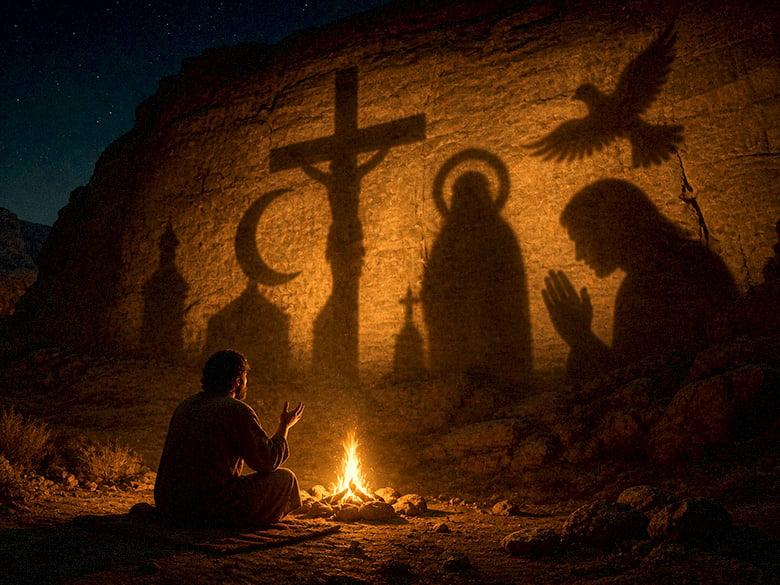
Christians love mocking mythology. Zeus throwing lightning bolts. Thor with a hammer. Athena popping out of someone’s head fully armored. Primitive people making up stories to explain thunder and crops.
And yet those same Christians will turn around and insist their own sacred narrative is not myth at all—it’s literal, historical, divinely dictated reality. Apparently every culture in human history created myths… except the one you happened to be born into.
The irony is almost impressive.
Human beings are myth-making creatures. We organize life through stories. Strip away literal belief and the function is still there—shaping identity, morality, belonging, and meaning. The real problem was never myth. The problem is what happens when myths claim unquestionable authority over reality and over people. That’s when stories stop helping humans make sense of the world and start controlling them.
The question was never whether myths exist. The real question is whether those stories serve people or rule them.
Humans Run on Story
Even people who leave religion often assume they’re leaving myth behind. The brain doesn’t work that way.
Humans instinctively interpret life through narrative. Archetypes, heroes, villains, transformation, redemption—these patterns appear across every culture because they help us organize experience. Without them, life becomes a series of disconnected events. Religion formalized that instinct by offering a cosmic story to live inside.
The problem is that over time those stories stopped being symbolic frameworks and started becoming systems of authority. What began as narrative became doctrine. What began as metaphor hardened into cosmology. And once that happened, the story stopped functioning as a mirror for human experience and became something else—a system demanding obedience.
You can watch it happen inside Christianity’s own origins. The early teachings of Jesus moved like ethical myth at its best. Parables weren’t doctrinal statements—they were narrative provocations, short ambiguous stories designed to destabilize assumptions and force listeners to wrestle with meaning. They didn’t close interpretation. They opened it. But once Christianity became institutional, that narrative style hardened into theology. Symbolic language turned into cosmology. The parable became dogma. And once that happened, the myth stopped belonging to the people listening. It belonged to the institution interpreting it.
When Myth Turns Toxic
The moment a myth claims divine authority over reality, it stops functioning as a story and starts functioning as a control structure.
Kings rule because gods chose them. Priests interpret divine truth for everyone else. Entire populations are told their place in the hierarchy was ordained by heaven. Questioning the story becomes rebellion against the universe itself.
This is the move fundamentalism perfected—metaphor into literal cosmology, symbolic stories into historical fact, institutions positioning themselves as the official interpreters of divine truth. The myth stopped being something humans used to explore meaning. It became something used to police belief. And once that happens, the story no longer belongs to the people living inside it. It belongs to whoever controls the interpretation.
Myth Is Narrative Technology
For people leaving rigid religious systems, myth itself often becomes the enemy. Every sacred narrative feels like manipulation. That reaction is understandable—but it misses something important.
Stories are tools. They can justify crusades and empires. They can also inspire abolition movements, civil rights struggles, and mutual care. Myth is narrative technology, and the real question isn’t whether we use it. We will. The question is whether those myths liberate imagination or imprison it.
What Ethical Myth-Making Looks Like
Ethical myth stays honest about being a story. It keeps the frame visible and invites reflection rather than demanding submission. The danger in many religious traditions is that metaphor slowly mutates into ontology—a story about meaning becomes a claim about how the universe literally works, and suddenly disagreement isn’t interpretation anymore, it’s heresy.
Ethical myth refuses to sanctify power. If a story exists primarily to stabilize hierarchy—gods choosing kings, priests mediating divine will, empires claiming sacred purpose—it fails immediately. A healthy myth challenges abusive power rather than protecting it.
Ethical myth stays open to revision. The moment a culture treats a narrative as fixed revelation, interpretation becomes dangerous and critique becomes rebellion. Healthy stories assume something more honest: future generations will see things we miss. They belong to the living, not the dead.
And ethical myth orients itself toward human flourishing rather than institutional loyalty. The value of a story isn’t measured by obedience but by whether it increases compassion, dignity, justice, and mutual care. If a myth requires people to harm themselves or others in order to remain faithful, it isn’t sacred. It’s abusive.
Traditions That Almost Got It Right
Some traditions came surprisingly close.
Buddhist teaching stories and koans function more like philosophical tools than religious commands—they provoke insight rather than demanding belief. Greek myths were often told as interpretive stories about human nature, not divine law: hubris, love, jealousy, fate, all held open for reflection.
Jewish midrash is the clearest model. It treats sacred texts as something to wrestle with rather than freeze in place—interpretation becomes part of the tradition itself, layered and ongoing, with rabbis openly disagreeing across centuries. The story remains alive precisely because no single reading ever gets to be final. Meaning emerges through engagement rather than submission.
In each case the myth stays dynamic. Nobody owns the interpretation permanently.
Stories Shape the World
None of this means stories are harmless. They justify wars and define enemies. They also inspire justice movements, compassion, and solidarity. Myths are powerful precisely because they give people orientation inside the chaos of life.
That’s why ethical myth-making matters. If we’re going to use stories to understand ourselves—and we will—we should be careful about the kinds we tell. Stories that cultivate humility, courage, curiosity, and care. Stories that help people imagine a more compassionate world without demanding obedience to institutions claiming divine authority.
Stories that help people think.
Myths That Liberate
Human beings will always tell stories to explain who we are and why our lives matter. That isn’t a flaw in human psychology. It’s one of our most powerful creative instincts.
The real problem was never myth. The problem was pretending our myths belonged to God instead of to us. Because once a story claims divine authority, questioning it becomes rebellion—and the story itself becomes a cage.
Ethical myth-making does something much simpler. It keeps the story honest. And in doing so, it leaves the imagination free.
If this felt a little too accurate, there’s more where that came from.
The Tribulation Survival Guide
— same world, fewer guardrails.

Or skip the algorithm →
Want to know how you’d actually survive the end times?
You Missed the Rapture — find out how you die
Podcast, socials, and the rest →












 Ad-Free & Subscriber Log-In