

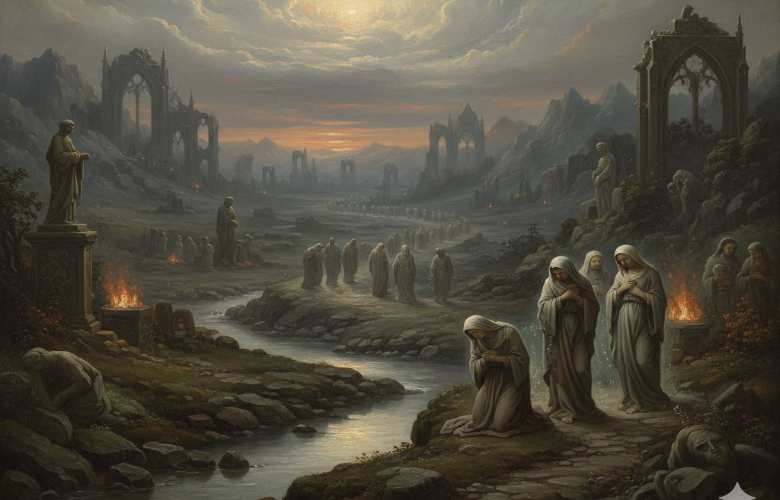
With the possible exception of the place and role of Mary, there may not be a greater source of conflict among Catholics and Protestants than eschatology. Eschatology is a discipline within theology that is concerned with the end times and the final state of the soul. A specific subject within eschatology that has led to much strife among Christians is purgatory.
While the doctrine of purgatory remains a significant source of Christian conflict, this essay will suggest that purgatory is not an ecclesial invention but a biblically supported and theologically necessary state of final sanctification.
What Is Purgatory?
In his Divine Comedy, the poet Dante describes the realm of Purgatory as a massive island mountain with seven terraces, where souls are purified of their sins before entering heaven. Each level or terrace corresponds to one of the seven deadly sins: pride, envy, wrath, sloth, greed, gluttony, and lust. The souls suffer punishments commensurate with their sins for the sake of being purified.
For its part, the Catholic Church defines purgatory as a “purification, so as to achieve the holiness necessary to enter the joy of heaven,” which is experienced by those “who die in God’s grace and friendship, but still imperfectly purified.” It should be noted that while those in purgatory do suffer as part of the purification process, “this final purification is entirely different from the punishment of the damned” (Catechism of the Catholic Church, paragraphs 1030-1031).
Having established the definition of purgatory, we must now examine what occurs within this state.
What Happens in Purgatory?
From a biblical perspective, the need for the soul to be purified is predicated on the teaching that nothing unclean will enter the presence of God in heaven (Revelation 21:27). Since sin defiles the soul, and if it be that the one who dies in a state of mortal sin is excluded eternally from heaven, it is manifest that purgatory is reserved for those souls who die with mortal sins forgiven.
It follows, therefore, that one may still die with impurities present in the soul, specifically venial sins and the temporal punishment due to sins already forgiven. Temporal punishment is not vengeance. Rather, it is a recognition that sin has two aspects. In addition to depriving one of communion with God, sin also entails an attachment to worldly or creaturely matters. Therefore, to obtain entry into heaven, it becomes necessary that these impurities be purged from the soul.
When we die, we undergo what is called the particular, or individual, judgment. Scripture says that “it is appointed for men to die once, and after that comes judgment” (Hebrews 9:27). We are judged instantly and receive our reward, for good or ill. We know at once what our final destiny will be.
At the end of time, when Jesus returns, there will come the general judgment. (Matthew 25:31-32). In this general judgment, all our sins will be publicly revealed (Luke 12:2-5), and if revealed, also punished. To this end, Saint Augustine writes that “temporary punishments are suffered by some in this life only, by others after death, by others both now and then; but all of them before that last and strictest judgment” (City of God).
It is between the particular and general judgments that the soul is purified of the remaining consequences of venial sin as well as any penance due for mortal sin. The soul will not be released from purgatory until the purification process is achieved. “I tell you, you will never get out till you have paid the very last copper” (Luke 12:59).
Criticism Of The Doctrine Of Purgatory
Before reviewing the two fundamental criticisms of the doctrine of purgatory, it should be mentioned that prayers for the dead are reserved for those souls in purgatory. The souls inhabiting the other two possible “destinations,” heaven and hell, do not benefit from prayers. The reason for this lies in the permanency of the state of their souls. The souls of heaven and hell are residents for eternity; there can be no change in their final state. That is not the case with souls in purgatory. Since petitionary prayers seek to effect a change, and since the souls in purgatory are subject to change, prayers for them are of great value.
That said, it is beneficial to examine the two basic arguments against the doctrine of purgatory. The first criticism is that purgatory is essentially an invention of the Catholic Church. Indeed, some critics have suggested that Pope Gregory the Great created the concept of purgatory as a way of forcing believers to pay for indulgences that would spare them from suffering in purgatory.
However, this critique does not stand up to scrutiny. For example, some of the earliest extant Christian writings, such as the Acts of Paul and Thecla and the Martyrdom of Perpetua and Felicity (both written during the second century), refer to the Christian practice of praying for the dead. Such prayers would have been offered only if Christians believed in purgatory, even if they did not use that name for it.
Additional evidence of praying for the dead appears in the catacombs beneath Rome. These prayers were placed there by Christians suffering persecution in the second and third centuries.
Also, there is the biblical story of the Maccabees. In 2 Maccabees, we read how Judas Maccabeus arranges for prayers and sacrifices for fallen soldiers, so as to “make atonement for the dead, that they might be delivered from their sin”. While Catholics accept 2 Maccabees as inspired Scripture, Luther and arguably later Protestant traditions removed it from the canon, partly due to this very reference to praying for the dead.
Finally, there is the story of Augustine’s mother, Saint Monica. Augustine recalls his mother asking him to pray for her departed soul. This request would make no sense if she thought her soul would not benefit from prayers. (Hippo, Augustine. The Confessions. New City Press, 2010).
The second criticism is soteriological in nature. The argument can be summed up this way. If Jesus affected salvation by paying for our sins, why is it necessary that some souls should endure a purgative state after death?
The first thing to point out is that the souls in purgatory will eventually enter heaven. In this sense, they are “saved.” Perhaps the best way to view it is to say that the salvic work of Christ has made our redemption possible; it has provided the framework for our salvation. Still, Scripture informs us that “If someone’s work is burned up, that one will suffer loss; the person will be saved, but only as through fire.” (1 Corinthians 3:15).
An analogy may be illuminating. If a child breaks a window and the father forgives him, the relationship is restored (guilt is removed through the salvific work of Christ), but the window is still broken. Penance is therefore necessary, and this is the sanctification or purification process that takes place in purgatory.
Conclusion
Ultimately, the doctrine of purgatory is not an invention of the Middle Ages or the Catholic Church. Rather, it is a practice rooted in the early Church and the Jewish tradition.
While it remains a point of division, understanding purgatory as a process of final sanctification rather than a second chance or insufficient grace helps clarify its role in Christian theology: to prepare the human soul for the purity of the Beatific Vision.













 Ad-Free & Subscriber Log-In