

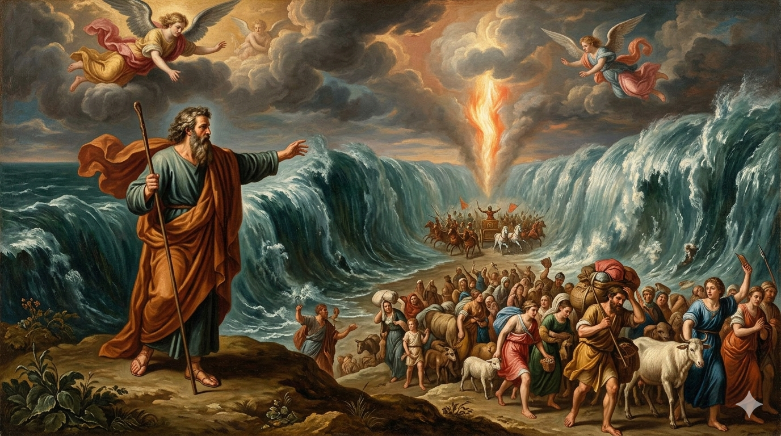
To put it mildly, there are some rather remarkable events depicted in Scripture. From the creation accounts in Genesis to Noah’s Ark to a talking donkey, the Bible contains stories that can strain credulity to the breaking point and naturally raise questions.
In this paper, I will examine what Catholicism has to say about the nature of these incredible stories and how they should be interpreted.
Schemes And Tropes
The Bible is not a unified book in the traditional sense. Rather, it is a library of books – seventy-three of them, to be precise – that utilizes various literary forms and genres that vary depending on the specific biblical book one is reading.
As such, it is incumbent on anyone reading or studying the Bible to be cognizant of who the author(s) were, the intended audience, and the purpose of each particular book. Additionally, it is important to take note of the genres and literary forms employed by the scriptural authors.
In turn, these various literary forms and genres employ numerous rhetorical devices. Two common devices are schemes and tropes. These are figures of speech that use language in unusual ways.
A trope is an artful deviation from the ordinary or principal signification of a word. A trope uses a word in an unusual or unexpected way. A scheme is an artful deviation from the ordinary arrangement of words, the effect of which is a creative alteration in the usual order of words.
Examples of these rhetorical devices used in Scripture include personification (attributing human traits to abstract concepts), hyperbole (intentional exaggeration to emphasize a point), metaphor (describing one thing in terms of another), and metonymy (substituting a related word for the literal one).
While it is unnecessary to delve much further into rhetoric, it is necessary to be aware of the various literary devices used by the biblical authors. It is also beneficial to examine why these rhetorical devices are used in the Bible.
Why Mythology And Allegory?
To the modern mind, the term mythology is almost synonymous with fiction. However, the term has a much broader definition in literature. The comparative religion scholar Joseph Campbell defined mythology as the metaphoric, symbolic, and “public dream” that points beyond literal facts to reveal the deep psychological and spiritual truths of human existence.
Campbell did not view mythology as strictly historical; rather, he saw it as “clues to the spiritual potentialities of the human life” and as an essential guide for navigating life’s stages. (Campbell, Joseph, and Bill D. Moyers. The Power of Myth. Harmony, 1988).
Applying a Catholic understanding to Campbell’s definition allows one to see these literary forms as means of God’s self-communication. As such, they can be considered a form of divine revelation.
First, the use of mythology and allegory helps to induce a sense of awe and wonder before the mystery of the universe. Second, it provides a framework for validating and supporting social and ethical principles. Finally, it has various pedagogical and psychological benefits.
Applying the above principles to the biblical text allows us to say some specific things about the use of mythology and allegory in the Bible.
Figurative History And Symbolic Narrative
Figurative history and symbolic narratives serve as a fascinating lens for exploring biblical truths because they can reveal deeper meanings within the sacred texts.
The Bible often employs allegorical language to convey profound spiritual realities, as seen in Jesus’ parables. For instance, in Matthew 13:31-32, the Kingdom of Heaven is likened to a mustard seed, illustrating how something small can grow into something magnificent.
Similarly, the Song of Solomon’s allegorical nature reflects the intimate relationship between Christ and His Church, emphasizing love and devotion (Song of Solomon 2:4).
The Apostle Paul draws on allegorical interpretation in Galatians 4:24, where he contrasts the two covenants through the story of Hagar and Sarah, highlighting the difference between bondage and freedom in Christ.
Such allegorical interpretations invite believers to delve deeper into the text, uncovering layers of meaning that point to God’s overarching narrative of redemption. In exploring mythological allegory, one can appreciate how these literary devices enrich our understanding of divine truths, as seen in Romans 1:20, where creation itself speaks to God’s eternal power and divine nature.
Ultimately, the use of allegory in Scripture encourages believers to seek wisdom and understanding, as Proverbs 4:7 teaches, cultivating a deeper relationship with God through His Word.
Suffice it to say that the biblical authors saw great value in using mythology and allegory to present God’s Word. How should Catholics reading the Bible today understand these literary devices?
A Catholic Interpretation
In light of the fact that the biblical canon was completed in the fourth century, and in light of the fact that it utilizes various literary devices and comprises various mythologies, how should modern-day Catholics understand Scripture?
To begin with, it is crucial for anyone reading the Bible to be aware of the four senses (literal, allegorical, moral, and anagogical) by which the text conveys meaning.
The literal sense conveys the author’s intended meaning, inspired by God, without recourse to mythology or allegory. However, interpretation requires considering context, culture, and literary genre, recognizing that truth is presented and expressed differently in historical, prophetic, and poetic texts.
The allegorical sense understands events, people, or objects as prefiguring Christ or the Church. For example, the “woman clothed with the sun” in Revelation is interpreted as Mary, Israel, or the Church.
A moral sense is a text that seeks to teach just actions and guide behavior.
Finally, the anagogical sense views earthly realities in terms of their eternal significance and heavenly home.
How can these interpretative tools be used in dealing with a difficult passage, for example, the “talking donkey” of Numbers 22:28? The Church takes a literal interpretation of the passage. This is to say that the Church teaches that the donkey actually did speak. As incredible as this may sound, the belief that God speaks through His creation is not without precedent (e.g., the burning bush of Exodus).
Given the nature of the text and the senses with which the Bible is to be interpreted, we can ask why the biblical authors chose to convey the Gospel message utilizing mythology and allegory.
Literary Choices, Or Something More?
A Catholic reading of the Bible suggests five reasons why the authors chose to use mythology and allegory to convey their messages.
In the first reason, the biblical authors (again, under the inspiration of God), use mythological and allegorical language to express complex, spiritual relationships, such as Jesus as a “vine” and believers as “branches” (John 15). The images conjured by the rhetorical devices would have been recognizable to the intended audiences, thereby helping explain certain divine truths.
The second reason concerns the cultural context of the ancient Near East. The biblical authors (such as those of Genesis and the Prophets) frequently used myth, epic, and war narratives to explain realities such as the conquest of sin or creation, a style common in their time.
The third reason for using mythological and allegorical language is its connection to tradition. Many stories were designed to repeat or mirror Old Testament figures and events (like Moses or Elijah) to show how Jesus fulfilled prophecy and brought salvation history to its climax.
The fourth reason centers on the emphasis of theological truths over literalism. While the Catholic Church holds certain events (such as the Fall of Man in Genesis) as historical, it encourages recognizing that many narratives are symbolic. The focus is on the meaning (theological truth) rather than on the literal, historical facts.
Finally, the use of certain rhetorical devices can inspire faith and virtue in readers. The use of storytelling, such as parables or symbolic narratives, is often more powerful and memorable for conveying spiritual lessons, promoting virtue and piety.
Conclusion
Anyone seeking to read the Bible must be aware of several considerations. Among these are the use of literary devices and appeals to mythology.
In many ways, the use of mythology and symbolism helps make the biblical story universal and timeless, and in this essay, I have endeavored to explain not only the types of literary and rhetorical devices used in Scripture but also their purposes.








 Ad-Free & Subscriber Log-In