

How Beliefs Emerge from Trauma
We tend to think of our beliefs as coming from an eternal being or a perfect, unchanging place in history that has somehow stayed undisturbed, pure, and holy for thousands of years. The obvious problem with this view is that since the Reformation 500 years ago, when Protestants separated from Catholics, belief systems have split into more than 180 major Protestant denominations, along with thousands of independent groups and possibly tens of thousands of variations.[1]
Every belief system and movement believes that they are right and that God is on their side.
So, where do our belief systems come from, if not from an authentic and eternal source?
Before we get to that question, it might help us understand why we need beliefs in the first place. As I mentioned earlier, beliefs aren’t facts, and they aren’t the truth. We can’t prove them in a scientific lab, and even archaeological discoveries sometimes raise more questions than they answer. My belief (chuckling to myself) is that they are simply assumptions. Sometimes we inherit them, and sometimes we make them up to give ourselves comfort from fear.
Why we think we need belief systems
Belief systems give us an interpretation of the world, even though they are often simple, made-up, and sometimes illogical. They create an illusion of being a framework for understanding right and wrong. They also help us feel connected by uniting around shared values and beliefs (assumptions).
So, when we are in a crisis and struggle to think clearly and don’t have time to research and learn on our own, we depend on groups and systems (parties/denominations/organizations) to give clear definitions, where we can agree or disagree, which determines our standing within the group and strengthens our sense of belonging. Sometimes, these groups are even helpful in solving our immediate problems, even if they don’t address the more troubling long-term issues.
Where beliefs really come from
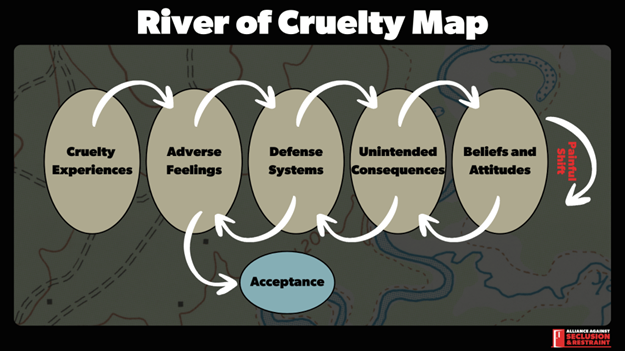
My friends, Dorthy and Steve Halley, from The Family Peace Initiative, explain it through their River of Cruelty model. They mainly use this model in Battery Intervention groups and frequently in connection with prison and parole offices. It is a highly effective program for unraveling the connections between the ways we are cruel and the cruelty we experience.
Please see this link for a more detailed explanation of this process, or follow along for a summary.
Our own experiences. The ways we experience cruelty are varied and can be confusing because sometimes cruelty is hidden within our social understandings and the agreements we casually accept with others. Many of these stem from childhood trauma, but we can also be profoundly affected in adulthood when people violate rules and fail to treat us as we expected.
High-control religions and families often create these negative experiences, not usually out of malicious intent, but because they aim to exert control. Shadow messages about our worth and status frequently start to develop in these environments.
Adverse Feelings: A common saying when discussing trauma is “It’s not just about what happened to us, but how we experienced it.” The negative feelings drive us to respond with a need to survive. The survival strategies designed to protect us from dangerous animals often activate automatically, causing us to increase our defenses subconsciously.
Defense Systems: To cope with intense emotions, individuals develop defense mechanisms that can lead to issues over time. These might include behaviors such as aggression, repression of feelings, or self-centeredness.
Unintended Consequences: While defense systems might provide temporary relief from negative feelings, they can lead to unintended negative effects that harm a person’s relationships and well-being. This may include being cruel to others. We often overreact to everyday situations, which then complicate our lives and relationships with others.
Beliefs and Attitudes: Underlying these defense mechanisms are beliefs and attitudes that maintain the cycle of cruelty, such as a need for control or the belief that showing vulnerability is a weakness. With spiritual beliefs, we don’t develop them when everything is peaceful and aligned; we form them because we experience cruelty, pain, or insecurity, as our nervous systems crave regulation.
Below is a graphic that shows this process more clearly. As you can see, it is a process that is more circular than linear. But don’t miss the point that beliefs and attitudes are formed in the midst of our struggles.
Completing the Circle
Community groups and religious organizations step in when they see us going through this river of cruelty. I never want to accuse groups or organizations of having bad intentions, but sometimes their understanding is limited. They usually ask us to accept the group approach to the problem, which they sometimes label as “sin.” The assumption they make is that if we are all centered around the same belief, then the issues will resolve themselves, maybe even miraculously.
When myths and stories are told about the group’s way of navigating life, they sometimes turn into sacred texts, giving a feeling of security by insisting they are right and that God supports them.
Although history shows that these types of communities and groups can provide a sense of regulation and immediate relief, they often fail to address the long-term problems.
A Way forward
As FPI explains, problems only start to be resolved when we can use different types of restorative practices that require focused effort and a certain level of expert understanding of the core issues we face.
They prescribe the following, which I offer in summary:
- Recognize the cruelty they have experienced and inflicted on others.
- Addressing the “River of Cruelty” by first confronting shadow messages, challenging the negative, often unconscious messages received during childhood that contribute to harmful behaviors.
- Accept responsibility for healing both the trauma experienced and the trauma inflicted on others.
- Develop healthy coping mechanisms and learn new ways to manage emotions and respond to challenging situations without resorting to cruelty.
- Break the cycle through accountability without shame.
- Hold individuals accountable for their actions without resorting to shame or humiliation.
- Develop the ability to understand and respond to both our own emotions and the emotions of others in a healthy way through an “Enlightened Witness.”
- Cultivate a culture of safety and respect by practicing personal responsibility.
As a former pastor with big ideas about what the church could achieve, I don’t hold any negative feelings if people choose to get involved in a faith community. I ask that we be realistic about what these groups can accomplish. While they may provide us with a sense of relief and stability, which is helpful, they are usually not equipped to address the trauma and cruelty we’ve endured, along with our cruelty toward others.
Exiting the River of Cruelty is like swimming upstream, recovering from our wounds, and doing the hard work of putting our lives back together.
Beliefs emerge from trauma and must be routinely questioned, not blindly accepted!
Be where you are, Be who you are, Be at peace!
Karl Forehand
[1] https://www.thearda.com/













 Ad-Free & Subscriber Log-In