

The Avignon Papacy refers to a period from 1309 to 1376, when the Papacy was, in effect, forcibly captured by France. And it’s in the news because of a shocking account of threats made to Pope Leo XIV by U.S. officials.
What is claimed to have happened: In January 2026, Under Secretary of Defense for Policy Elbridge Colby summoned Cardinal Christophe Pierre to a meeting in the Pentagon. The Cardinal was serving as Apostolic Nuncio — the Pope’s ambassador — to the U.S. at the time. It’s reported that in this meeting, Elbridge told the Cardinal that the United States has the military power to do “whatever it wants,” and that Pope Leo XIV, the first U.S.-born pope, had “better take its side.” And an unnamed official at the meeting allegedly invoked the Avignon Papacy, when the French Crown used its military power to control a series of popes.
Since his election to the papacy in May 2025, Pope Leo XIV has been openly critical of the Trump Administration’s mass deportation policies. But what is said to have triggered the Pentagon meeting was a major address given by His Holiness in January 2026. Some Pentagon officials had picked the speech apart and found it critical of the Trump Administration. His Holiness did not explicitly mention the U.S. or the Trump Administration in the speech. But the officials believed the Pope was calling out Trump for his “Donroe Doctrine,” which assumes the U.S. may dominate all other countries in the Western Hemisphere. In particular the officials took offense when Pope Leo said, ” A diplomacy that promotes dialogue and seeks consensus among all parties is being replaced by a diplomacy based on force.” And I am personally alarmed that people who think this way might be running the Pentagon.
What Was the Avignon Papacy?
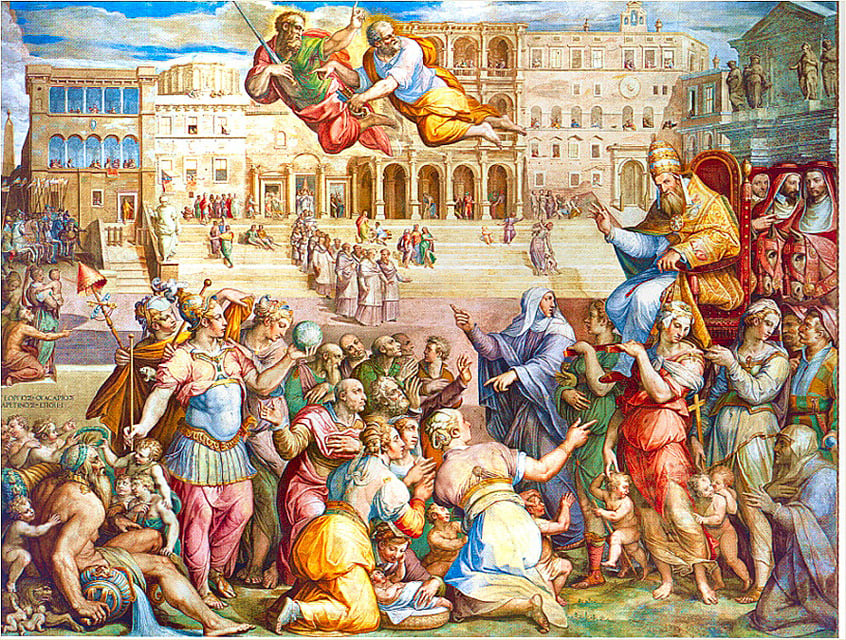
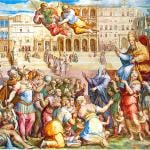
Through the long history of the papacy there have been many clashes between kings and popes. But disagreements between Pope Boniface VIII (1230–1303) and King Philip IV of France (1268–1314) boiled over into war. In 1303 Philip’s army attacked the Pope’s palace outside Rome and held Boniface captive for three days. The Pope died of many injuries shortly after. Pope Boniface VIII was succeeded by Pope Benedict XI, who died the following year. The Conclave that elected the next pope was deadlocked for months, largely over the issue of what to do about France. Eventually the Cardinals chose Raymond Bertrand de Got, Archbishop of Bordeaux and a close friend of King Philip, who became Pope Clement V.
To please King Philip, Pope Clement V was crowned in Lyons and remained in France. In 1309 he took up residency in Avignon. Today Avignon is a lovely old city in the south of France, about 90 km or 60 miles northwest of Marseille. In the 14th century Avignon was not in France but in the Kingdom of Arles. But this was a meaningless distinction. Kings of France had enormous influence over what went on in Arles and in the sumptuous Palais des Papes in Avignon. The next six popes after Clement V were all French and remained in Avignon, under French control, until the last Avignon pope, Gregory XI (1370–1378) returned to Rome in 1376.
When Gregory XI died in 1378, large crowds of Romans converged and called on the Cardinals to choose a Roman Pope, not another French one. The Cardinals elected Bartolomeo Prignano, Archbishop of Bari, who was Italian but not a Roman. Unfortunately, the new Pope Urban VI appears to have been psychologically unstable. Six months later the Cardinals declared that election invalid and chose another pope, leading to a schism and convoluted mess in general that I wrote about in an earlier post, Why Pope Gregory XII Resigned.
Postscript
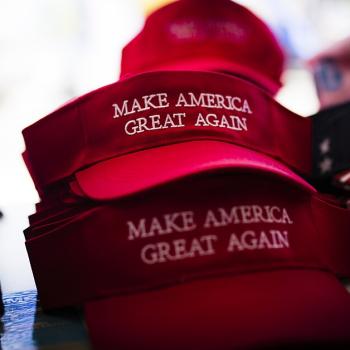
I do not know if President Trump had prior knowledge of the Pentagon meeting, although it wouldn’t surprise me if he did. President Trump likes to portray himself as a great champion of religious liberty, but time and again he reveals himself to be anything but; see MAGA’s Assault on Religious Liberty. The President favors religious institutions that support his policies. Otherwise, not so much.
According to Forbes, the Vatican has confirmed the Pentagon meeting took place on January 22, but has made no further comment. The Pentagon insists the meeting was “respectful.” However, it’s public knowledge that Pope Leo XIV declined an invitation from Vice President J.D. Vance to visit the U.S. on July 4, 2026, the 250th anniversary of Independence. His Holiness also declined an invitation to join President Trump’s Board of Peace. Today there are reports that Pope Leo XIV may not visit the United States as long as Trump is president.
This news story was first reported by Mattia Ferraresi at The Free Press, “Why the Vatican and the White House Are on the Outs.” If you don’t want to finagle your way through the Free Press subscription firewall, the story has been picked up by other news media, such as Newsweek. See also Christopher Hale at Letters from Leo.










 Ad-Free & Subscriber Log-In