

Consciousness is certainly one of the most challenging and interesting topics that I have encountered in my spiritual journey. Perhaps Ultimate Reality (God) is the mind of the Universe.
In my writing, Ultimate Reality is probably NOT personal, possibly NOT supernatural, and perhaps NOT even intentional. I use this neutral term to describe the “ground of being, “NOT a being, and there is nothing “woo woo” about it. In fact, there are striking parallels between Eastern mysticism and quantum physics, which is our best description of the physical universe.
In The Way, I say that the Western worldview is generally based on “materialism.” Materialism suggests that consciousness originates from energy and matter. The other way to look at things, which is more common in the Eastern worldview, is “idealism.” Idealism suggests that energy and matter originate from consciousness, not vice versa. Consciousness is fundamental.
According to philosopher David Chalmers, there is the “hard problem” of consciousness. How could something material, like an organism, produce something immaterial, like a thought? Likewise, there is the “other hard problem” of consciousness. How could something immaterial, like a thought, produce something material, like an organism?
Idealism seems puzzling at first. However, recall that solid objects are not really “solid,” and that empty space is not really “empty.” And, ultimately, we process sensations in our brains, even when we “hear” with our ears and “see” with our eyes. Sir James Jeans, an astrophysicist, once wrote, “The universe begins to look more like a great thought than like a great machine.”
Perhaps Ultimate Reality (God) is the Mind of the Universe
In Western traditions, consciousness is NOT well-understood or widely-discussed. But in Eastern traditions, consciousness is an essential aspect of Ultimate Reality. In fact, in Hindu philosophy, satchitananda is a Sanskrit term meaning “being, consciousness, bliss,” which describes the nature of Ultimate Reality or the supreme consciousness.
In Buddhism, consciousness is a dynamic, ever-changing process of awareness that arises and falls away as conditions change. We perceive consciousness through the five senses, as well as through the mind, in ideas, memories and thoughts. In Case 30 of The Gateless Gate, Damei (Daibai) asked Mazu (Baso), “What is Buddha?” Mazu said, “This very mind is Buddha.”
As Geoffrey Shugen Arnold explains, “The universe asks; the universe itself responds. This is miraculous awareness. Mind is Buddha. This is the mind of the universe. It is the one great body that fills heaven and earth. Where is the self to be found? This is why the search for enlightenment or nirvana beyond this mind is impossible. There is nothing outside of it.”
In Taoism, the Tao is the cosmic, ever-flowing source of life. Taoists believe that individual awareness is NOT separate from the Universe; it is an extension of the whole, without separation.
Imagine that Ultimate Reality is NOT a personal being, but the impersonal “ground of being.” Perhaps St. Paul was talking about this ground of being when he quoted a pagan philosopher, saying, “In him, we live and move and have our being.”
Perhaps Ultimate Reality (God) is the mind of the universe, and the universe is a great thought. Here, Ultimate Reality does NOT create consciousness; Ultimate Reality is Consciousness. Also, here, we do NOT have a relationship with Consciousness; we participate in Consciousness.
A World Appears
I took a year-long break when I wrote The Way, so I could concentrate on “consciousness” and understand it well enough to write about it. Recently, I read A World Appears by Michael Pollan. Pollan is a science writer, not a scientist, and his writing is accessible and insightful. He asks great questions and arrives at tentative conclusions about a broad and deep subject.
Pollan explores the concept of sentience, a precursor to consciousness. He reports that organisms without brains (such as plants) demonstrate sentience when they communicate with each other and when they respond to their environments. Also, he studies the concept of feelings. Some neurologists argue that feelings beget consciousness; consciousness does NOT beget feelings.
Others assert that uncertainty begets homeostasis, which begets consciousness. Homeostasis refers to the process of maintaining internal stability while experiencing external instability. Here, homeostasis might apply to any “self-organizing system,” such as a colony, an ecosystem, a tropical storm, or a virus. It might be possible to embed these processes into artificial intelligence, too.
Pollan writes, “I was beginning to see that there exists a place, one way, way out there, where the reductive logic of the brain-as-computer meets the magic of transcendence.” Later, he wonders, “So where does that leave us? Exactly where we already were: in the exitless labyrinth of consciousness.”
Pollan looks at the concept of thought from three different perspectives, namely thoughts as a “stream of consciousness,” as discrete thoughts, and as spontaneous or unconscious thoughts. Then, he studies the concept of self. He suggests that experiences and memories constitute the self and that the self may be an illusion that is not essential to consciousness.
Pollan’s writing, like my writing, is reporting. Pollan’s book suggests that the state-of-the-art thinking about consciousness looks beyond brain-as-computer and beyond self-as-intentional agent. He asks intriguing questions about whether other living beings (such as plants and animals) and non-living systems (such as computers and tropical storms) experience consciousness.
“My Time in the Cave…”
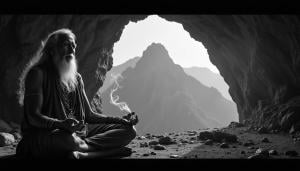
Pollan concludes with a stay in a cave on a Buddhist retreat, where he attempts to strip away his sense of self. In the cave, Pollan writes, “The moment of being fully, freshly present to the universe stopped me cold and made me wonder if all my hard thinking about consciousness had missed something crucial about it…. the less of it I was actually experiencing—whatever it was….
“My time in the cave had shown me another way to look at consciousness: less as a scientific or philosophical puzzle to be solved and more as a practice, a way to once again be altogether here, present to life and to this vault of stars.” To me, it was fitting that Pollan ended his inquiry by attending a Buddhist retreat and meditating on spiritual practice and transcendence.
Similarly, in The Way, I said, “The mystics describe a state of cosmic consciousness or unity consciousness, in which we can transcend our egoic selves and attain a sense that everyone is related, and everything is connected. This cosmic consciousness is sometimes known as ‘Buddha nature’ in Buddhism or ‘Christ consciousness’ in Christianity.”
When we discuss consciousness, we can get tangled up in semantics. Is consciousness wakefulness? Or is it sentience? Is it awareness? Or is it self-awareness? In the Eastern worldview, consciousness is something like the ground of being. Pollan seems to agree by dispelling the concept of self, emphasizing experience over intellect and focusing on transcendence.
Consciousness is certainly one of the most challenging and interesting topics that I have encountered in my spiritual journey. Perhaps Ultimate Reality (God) is the mind of the universe.










 Ad-Free & Subscriber Log-In