

The inconsistency of the current socio-political climate keeps the populist in check with baited breath on the next evolution. Continuing to question, “Where are we?” by the press and sociologists begins to wear as thin as the culture’s patience. Yet, what other question can one ask at this time? A cursory review of the daily and evening reports contains some aspect of this point: “Where are we?” Attempting to answer is just as futile an action as asking the question at the start.
Reflecting on times when the world seemed to begin this line of questioning, a couple of tracks surfaced that addressed and called for action around this theme. The Black Eyed Peas’ track “Where Is the Love?” and “Fallen” by Classified work as strange bedfellows in this conversation. Coming at different times, yet connected in attention to the theme, these international artists situate a work centered around community interest and involvement in support of a slowly crumbling cultural structure.
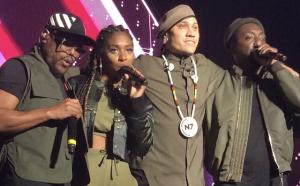
Examples Of Love: The Black Eyed Peas and Classified
The Black Eyed Peas, Where Is The Love? (Official Music Video), June 16, 2003,
This track is lined with questions. The starting question is offered to a fictitious, composite mother-image, serving as a terrestorial assistant. Before the chorus, there’s a call to the “Father,” coupled with multiple stares upward to the sky. This is an extra-terrestrial call, seeking understanding and knowledge of the local unfolding issues. In both cases, the unsettled nature of the voice is concertized.
The perspective starts on Earth and eventually rises to the heavenly. Mother, as a metaphor for a grounded culture, is called upon first. The physical, visual is understood and sought for immediate answers. The non-physical, non-visual is less understood, but eventually sought after to answer the unanswered questions. Patience in a response is given. Where the desire is for the mother image to support the immediate, localized issues, while the father figure is looked to for credible, secure, and foundational matters at hand. Though both positions are anthropomorphized, the lineage of the call for assistance, from mother first, then to father, illustrates the lack of attention or discipline to call on the Father, the Lord, first, not last.
The Black Eyed Peas involve the entire community to question where the love is in their environment. The majority of the video takes place in the back of an armored car. One can read this as once the ‘love’ is found, it will be so valuable that it must be protected, at any cost.
Born at a time of grand distress in the U.S., after 9/11, the track raises some controversial points, aligning oppressive and discriminatory actors with this atrocity. The track doesn’t answer this point, but rather underscores this with an urgent call to find love somewhere in the turbulent nature of the times.
The question the track presents is prefaced by a litany of social issues, each rhetorically pointing to where the love is to be found. The final line of the track’s chorus states that “It’s got me questioning, ‘Where is the love?’” Each member provides their cultural analysis of situations that challenge the involvement of love, working to illustrate how love is marginalized. This line of review leaves the reviewer seeking a credible response from the group. Rather, the point leaves the one questioning, ‘Where is the love?’
The use of the van, carrying members of the group, broadcasting their thesis to the included communities, symbolizes the movement of love across borders; a position of cross-cultural inclusivity founded on cooperation and a universal reading of love.
The urban landscape tropes on the theme that love is the most important for marginalized, oppressed, underrepresented, and disenfranchised communities. Emphasizing the images of youth centers, the central theme of the necessity for love to be provided to and built upon the forthcoming generations. Coming from the vocalization of adults, youth is transposed into a space of being the survivors of and construction agents for love in the future. A time-honored point, which is updated and contextualized in the current cultural fabric of the U.S.
“Where Is the Love?” moved the Black Eyed Peas from an established Hip Hop group to a pop collective. A well-selected work and title to do so for the group. The Black Eyed Peas take advantage of the human interest of this track to speak to pop culture. The overwhelming success of the track brought the Black Eyed Peas from an underground group to the global arena.
“‘Where Is the Love?’ saw success on radio airplay charts, peaked at number eight on the US Billboard Hot 100, and topped the charts in Australia, Ireland, and the United Kingdom, where it became the biggest-selling single of 2003 (Wiki Creative Commons, n.d.).
The Black Eyed Peas, Will.i.am, Taboo, and Apl.de.ap, offered the country a question without an answer. Electing to reference pop culture as narratives on the track’s theme, the group was able to neutralize the necessity to provide an answer to their inquiry.
Straddling a soul music influence with a Hip Hop narrative, orchestral gestures, and choir textures are strategically placed to present a holistic community arc of the track. The guerrilla tagging of the question mark poster inverts an act seen as disturbing the image of a community into one promoting a positive non-verbal statement in support of elevating a call to question the inclusion of love, physically, viscerally, and literally in the cultural identity.
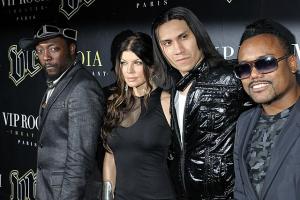
The intrigue of the work is what the track does not state; it doesn’t address a credible response to finding or building love. Rather, the scope of the track moves from a mother’s love to begging love from God, the Father, to passing what is known and understood about love to the youth. Is this enough of a response from a group that had found a global audience? A subtext of the track speaks to the lived experience that, for any one community, the concept and expression of love differ. Undenying the human necessity and importance of love, the absence of a confirmed definition of love in the track opens the conversation for a listener to challenge their notion, understanding, and application of love personally, locally, and globally.
The Black Eyed Peas, #WHERESTHELOVE ft. The World, 2016,
“In 2016, the Black Eyed Peas put together a supergroup to re-record this tune in response to prevailing social issues of that era. It featured many big names, amongst them being Jamie Foxx, Diddy, Nicole Scherzinger, Mary J. Blige, The Game, Usher, DJ Khaled, and of course, Timberlake. Moreover, other celebrities such as Kendall Jenner, Jaden Smith, Kareem Abdul-Jabbar, and Quincy Jones appeared in the music video. And like with any true music supergroup, the proceeds from the song were donated to charity” (Song Meaning and Facts, September 2020).
In a more developed, gospel and world-influenced version, attention is given more to a globalized sensibility of humanity. Cameos in the original 2003 version are expanded to profile a calling card of artists and personalities to highlight human interest. Taking the lead from the historic “We Are the World,” this later version of the critically acclaimed song by the Black Eyed Peas strives to advance the cultural needle to current socio-political, economic, and environmental issues. As topical as this revision is of the original, it did not gain as much attention as the former.
U.S.A. For Africa, We Are the World, 1985,
We Are The World 25 For Haiti, Official Video, February 1, 2010,
“Recorded on February 1st, 2010, in the same studio as the original 25 years earlier (Henson Recording Studios, formerly A&M Recording Studios) “We Are The World 25 For Haiti”, in which Quincy Jones and Lionel Richie serve as executive producers and producers, was created in collaboration with executive producers Wyclef Jean, Randy Phillips and Peter Tortorici; producers Humberto Gattica and RedOne; and co-producers Rickey Minor, Mervyn Warren and Patti Austin to benefit the Haitian earthquake relief efforts and the rebuilding of Haiti…The 25th Anniversary recording features over 80 artists and performers. The recording of We Are The World 25 For Haiti embodied the same enthusiasm, sense of purpose, and generosity as the original recording 25 years ago. Every one of the artists who participated, regardless of genre or generation, walked into the room with their hearts and souls completely open to coming together to help the people of Haiti” (We Are The World, YouTube, February 2010).
Fallen Forward To See The Present From A Personal Past
Classified, Fallen, Half Life Records, 2018,
The fluidity of this track by Classified is exceptional. Released in 2018, the work remains current in the socio-political fabric. The mobility used throughout the work is a subtle reading of the persistent activities of the urbanized self.
Faced with multiple disturbances, the image, Classified, does not stop being involved in any event. Again, a metaphor of the microscopic trajectory invested in a globalized society.
Giving attention to any event beyond the blinders of life is not worth the attention or assistance. Humanity is objectified as an interference with the preoccupied self. Life is subjected to a mobile silo, devoid of external conditions, which are seen as a means to derail productivity.
A tinge of anti-social attitude can be seen, which Classified defuses later in the track with the inclusion of a mixed-race couple. A purposeful portrait, this couple slows the pace of life, returns to a person-to-person contact, points to the necessity for active personal connection, and recounts the need for cross-cultural relationships.
“I appeal to you, brothers and sisters, in the name of our Lord Jesus Christ, that all of you agree with one another in what you say and that there be no divisions among you, but that you be perfectly united in mind and thought” (1 Corinthians 1:10 NKJV).
The latter majority of the video is in a park, symbolizing luxury, slowed pace, reflection, introspection, and calm. The interracial couple embraces this environment and each other. The viewer is phenomenologically recentered from an external agent to an internal emotional. The lulling tone of the track echoes this softened pace. As the final seconds of the track countdown, the physical contact illustrated by the interracial couple slows. The temporal nature of life is juxtaposed with the opening scenes.
Classified implores a quiet commentary on the rushed, unlived, collision course of time, with one in need of a slower pace to digest the moments that proverbially are being lost.
“Truly my soul finds rest in God; my salvation comes from him” (Psalm 62:1 NJKV).
The astute viewer will further note that the narrator, Classified, is out of the immediate proximity. The gaze of the narrator is transposed to an emotional gravitational pull. Without the narrator’s viewpoint, the reviewer is left in an otherwise unsettled environment, a park, lined with a couple participating in contradictory activities from the earlier events. The viewer is allowed to question their involvement in both situations, rushed and hushed.
The repeated chorus, “I don’t know what it is/ I’m fallen,” hangs in the air over the light timbre of the track. Classified gestures this question as a personal inquiry for the viewer. Even if the viewer does not know what it is in their life that forces the necessity to hurry-and-wait, they are assured that at some time, somewhere, somehow, they will fall, but what type of fall is the rhetorical question.
The “fall” can be one over the obstacles of life or a “fall” back to a core human existence. The first part of the chorus, “I don’t know what it is,” is less a question as it is an opportunity to self-analyze one’s position in life. Where are “you”? If you are unsure, then the question is “What’s promoting ‘you’ to continue on a prescribed path? Or, if you do know where ‘you’ are, then what is it that has granted the availability to “fall” into a valuable, human pace of life? In either case, the chorus’s critical analysis of living experiences begs to know or don’t know what ‘it’ is, then to uncover the ‘it’ to acknowledge and understand your personal position in a non-ceasing or secure location.
“Peace I leave with you; my peace I give you. I do not give to you as the world gives. Do not let your hearts be troubled and do not be afraid” (John 14:27 NKJV).
“I don’t know what it is/ I’m fallen” is more than a closing repeated chorus; it’s a critical personal inquiry contextualizing individual space-place and representative meaning. This reading can simply be applied to a larger context.
Classified elects to start on a micro level rather than a macro level. The nonverbal communication hope, from the rooting of this application on a smaller, introspective level first, is that the incumbent energy released from this inquiry will spread from the lower to the higher.
There is an assumption of the intoxication of this energy. Classified encourages release. When one, a singular position, begins to unpack the totality of the work — text (video), language, and narrative (perspective), the release of energy from the inquiry will catch hold of those in the immediate sphere of influence. A tricky move, yet one sees elsewhere to encourage unexpected changes. A track which could easily be bookshelved as another quiet Hip Hop track. A track that contradicts surface readings and listening. A track loaded with somber reality and a hopeful, humane closing.
Classified, Fallen (Stripped Down), 2018,
Absent the images, the “Stripped Down” version of “Fallen” by Classified underscores the humanity of the work. It is here that the lyrics hold more weight. The unfolding of reality, a strength in the work of Classified, is raised to a higher level.
What this acoustic version promotes is the core intent of the work, as a critique of contemporary days, with a call to action to return to human interaction.
“Fallen” is less of a love song, which could be misunderstood in the original with the included video. The last mixed-race romance brings this point to the foreground. Rather, Classified is using this as a metaphor for intercultural connections. Expanding this metaphor, Classified contextualizes this work, “Fallen,” as a social inquiry with a response.

Both works presented a concertized change in the perspective of the community to enhance a cultural profile. Each presents a different angle to start the conversation. A commonality in each is the value of the conversation rather than an answer. These are not elderly tracks, but have found a position to frame a point, what love is, and how we can hold onto it once we “know” what love is.
“I will instruct you and teach you in the way you should go; I will counsel you with my loving eye on you” (Psalm 32:8 NKJV).












 Ad-Free & Subscriber Log-In