

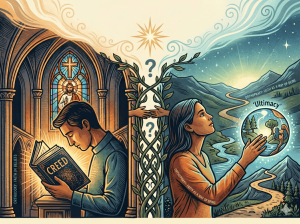
Many Christians do NOT understand non-religious spirituality. Christianity focuses on beliefs, and its beliefs focus on a personal God. But most religious and non-religious traditions focus on practices (orthopraxy) more than beliefs (orthodoxy), and they may NOT believe in God.
Spirituality, broadly defined, involves the connection to something greater, which is NOT necessarily personal, supernatural or intentional.
Some religions allow their practitioners to adopt different beliefs, and some religions do not worship gods at all. Hindus can be atheistic, monotheistic, or polytheistic; they can be dualistic or nondual. They can worship Brahman (formless Ultimate Reality) in many forms.
Buddhism does not focus on the existence of a creator deity. It emphasizes personal experience and enlightenment over theological beliefs. Different Buddhist schools have varying interpretations of deities, but Buddhism is generally agnostic.
In this country, we hold many different beliefs. According to Pew Research Center, many of those who DO believe in God DO NOT believe in the God of the Bible, and many of those who DO NOT believe in God DO believe in a higher power or spiritual force.
Faith in Christianity
In Christianity, the concept of “faith” has been corrupted. The Greek word for faith, pistis, means “trust; faithfulness; involvement,” rather than baseless acceptance of a creed or blind belief in God. Rather, faith is an encounter with Ultimacy, an orientation, a way of being.
Paul Tillich, a Christian philosopher, wrote that faith is not “an act of knowledge that has a low degree of evidence… Faith is more than trust in authorities, although trust is an important element of faith.” Tillich said that real faith relates to character, not content.
Wilfred Cantwell Smith, a scholar of comparative religion, described faith as “an orientation of personality, to oneself, to one’s neighbor, to the universe; a total response, a capacity to live at more than a mundane level; to see, to feel, to act in terms of a transcendent dimension.”
Since the Reformation, Protestants believe that we are justified by faith in Jesus, and Paul mentions “faith in Jesus” in Romans 3:22. However, some scholars believe that the “faith in Jesus” should be translated as the “faith of Jesus,” analogous to the “faith of Abraham.” Here, Abraham had enough trust in God to sacrifice his son, as Jesus had enough trust in God to sacrifice his life.
Many Christians do NOT understand non-religious spirituality.
Faith in Buddhism
Sharon Salzberg, a Buddhist author and meditation teacher, writes in her book Faith:
“I want to invite a new use of the word faith, one that is not associated with a dogmatic religious interpretation or divisiveness. I want to encourage delight in the word, to help reclaim faith as fresh, vibrant, intelligent, and liberating.
“This is a faith that emphasizes a foundation of love and respect for ourselves. It is a faith that uncovers our connection to others, rather than designating anyone as separate and apart.
“Faith does not require a belief system, and it is not necessarily connected to a deity or God, though it doesn’t deny one. This faith is not a commodity we either have or don’t have—it is an inner quality that unfolds as we learn to trust our own deepest experience….
“In Pali, the language of the original Buddhist texts, the word usually translated as faith, confidence or trust is saddha. Saddha literally means “to place the heart upon.” To have faith is to offer one’s heart or give over one’s heart….
“In Pali, faith is a verb, an action, as it also is in Latin and Hebrew. Faith is not a singular state that we either have or don’t have, but it is something that we do….
“Buddhism uses an analogy to describe what happens when we allow fixed beliefs to contour reality for us. Buddhists say that holding such views is like gazing at the sky through a straw.”
Faith in Non-Religious Spirituality
Jim Palmer, founder of the Center for Non-Religious Spirituality, wrote in a Substack article called “The Existential Impulse”:
“What actually replaces God when you outgrow religion is not another belief. It is a different relationship to the existential impulse itself. It is the movement from outsourcing meaning to taking responsibility for how meaning is formed, tested, and lived.
“This is not a small adjustment. It is a structural shift. It changes how a person understands themselves, how they relate to reality, and how they engage the fundamental conditions of being human….
“Post-religious spirituality, properly understood, is not a diluted version of religion. It is not an attempt to preserve comforting language while discarding doctrine. It is a reconfiguration of how meaning is generated and stabilized….
“This is where a different kind of spirituality begins. Not as belief in a constructed object, but as conscious participation in the processes through which meaning, value, and orientation are formed. It is more demanding. It offers fewer guarantees. But it is also more precise. It places the human being back into direct relationship with the conditions of existence, without unnecessary intermediaries.”
Many Christians Do NOT Understand Non-Religious Spirituality
Br. David Steindl-Rast, a Christian mystic, is one of a minority of Christians who writes about faith in this more universal sense:
“Having faith does not mean subscribing to some dogmas or to some articles of faith or anything like that. Faith ultimately is courageous trust in life. The particular form that our religious faith takes depends entirely on the time and the place and the social structure and the cultural forms into which we are born… But the essence of our faith is the same at all times and places, and it is the courageous trust in life.”
Many people have faith which is NOT centered in belief or in God. Their faith involves an acceptance of Mystery; an encounter with Ultimacy; a trust in themselves, in others, and in the Universe; and/or an orientation or a Way of being. Further, this faith is centered in our connectedness, our recognition of transcendence, our search for meaning, and/or our way of living in the world.









 Ad-Free & Subscriber Log-In