Loyal dogs who mourn the deaths of their owners

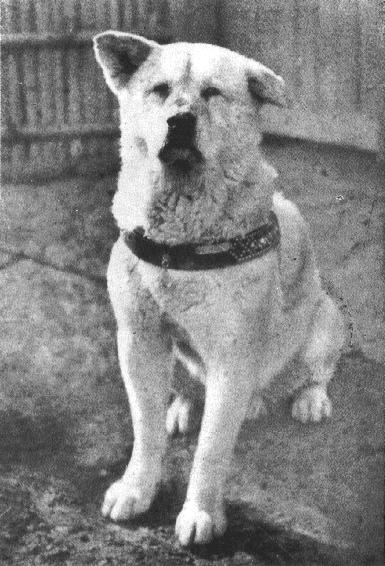
Hachiko is just one of many stories of faithful dogs who mourned the deaths of their owners. (Photo http://en.wikipedia.org/wiki/File:Hachiko.JPG)

Hachiko is just one of many stories of faithful dogs who mourned the deaths of their owners.

A story popped up in my Facebook newsfeed today about a dog in Italy who has been showing up at Catholic mass every Sunday since its owner died two months ago.

According to news stories, a German Shepherd named Tommy used to accompany his owner to mass, sitting quietly at her feet.  When his owner died two months ago, the dog attended her funeral, along with the other mourners, and has been showing up regularly every since.

It reminds me of a movie I watched over the Christmas holiday called “Hachi”. (Gotta love the $5 bargin bin at Walmart.)  The movie is set in the US, but is based on the true story of a dog named Hachikō in the 1920s in Tokyo, Japan. It’s a tear jerker, thats for sure. Hachikō was owned by Hidesaburō Ueno, a professor in the agriculture department at the University of Tokyo. The loyal Akita accompanied his master every day to the station and was waiting faithfully every day upon his return. When Hidesaburō Ueno died suddently in 1925, Hachikō spent the next nine years waiting daily at the Shibuya station. His faithfulness made him a national hero and a national symbol of loyalty. Statues have been erected in his name, and his stuffed body is on display in the National Science Museum of Japan in Ueno, Tokyo.

There are lots of stories like this -  an Argentinian dog named Capitán who sat every evening for six years on his owner’s grave; a fallen Navy SEAL’s Labrador retriever named Hawkeye who in 2011 laid down next to his owner’s casket at a funeral service, refusing to leave; Leao, a mixed breed who stayed by the side of her owner who died during Brazil’s flood of January 2011; Shep, a Border collie in Montana, who in 1936,after watching the coffin of his master loaded onto a train, maintained a vigil at the station for six years.

I think they serve as evidence that the human/canine bond is much more complex that just dog and owner. Our dogs really do connect with us emotionally.

I wrote recently that it’s been a year since Scout died, and that I’m really having a hard time. These kind of stories give me some comfort as I lie in bed at night crying and missing my beloved dog. It’s not silly. If the situation was reversed, I think he’d be feeling the same way.

  • Patti O’Kane

    Ms. Brokaw, Joanne, When my cat Ferdie dies (he’s slowly dying now at 17 yrs. old. IV hydration, special diet and medications fill his body but his spirit craves & continues to enjoy life. He basks & soaks up sun in a loft bed whose steps he still climbs) I will send this article to friends from the Health section of the NY TImes. The Time reprinted the enclosed article from the Washington Post. Hope this adds some more meaning to your sad & sweet remembrances. Patti

    http://well.blogs.nytimes.com/2012/03/27/grieving-for-pets-and-humans-is-there-a-difference/

    http://www.washingtonpost.com/national/health-science/the-death-of-pet-can-hurt-as-much-as-the-loss-of-a-relative/2012/02/21/gIQALXTXcS_story.html

    PS. I have no investment in this company (Zazzle) however my cats have periodically graced my Christmas/holiday stamps, while alive, especially 5 y/o mystic Fusus (named after a book, Fusus al-Hikam by Sufi mystic Ibn Arabi which speaks of succeeding prophets…long story there…) swatting my Christmas tree. A lovely, generous cat artist (Jill West) gave me permission to use her image of St. Francis and a tuxedo cat inserting Ferdie’s name & creating a postage stamp (via the stamp printing company Zazzle.com) that went all over the world. I’ll send you the images….

  • http://aediculaantinoi.wordpress.com/ P. Sufenas Virius Lupus

    In these stories, I’m reminded of an old Zoroastrian belief–and, for that matter, the fact that in Zoroastrianism to this very day, a special “four-eyed” dog must verify that a human is truly dead in order for the rites for the dead to take place. In any case, the belief was that humans had to be good to dogs during their lives, because once they passed over into the afterlife, if the spiritual dogs there (and, presumably, ones that were still alive, too) did not mourn for the human by howling, the human’s soul could not pass on to judgement and the rewards of the afterlife, and instead wandered aimlessly, unable to cross over. Canid associations with death are not uncommon in many other world religious cultures (e.g. Anubis and Egypt; Cerberus and Greek; etc.). I’m also reminded of the story of Greyfriars Bobby from Edinburgh–there’s a statue of him near that cemetery to this very day!