

Who is Jesus? Why did he die? And why does it matter? The classic rock opera Jesus Christ Superstar answers those questions in ways we can’t ignore.
That’s because this record forces us to confront the scandalous and paradoxical truth at the heart of Christianity. It ‘s the truth that shows us what salvation really means: the truth that lays bare what it means to be a Christian. In this 2-part post, I’ll show how the greatest song from this classic album has helped me understand this truth – and how it might help you to do so as well.
THE ALBUM, THE SHOW, THE FILM
Originally conceived as concept album, Jesus Christ Superstar was quickly turned into a Broadway show and then a feature film. Its popularity hasn’t diminished since then. It’s a staple of high school, college, and community theatre groups, and it sprang to life again in 2016 in a live television version starring John Legend. (Check out this fan-run website for all things JCS: its the deepest dive on the internet!)
With music by Andrew Lloyd Webber (of Phantom of the Opera fame) and words by Tim Rice (Elton John’s lyricist for The Lion King), Jesus Christ Superstar tells the story of the events leading up to his crucifixion. It’s stuffed with memorable songs for each major moment in the Passion narrative – from Palm Sunday to the Jesus’s death.
For me, the most powerful song on the record is “Gethsemane.” It is an epic dramatization of Jesus’s prayer to God before his arrest. But it’s not just a suspenseful scene pushes the narrative forward. It’s actually a character study. Using the power of creative license, it invites us into Jesus’s mind and shows us the full range of emotions that he must have been feeling during those hours alone with his father. As a result, it gives us a realistic depiction of Jesus that helps reveal his true character.
GETHSEMANE: A CLOSE LISTENING
The song starts simply. An acoustic guitar strums steadily in the background – a sober reflection of the intimate intensity of this moment. When Jesus sings, his voice climbs slowly, step-by-step, as if he is approaching God cautiously. Out of the darkness of a minor chord, he sings, “I only want to say…if there is a way…” Before he knows it, he’s at the top of the hill, and his agonized plea spills out from his lips: please, God, remove this poison cup from me. As he does the skies open, and bright major harmony harmonizes shines forth.
But then he retreats from God’s presence, his voice descending again. Why? Because he acknowledges, ashamedly, his weakness. He admits that he has come to doubt his mission. As his melody descends, he sounds like Adam hiding from the presence of the Lord in the Bible’s first garden. The verse ends with the same minor chord as at the beginning, creating a musical prison that illustrates the inescapable reality of his situation.
After a moment, however, Jesus tries again. This time he admits his weariness up-front. Unburdened, his voice starts to climb once more, and he addresses his Father with righteous confidence: he’s done everything he has been asked – for more than thirty years! Fighting off his weakness, he turns his eyes back up to heaven, gathers his courage, and raises a direct challenge to God’s fairness and justice. Can God really judge him if he doesn’t want to go through with the plan? He has in fact asked more from him than any other man.
THE CLOUDS GATHER
When Jesus sings the word “man”, the music suddenly becomes darker. The tempo slows and the orchestral fabric thickens. The bass begins a tragic descent, tunneling down, down, down, carving out an abyss with no escape. Clearly, reminding himself of his humanity has brought the implications of his decision into stark relief. At first Jesus thinks about what he will endure – the mocking, the torture, the crucifixion. As thoughts of nails and thorns fill his head, his anger explodes. The music takes off as Jesus repeats his challenges to God. His words spill out breathlessly, the syncopations of the rhythm making it nearly impossible for him to sing each thought before the next one crashes over him.
His questions become increasingly faithless, moving from anger all the way to breathtaking disrespect. He cajoles his father. He appeals to his vanity. He even turns to sarcasm, pleading with his father to show him “a little of your omnipresent brain.” Frantic and unhinged, his anger and fear color his thinking. He becomes self-absorbed – and can you blame him? It’s his own life that’s on the chopping block. He doesn’t ask God for a reason why needs to die, or why he should die, but why God wants him to die. Then he questions God’s plan itself – and not only that, but God’s judgment and wisdom. Soon his words dissolve into screams. Trapped and terrified, Jesus starts to taunt God: go head, Father, just watch me die. The orchestra picks up the taunt, crashing over Jesus like a tidal wave, hammering a merciless 5-beat pattern over and over and over again, until….
THE LAST GASP
Everything stops. The orchestra suddenly disappears in a puff of smoke. Jesus’s rage is gone. Now it is simply replaced with exhaustion. He is back where he started. Nothing has changed – especially the will of his Father. Then, for the last time, he tries the words of his original prayer again. But it doesn’t work. He has nowhere to go – except Golgotha. With his last fumes of hope – or is it anger? – he cries out one last time. But now he’s not praying for deliverance. He’s acknowledging defeat. He’s just a pawn in a war engineered by his Father, and there’s no escaping the front lines. So he gives in. Shaking his fist as God drags him to the cross, he charges his Father with his murder: Bleed me. Beat me. Kill me.
THE ABYSS
This song shows us Jesus’s deepest, darkest thoughts. They are the thoughts of someone who has come face-to-face with the defining reality of human existence: mortality. They are the thoughts of someone whose pleas for deliverance have been rejected – rejected by the One whom you love more than anything, and who claims to love you, too.
These aren’t the thoughts of a superstar. They are the thoughts of a failure. They aren’t pretty. They are ugly. They are shocking. But they aren’t surprising.
That’s because they are realistic. They are what any human in this situation would feel.
JESUS’S HUMANITY
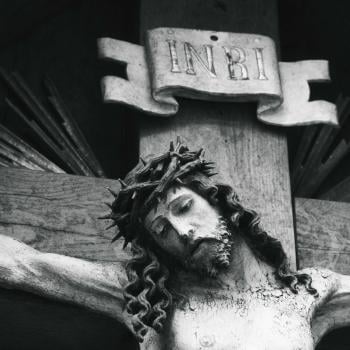
As a Christian, it hurts to listen to this song. But it’s important to hear it. Just like looking on a painting of the crucifixion, it’s a constant reminder of the unique and powerful irony of the Christian faith: the face the God we serve is the God who was crucified.
In Ted Neely’s performance I hear echoes of my Savior’s actual voice, a voice – like Jesus’s (and like mine) – that undoubtedly became hoarse and incoherent after hours of pleading and crying to his Father. In the orchestral tidal wave of Andrew Lloyd Webber’s music, I feel the overwhelming emotion that certainly coursed through the veins of a real-life Jewish teacher calling out from the pit. In Tim Rice’s razor-sharp lyrics, I see the etchings of real words prayed by a broken and exhausted man backed into a corner by a mission and a world he didn’t choose. “Gethsemane” weaves all of these strands together into a tapestry that wraps itself around me, its various threads forming a picture of Jesus in my mind that’s more textured and realistic than any I’ve seen before.
This Jesus is hard to ignore – or forget. And that helps me when I am struggling with doubt. Today, when I close my eyes to pray – especially in those moments of despair – I don’t need to conjure up an image of him out of thin air. Instead, I can call up the vibrant, realistic image of Jesus of that appears in “Gethsemane.” He seems like a real person. That’s because I’ve heard his voice – and it’s a voice crying out in a language I can understand: a language fluent in the grammar of humanity.
WHY IT MATTERS
Bringing Jesus to life again isn’t the only gift “Gethsemane” gives me. By allowing me to see inside Jesus’s mind in his darkest moment, it provides me with something more valuable: insight into his character. It helps me understand who he really is. And the realistic, relatable, and three-dimensional image of Jesus that coalesces in my mind ultimately helps me remember why I love him – and why I want to pattern myself after him. But it does even more. It also helps me understand how to follow him today.
So what does “Gethsemane” reveal about Jesus’s character? And why does it matter? I’ll discuss that in my next post.











 Ad-Free & Subscriber Log-In