

In Minnesota, “justice” claimed the life of Renee Good. And some want a victory parade—forgetting that their victory is presiding over a funeral.

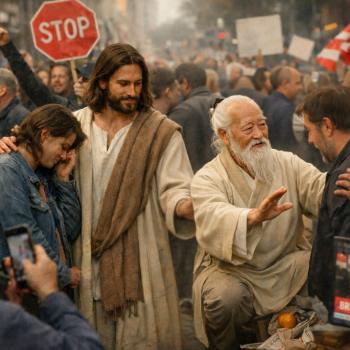
On social media, people who call themselves Christians say that those who do not cooperate with law enforcement will get themselves “popped.” ICE’s “justice” they seek has left over thirty people dead in ICE custody in 2025, and one Good person who needs a funeral in 2026. Jesus and Lao Tzu remind us that when violence erupts, even in the name of “law and order,” there are no winners.
Put Away the Sword
Picture a victory parade—flags waving, brass bright—while, just off camera, families dress in black. Lao Tzu would turn the lens away from the triumphant ones who justify violence to focus on those who suffer. Weapons are “terrible things,” and even a win for some is a kind of funeral. Jesus turns our attention farther still. Put away the sword. Love your enemies.
Holy Non-Coercion
Together, the sage and the Christ tutor us in holy non-coercion—wu wei not as passivity but as a moral posture that calls us to act only as love requires. The Tao asks us to protect without exulting, reminding us that if we must “win,” we should stand as if at a graveside. This chapter is a modest invitation to sobriety, to guard our hearts from triumph, and to seek peace that does not need an enemy. The thirty-first verse of the Tao Te Ching elaborates on the hollowness of victory:
Lao Tzu’s Tao Te Ching, Chapter 31
Ron Hogan Version
Weapons are terrible things.
If you want to get right with Tao,
reject weapons.
The Master,
knowing all things came from Tao,
recognizes what he has in common
with his enemies
and always tries to avoid conflict.
But when there is no other choice,
he uses force reluctantly.
He does so with great restraint,
and never celebrates a victory;
to do so would be to rejoice in killing.
A person who would rejoice in killing
has completely lost touch with Tao.
When you win a war,
you preside over a funeral.
Pay your respects to the dead.
The Jesus of Revelation
Many Christians envision the returning Christ as described in the book of Revelation, with eyes of fire and a sword from his mouth. That is a different view of Christ than the one we find in the Gospels. How do you think Jesus, who blesses the peacemakers, might feel about the way John depicts him in his famous apocalypse? How would he respond to the violence of ICE agents, or the dehumanizing rhetoric that justifies such killings? The Prince of Peace tells Peter that he should reject weapons. Jesus does not glorify violence; he focuses on peacemaking.
Seeing the Other Person’s Humanity
Lao Tzu writes, “The Master, knowing all things came from the Tao, recognizes what he has in common with his enemies and always tries to avoid conflict.” That’s the key to peacemaking: seeing the other person’s humanity and the divine image they bear. When you look for their humanity, you discover a neighbor who loves their family, has hopes and fears and dreams, and wants the very best, as they understand it. It’s hard to hate someone when you can see the ways in which you are alike. Nicole Good was someone’s neighbor, someone’s loved one. What if the ICE agent who shot her had seen her in this light? It’s hard to hate—or kill—someone when you see their humanity.
When you recognize that all human beings bear the divine image, then violence against another person can become violence against God. The use of force always risks violating another’s agency, which is among God’s greatest gifts. Only when necessary should force be used, and even then, with the greatest restraint. Its aim, if unavoidable, is limited: to prevent imminent harm, not to punish or humiliate. Yet how often is force used not to protect, but to control—to enforce compliance, to instill fear?
If you find yourself in a position to exert your will over someone else’s, you should never see your success as a victory. “Love does not rejoice in wrongdoing,” says the apostle. Therefore, the spiritual person should grieve even in those circumstances where righteousness or “justice” forces them to act in opposition to others.
Presiding Over a Funeral
Lao Tzu says, “When you win a war, you preside over a funeral. Pay your respects to the dead.” This passage of the Tao Te Ching certainly applies to physical war and killing. It also reframes ordinary conflict—boardrooms, classrooms, comment threads—anywhere we press our will against another. To engage in such behavior is to preside over a funeral. It injures not just the other person but devastates your own soul as well. The funeral for Nicole Good is a reminder: every act of state violence is a failure of peace, a rupture of the sacred.
People of Peace
Lao Tzu and Jesus both call followers of the Way to be people of peace. In Stephen Mitchell’s translation of the Tao Te Ching, Lao Tzu discusses that person of peace. He says, “Peace is his highest value. If the peace has been shattered, how can he be content? His enemies are not demons but human beings like himself. He doesn’t wish them personal harm. Nor does he rejoice in victory.” This is moral non-coercion in practice.
Whenever Jesus encountered someone possessed by demons, he was careful to separate the individual from the spirits that were controlling them. He never contended against the person. He rebuked the unclean spirits, restored the person, and moved on. Most of our battles aren’t with demons but with neighbors; the pattern still holds—separate the person from the problem, act to protect, and don’t gloat. When conflict is necessary, choose to engage with compassion. Jesus summed it up with one phrase: “love your enemies.” It’s hard to love your enemies when you gloat over their defeat.
Ponder…
We tend to picture demons as twisted, hideous, de-human, or less than human. To make someone your enemy, you must demonize, or de-humanize them so that you can hate them entirely. It’s hard to hate a person who loves their family, has hopes and dreams, and puts their pants on just like you. So, we warp those we fear into monstrous shapes; it spares us from recognizing our kinship. It’s easier to kill a demon, or someone you view as less than human.
This is why Nazi Germany referred to Jewish people as an infestation, so soldiers could view genocide as the extermination of vermin, rather than the murder of their neighbors. Every time we use (or permit others to use) racial epithets, gender-disparaging language, or hate speech directed toward people of other nations, languages, or religions, we remove their humanity so we can justify hate. Language trains the heart—for mercy or for murder.
Is there anybody you love to hate? Consider how this demonization of enemies goes contrary to the Tao of Love. What are some ways that you can change your vocabulary to express the unconditional love of God? How might you challenge the dehumanization and demonization of others when you see it in the workplace, on social media, or anywhere else in your sphere of influence? Consider one setting this week where you’ll practice: refuse the slur, name the image of God, and bless instead of boast.
















 Ad-Free & Subscriber Log-In