

Jesus & Lao Tzu: The Peaceable Kingdom
Do you want to live in a peaceful nation? The Way of Love calls us to stop focusing on divisiveness and embrace our inherent oneness.
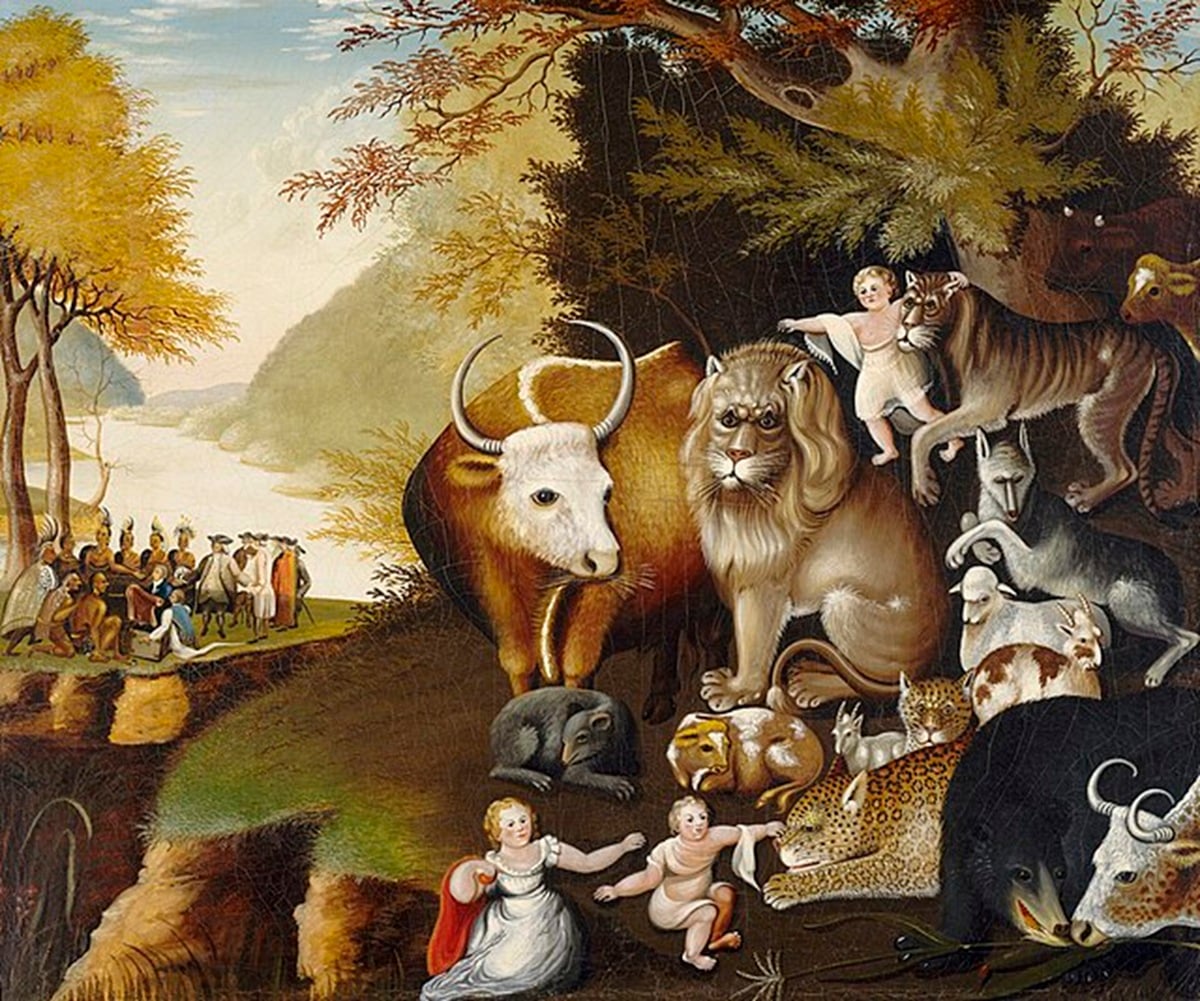
Jesus talked a lot about the Kingdom of God. The Chinese philosopher Lao Tzu envisioned a kingdom that orders things without force. Lao Tzu’s picture pairs with Edward Hicks’s Peaceable Kingdom (ca. 1833), based on the prophecies of Isaiah 11 and 65. This famous work of art depicts the lion lying down with the lamb, the ox and the leopard eating grass together, and the child placing his hand in the adder’s nest. It’s a world where predators drop their fangs and prey lose their fear. It’s more than a ceasefire—it’s a shared life.
Peace Between Opposing Forces
Some view this as a prophecy of the future. Many compare this to the description of the new heavens and the new earth in Revelation 21. Both long for a time of peace—not just between nations, but between opposing forces of nature.
These prophecies anticipate a harmony that the prophets can only imagine as a future event. But is this kind of utopia reserved for a time to come? Or do they depict the way the world would be if everyone followed the Way of Love? The real question for this chapter is simple: What kind of order gathers people without coercion? Lao Tzu weighs in:
Lao Tzu’s Tao Te Ching, Verse 32
Victor H. Mair Version
The Way is eternally nameless.
Though the unhewn log is small,
No one in the world dares subjugate it.
If feudal lords and kings could maintain it,
The myriad creatures would submit of themselves.
Heaven and earth unite to suffuse sweet dew.
Without commanding the people,
equality will naturally ensue.
As soon as one begins to divide things up, there are names;
Once there are names, one should also know when to stop;
Knowing when to stop, one thereby avoids peril.
In metaphorical terms,
The relationship of all under heaven to the Way is like that of valley streams to the river and sea.
The Tao Unites All Things
Lao Tzu says that the myriad creatures would tame themselves when rulers “maintain the Way.” What’s more, human beings would naturally reach unity with one another, without compulsion or control. That’s what wu wei looks like in public—the way order works without force. This is because the Tao unites all things.
The sage continues his discussion of the unified cosmos. To understand the universe, one may need to create names and divisions. But the verse adds a limit: you must know when to stop. Reality shows us that all things are one, and each of us is part of the Holy Whole.
Like a Raindrop in the Sea
Lao Tzu compares the unity of all things to the continuity of water. Picture a raindrop leaving its cloud and falling to the earth. Splashing into a puddle, it loses its individuality as it merges with the surrounding water. Soon, the puddle becomes a rivulet that flows to a stream. That stream makes its way to a creek, which feeds into a river. That river runs to the ocean, its fresh water combining with the salty sea. In metaphysical terms, the relationship of all under heaven is like the relationship of one drop of water to the sea. They may seem separate, but in reality, they are one.
Naming Divides Things
In the Genesis narrative, once God creates the world, God places the first human being in the garden to tend it. Then God commands the earthling to name all the creatures. Adam names each of the animals whatever he chooses. By doing so, he divides one thing from another.
Before naming, all things were as one. Once names are assigned, separation takes place. Naming can be useful for differentiating, but you have to know where to stop. The verse makes this explicit: This is why Tao has no name. All things emerge from Tao, and to Tao all things will return. Likewise, this is why God has no name, and the closest we can come to naming God is “I Am.”
Lao Tzu says that everything that can be named is a tributary to the one. As long as we hold to the differences between us, as long as we insist upon names that separate us, we remain disjointed. But when we hold to the Way that is eternally nameless, no one in the world can subjugate us. When we keep to the Way, people find their peace.
Practice…
Like Edward Hicks, try your hand at painting. See if you can depict the aspects of your own personality that seem to be at odds with one another. Paint your “lion” and your “lamb” lying down together. For example, the meditative side of yourself embracing the go-getter. Or your inner demons having tea with your better angels. How would you depict the unity between the seemingly disparate elements of your soul?
Realize that, just as each of these is a part of you, so you are undivided from others with whom you seem to be at odds. You are part of the One, just as they are. Is there space in your painting to show yourself sitting down to visit these holy Others in your life, with whom you feel some tension—and a way that the scene moves toward shared presence rather than control?
For related reading, check out my other articles:
- Love Knows No Borders: Walls, Deportations, & Tariffs
- “I’m Sorry, Eh?”—How to Apologize Like a Canadian
- Peacemaking: Looking Them in the Eye of Their Personal Storm











 Ad-Free & Subscriber Log-In