

Your home is your castle—but is it your sanctuary? Household shrines can turn ordinary rooms into sacred space.

It’s almost time for spring cleaning—why not use your home cleanout as a time to carve out a little breathing space for your spirit?
Spring Cleaning
Spring cleaning is about more than dusting and decluttering. Around the world, it’s a spiritual tradition.
- Before the celebration of Passover, many observant Jews give their homes a good cleaning. They also remove all traces of leavened bread (chametz) from their home. This is a way of remembering the Israelites’ exodus from Egypt.
- Persian New Year (Nowruz) is celebrated around the Spring Equinox. In this 3,000-year-old tradition, families “shake the house” to cleanse it of bad luck and usher in blessing.
- At the start of Lent, Greek Orthodox Christians traditionally observe “Clean Monday,” cleansing the home and the body in preparation for Great Lent. Globally, many Christians who observe Lent focus on cleaning the home to prepare for Easter, giving special attention to a home altar, if they have one.
- Chinese New Year (this year, from February 17 to March 3) likewise involves sweeping away dust to cleanse the home of bad luck and invite prosperity.
If you plan to do some spring cleaning this year, why not make it a spiritual practice, as well as a practical one? Once you’ve cleaned your rooms out, consider carving out some sacred space to remind you to nurture your spirit.
Sacred Space in Your Home
In How to Create Sacred Space in Your Home, I write:
When you enjoy your quiet time alone with God, consider having a sacred place to make that time more special. Throughout the Judeo-Christian tradition, people have marked places as holy. Jacob set up a standing stone in the spot where he wrestled with God. He called the place Bethel, which means House of God. The Hebrew people, wandering in the desert, created a mobile sacred place in the form of the tabernacle. Later, they built a permanent temple. Even within this temple, there was the Most Holy Place where the high priest met with God. During the exile, Jewish believers met in synagogues because the Babylonians destroyed their temple. This synagogue-centered tradition continued even after the remnant returned to Israel and rebuilt the temple. The synagogue would endure as the most important Jewish sacred place after the Romans destroyed the temple yet again. (Click here to read a history of the Jewish temple.)
Later, Christians would create their own sacred spaces and call them churches. The Church erected monuments and altars over many pagan sacred places, where generations of pre-Christian believers knew the veil between worlds to be thinnest. It’s human nature to carve out special space to meet with God in prayer. But sacred space doesn’t need to be confined to established houses of worship. Why not create a sacred breathing space in your own home?
Setting Up My Sacred Spaces
Throughout the decades, I’ve lived in several homes and have set up many sacred spaces. Here are a few examples from my own homes:
- A patch of woods between my neighbor’s house and mine became a place where I could follow Jesus’s example and go “to the wilderness” to pray.
- The circular concrete top of a well in my backyard became an altar where I partook in solo Communion once a month—and symbolically shared it with the angels who attended.
- A special shelf contained Bibles, journals, and candles that I lit when I prayed. I also kept a little pot with a lid, where I would write down prayers and keep them in the pot for a month, and later burn them outside when I had the Lord’s Supper on my well cover.
- (Simple but sweet), an overstuffed armchair where I did my devotions before the rest of the family woke up. It wasn’t especially decorated, but I burned incense to turn ordinary space into sacred space.
- In my current home, I don’t have a particular prayer space—but I do have objects that have become sacred to me over the years, prominently displayed throughout our house. Here are a few pictures to illustrate:
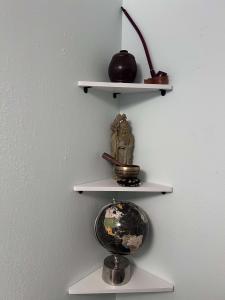
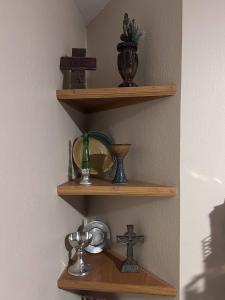
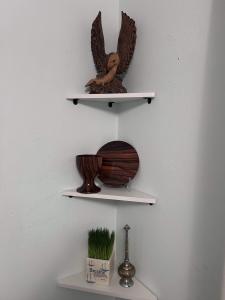
Each of these objects has had special meaning to me over the years. While in the past, I might have set up temporary sacred spots or kept a singular shrine in my home, these days I’ve scattered holy artifacts everywhere, so the entire house is a shrine.
What Kind of Sacred Space is Right for You?
So, as you begin your spring cleaning, it might be the right time to consider—what kind of sacred space is right for you? Here are a few ideas:
- A garden window with plants that bring you joy.
- Turn your bathtub into sacred space with scented candles, bath bombs, and a reading desk that goes across the tub. “Calgon, take me away!” could be your mantra.
- A dining room table with candles that turn every family meal into a sacred event
- The stove where you prepare your family’s meals – What could be more sacred than making good food to nourish those you love?
- An in-home coffee bar where you entertain guests. Hospitality is a sacred act.
- Create a rock garden or place planter boxes on an apartment balcony. You don’t need lots of room to create sacred space.
- A “she shed,” “man cave,” or other non-gendered hangout where you can just be by yourself.
- I’ve known people who create literal “prayer closets” in their homes. Do you have an available closet or cupboard? Give it a try.
- A corner of your yard where you can put a bench, propane fire table, wood fire pit, patio set, or other furniture for you to enjoy while you have spiritual time.
Decorate your shrine however you want. Make it distinctly yours. Surround yourself with objects that remind you of God, of people you love, and of sacred places you’ve visited. Let it feel like home—and like prayer.
Holy Ground
In my opinion, when the Israelites built the temple, they lost one valuable thing—the idea that holy ground is portable. With the tabernacle, they remembered that God moved with them from place to place. God’s presence is not confined to one location, but moves with you, like a pillar of fire or the ark of the covenant.
It’s important to remember that surrounding yourself with sacred objects isn’t what makes secular space into holy ground. These things help you remember God’s presence—but God lives within you. The holy of holies is within your heart, for you are made in the divine image. This means that holy ground is wherever you are. Whatever space you create in your home should be a reminder that God is present within you, and inside the people who inhabit your home—and that “breathing space” is available even on ordinary days.














 Ad-Free & Subscriber Log-In