

March 22 is World Water Day. Let’s talk about what holy water does—and doesn’t—do. And how you can use it in your own faith.

If, like me, you grew up on a steady diet of vampire movies, you already know the rule: holy water isn’t for blessing. It’s for burning. The church may have invented holy water to cleanse, but movie-holy-water corrodes like battery acid. Far from a sacrament, it’s a superweapon. Here are a few movie examples from my younger days:
Holy Water as a Weapon
In The Lost Boys (1987), the heroic teenagers sneak into a church and fill their squirt guns with holy water. Toys become weapons. Blessings become delivery systems for pain and flames. Put together a church youth group and chemical warfare, and you’ve got The Lost Boys.
Constantine (2005) upgrades this idea from Super Soakers to sprinkler systems. Constantine’s crew rains holy water through a building’s plumbing, suppressing demonic presence and keeping evil at bay.
In Van Helsing (2004), holy water becomes an enhancement to an already formidable crossbow. Dip the bolt in holy water, upgrade the ammo, and the bolts preach the sermon at high velocity. The movie logic goes, “If it’s holy, it must hurt the bad guys.”
These examples of holy water used as a weapon are ridiculous. They are also revealing.
Because moviemakers didn’t invent the concept. They borrowed an old religious idea, that holiness is dangerous. Purity burns. The “unclean” should experience agony in the presence of the sacred. Movies just take the concept and translate it into Technicolor. They turn a ritual of blessing into a prop for violence. They make a “holy” thing act like a weapon.
But real holy water, at its best, is supposed to do the opposite.
The History of Holy Water
Holy water didn’t start as vampire acid, though. It has a long history of purifying sacred people, places, and things. Judaism’s washing and purity practices date back to the Mosaic law. So, Christians naturally continued the tradition of treating water as spiritually significant.
Early baptisms required “living water” (rivers/streams rather than lakes/ponds). Later, the sacrament moved indoors. By the 4th century, priests were blessing baptismal water, even exorcising it to remove evil.
Soon, the idea expanded beyond baptismal water. Church leaders applied blessed water to all sorts of sacred purposes. In lieu of anointing oil, holy water blessed homes, sick people, sanctuaries, and those in need.
Though movies tend to depict holy water as Roman Catholic only, it is also found in Orthodox, Anglican/Episcopal, Lutheran, and other communities. In Roman Catholic terms, a deacon, priest, or bishop can bless holy water. Pretty much anyone can use it as a devotional practice: crossing themselves when entering/leaving a church, blessing children, blessing a home, praying in times of grief, fear, or illness. Typically, only clergy can bless holy water, but lay people can (and are encouraged to) use it.
Unlike the movie trope, holy water historically has been used as a small sign of baptismal identity and cleansing, not a form of liquid lava to cast upon your enemies. Which leads me to how I use it when I’m not fighting undead leather-jacket vampires.
How I Actually Use Holy Water
I’ve used holy water too. Not to melt villains, but to bless ordinary things like homes, hospital rooms, and church buildings. When praying over the kind of place where fear and grief like to take up residence, I’ve sprinkled a little holy water to bring my petitions into the three-dimensional world.
Here’s one moment that sticks with me. One church that I served as pastor tended to have contentious business meetings. Anticipating a particularly thorny meeting, I remember walking through the church building, praying over the space, invoking God’s presence on that holy ground. I dipped my fingers in holy water, flicked a light arc of water toward the pews where congregants would sit bickering instead of worshiping, and prayed peace on those who would assemble within the hour. Maybe the holy water and prayer changed the atmosphere. Maybe it changed me, and I became holy ground, radiating peace to those who entered it. Either way, that holy water made a difference that night—even if nobody knew it but me.
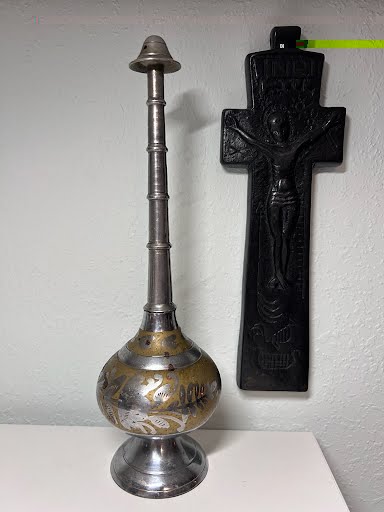
I even use a metal sprinkler bottle that I found at a yard sale—technically, the kind of thing meant for rose water or perfume. Mine has been promoted to holy water duty. Fill the base, flick the wrist, and a quick burst arcs out like a tiny rainstorm. It looks like something an action hero would carry in a trench coat.
But in real life, it’s not a weapon—it’s a physical representation of what’s happening in the spiritual realm. It says, “This place, these people, this moment all belong to God.”
I came from the Southern Baptist world, where holy water is viewed as a lucky rabbit’s foot—not much good for the person who uses it, and not particularly lucky for the rabbit, either. But I came to see it not as a magic charm, but as ordinary water set aside for a holy purpose—a small, tangible sign of blessing. My Baptist church members, often deprived of ritual symbolism by our denomination’s plainness, often welcomed holy water as a powerful symbol. So, when I was a parish minister, I used it when I could—and still do, upon occasion.
And yes, people sometimes ask for a “recipe,” so here’s the way I explain it without turning it into a spiritual DIY project.
My Holy Water “Recipe”
Before I give it to you, I need to be clear that if you come from a tradition where only ordained clergy can bless holy water, you might think carefully before concocting your own. But, if you come from a tradition that believes in the Priesthood of All Believers, and if you’re game, making holy water is simple to do. Just remember—you’re not manufacturing holiness like a chemistry experiment. You’re preparing water to be used as a sign of God’s presence and purification. Note: unlike a cooking recipe, there are no measurements here—you’re not going to drink this.
- Water: Use clean water. If you want symbolism, use water that means something (from your tap at home, from a river you love, or from a place of memory).
- Optional salt: Many Christian traditions include salt as a symbol of preservation and covenant. A pinch is plenty. (If that isn’t your tradition, skip it.)
- Optional anointing oil: This makes the holy water smell nice—but keep in mind, whatever you anoint with oily water is going to get a little bit oily.
- Prayer of blessing: Pray over it plainly. Thank God for water as a gift. Ask that it be used for healing, protection, cleansing, and remembrance of baptism.
- Scripture (optional but meaningful): A short line about water—creation, baptism, cleansing, or “living water”—not as an incantation, but as a way to let the story shape the practice.
Then use your holy water gently. Bless a doorway, a child, a home. Bless your own anxious body. This holy water is not a weapon against invisible enemies. It is a tool to help you focus on the better truth that God meets us in ordinary matter—water, breath, touch, tears.
Join me next time…
Join me for my next article, “Holy Water Isn’t Acid: Stop Weaponizing Faith.” I’ll discuss our tendency to turn enemies into monsters and then use our faith as acid to burn them.
More practices, audio, and work-in-progress notes live on Patreon: [https://www.patreon.com/cw/GregoryTSmith]
For related reading, check out my other articles:
- Jesus, Lao Tzu, And Bruce Lee: “Be Water, My Friend”
- Why Christ’s Ascension is Greater Than the Resurrection
- Jesus and Lao Tzu at the Well of Living Water

















 Ad-Free & Subscriber Log-In