

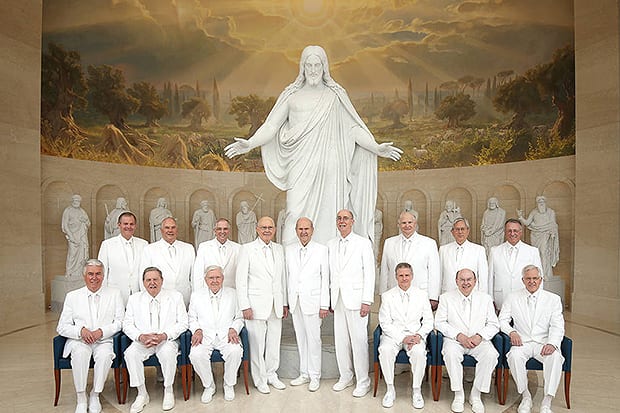
This article that I wrote went up yesterday in Meridian Magazine: “The Keys of Heaven and Apostolic Succession.” At its conclusion, I recommend several resources that I think some will find both useful and enjoyable. (I’m still stunned at the fact that we can hear the recorded voice of President Wilford Woodruff from 1897 as he testifies of the Prophet Joseph Smith.) Also in Meridian, here is a summary of the meeting in which the new First Presidency was announced: “Dallin H. Oaks Ordained as Church’s New President.”
And, while we’re in the neighborhood, this is an excellent profile of the Church’s new president: “Who is President Dallin H. Oaks? A man shaped by loss, defined by resilience and warmth: Behind his prodigious intellect and an enormous capacity for hard work is a warm, jovial family man with a defining faith in Jesus Christ” For what little it may be worth, it’s consistent with my own handful of personal experiences with President Oaks over many years.
My unfortunate habit of paying more attention to critics of the Church than most of them deserve can sometimes be more than a little discouraging. I’m already seeing attacks on the character and life of President Oaks (who is, among other things, said to have a long record of intolerance, lies, and unethical behavior). I expected no less. But I admit to some surprise at seeing attacks so soon on D. Todd Christofferson.
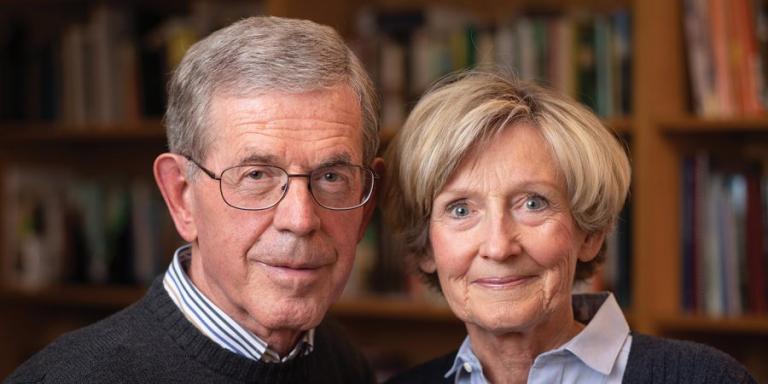
Incidentally, in yesterday’s blog entry I shared a link to an article about Provo, a city “with a scandalous past.” I intended, but forgot, to mention an anecdote about Elder Bruce C. Hafen from back during his pre-general authority days as Provost of Brigham Young University. (It’s an office that many colleges and universities have, but that BYU only had during, I think, two university presidencies and does not currently have.) He invited faculty and staff to propose definitions of the term provost, and the winning entry — I don’t know from whom it came — was “provost (adj): ‘most like Provo.'”

A reader of this blog who comments civilly, intelligently, and respectfully despite his fundamental disagreement with my worldview — he can correct me if I’m wrong, but I think he’s an atheist or an agnostic — wrote to contest my summary of what I take to be the apostle Paul’s position in 1 Corinthians 15:
Moreover, if Christ did not rise from the dead, if there is no hope for a life beyond the grave, then it seems pointless to sacrifice our time, our talents, our energy, or our wealth for any cause beyond ourselves.
He writes, reasonably enough, that, even if there is no eternal life, we are alive now. We can still love, and find joy and happiness, especially if we don’t think overly deeply about how it will all end. And kindness and charity are still possible and, yes, fulfilling in their way.
This is all true, and I happily acknowledge it. (He badly misfires, however, when he seems to suggest that my viewpoint is “mercenary.” I made no mention of any desire for divine reward or any fear of divine wrath, and such considerations have absolutely no bearing on my position.)
This is a big issue, and I’m still formulating my thoughts on it. So let me take a quick and preliminary pass at a response.
I’ve always been impressed by the eloquent summation given by the British philosopher, logician, mathematician, public intellectual, 1950 Nobel laureate in Literature, and vocal atheist Bertrand Russell (1872-1970) — who was very famous when I was growing up — in “A Free Man’s Worship” (1903). It’s probably the most famous passage from what is perhaps his best known and most reprinted essay:
Purposeless [and . . .] void of meaning, is the world which Science presents for our belief. Amid such a world, if anywhere, our ideals henceforward must find a home. That Man is the product of causes which had no prevision of the end they were achieving; that his origin, his growth, his hopes and fears, his loves and his beliefs, are but the outcome of accidental collocations of atoms; that no fire, no heroism, no intensity of thought and feeling, can preserve an individual life beyond the grave; that all the labours of the ages, all the devotion, all the inspiration, all the noonday brightness of human genius, are destined to extinction in the vast death of the solar system, and that the whole temple of Man’s achievement must inevitably be buried beneath the débris of a universe in ruins—all these things, if not quite beyond dispute, are yet so nearly certain, that no philosophy which rejects them can hope to stand. Only within the scaffolding of these truths, only on the firm foundation of unyielding despair, can the soul’s habitation henceforth be safely built.”
That seems a pretty clear-eyed view of things from an atheistic, naturalistic viewpoint. It’s cold and clear and lacking sentimentality.
Can we find local happiness in a blind, indifferent universe that’s full of chaos and pointless suffering? Certainly. As Voltaire’s Candide puts it, taking a Stoic rather than a despairing point of view, Il faut cultiver notre jardin (“We must cultivate our garden”). We can find limited happiness on our little patch, in our little locality, if we don’t look too far into the future or too far abroad.
But doing so can sometimes seem rather like the proverbial rearranging of the deck chairs on the Titanic. Building sand castles on the beach can be fun, but it seems quite pointless, or at least quixotic, to put any huge degree of effort into constructing elaborate and artistic sand castles that will be destroyed within, at most, a few hours.
If, indeed, we don’t simply commit suicide — in his essay The Myth of Sisyphus, Albert Camus famously declares that, given life’s absurdity, its objective meaninglessness, suicide is the “one truly serious philosophical problem” — perhaps the best response to the absence of God, the inevitability of death, and the sheer random pointlessness of life and the cosmos, would be to tend to our own livelihood and well-being, perhaps extending our care to our loved ones and immediate neighbors, while leaving others to cultivate their gardens as they choose.
Curiously, the biblical book of Ecclesiastes expresses such a view rather well:
1:1 The words of the Preacher, the son of David, king in Jerusalem.2 Vanity of vanities, saith the Preacher, vanity of vanities; all is vanity.3 What profit hath a man of all his labour which he taketh under the sun?4 One generation passeth away, and another generation cometh: but the earth abideth for ever.5 The sun also ariseth, and the sun goeth down, and hasteth to his place where he arose.6 The wind goeth toward the south, and turneth about unto the north; it whirleth about continually, and the wind returneth again according to his circuits.7 All the rivers run into the sea; yet the sea is not full; unto the place from whence the rivers come, thither they return again.8 All things are full of labour; man cannot utter it: the eye is not satisfied with seeing, nor the ear filled with hearing.9 The thing that hath been, it is that which shall be; and that which is done is that which shall be done: and there is no new thing under the sun.10 Is there any thing whereof it may be said, See, this is new? it hath been already of old time, which was before us.11 There is no remembrance of former things; neither shall there be any remembrance of things that are to come with those that shall come after.12 I the Preacher was king over Israel in Jerusalem.13 And I gave my heart to seek and search out by wisdom concerning all things that are done under heaven: this sore travail hath God given to the sons of man to be exercised therewith.14 I have seen all the works that are done under the sun; and, behold, all is vanity and vexation of spirit.15 That which is crooked cannot be made straight: and that which is wanting cannot be numbered.16 I communed with mine own heart, saying, Lo, I am come to great estate, and have gotten more wisdom than all they that have been before me in Jerusalem: yea, my heart had great experience of wisdom and knowledge.17 And I gave my heart to know wisdom, and to know madness and folly: I perceived that this also is vexation of spirit.18 For in much wisdom is much grief: and he that increaseth knowledge increaseth sorrow. . . . (1:1-18)3:19 For that which befalleth the sons of men befalleth beasts; even one thing befalleth them: as the one dieth, so dieth the other; yea, they have all one breath; so that a man hath no preeminence above a beast: for all is vanity.20 All go unto one place; all are of the dust, and all turn to dust again. (3:19-20)
One helpful little essay on the subject that I can commend is from the prominent Evangelical Protestant philosopher William Lane Craig: “The Absurdity of Life without God.”











 Ad-Free & Subscriber Log-In