

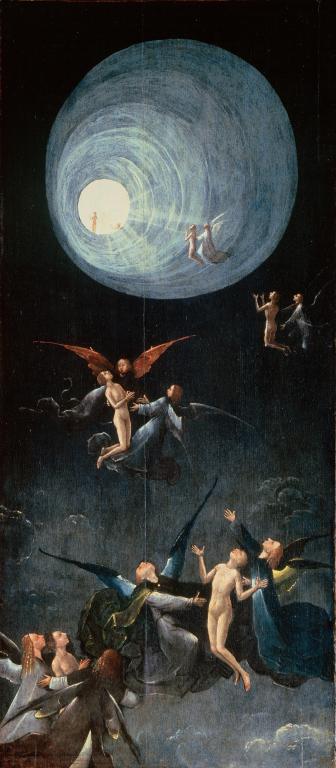
(Wikimedia Commons public domain image)
I’ve shared the painting directly above several times here before. I’ve seen it in the Gallerie dell’Accademia in Venice, Italy. It’s part of a polyptych of four panels, entitled Visions of the Hereafter.
I find the work intriguing because it seems to reflect so very accurately the descriptions of the tunnel, and of the light at the end of the tunnel, that commonly recur, though not invariably so, in modern accounts of near-death experiences. (See the narrative of Ella Jensen immediately below for an example of a near-death experience that does not include a tunnel.) Raymond Moody’s phenomenal 1975 bestseller, Life After Life, made the “tunnel” famous, of course, but relatively few Dutch painters born in the mid-fifteenth century seem to have read Moody’s book. So where does the imagery come from? I think it not at all unlikely that Bosch was either depicting an experience of his own or, perhaps more likely, portraying the experience of another that had been recounted to him. I, at least, don’t know which of those two possibilities, if either of them, might be true.
In any event, during my recent reading of Sam Parnia’s Lucid Dying: The New Science Revolutionizing How We Understand Life and Death I was pleased to come upon an unexpected reference by Dr. Parnia to Bosch’s Ascent to the Empyrean, a reference that accords with my own reading of the work:
As much as I like this painting, nothing about it particularly surprised me the first time I saw it. It was first shown to me by a patient who had been successfully resuscitated. He was struggling to describe the experience he claimed to have had while his heart had stopped. Eventually, he gave up and simply relied on this image. Bosch was painting something I’d heard described many times, both as a doctor and a researcher focused on understanding the experience of people who’ve died and been resuscitated. Over the years I’ve met countless survivors who’ve described a recalled experience of death. They are of all ages, beliefs, and backgrounds, yet there is a uniformity to their experiences. They all describe some variation of the scene depicted in this painting. (50)

While I’m looking again at Dr. Parnia’s book, I think that I’ll share another passage from it:
The first systematic study of what people experience in relation to death was carried out in 1892 by Dr. Albert Heim, a Swiss professor of geology at the University of Zurich and director of the Geological Survey of Switzerland. Heim’s work, especially his Mechanismus der Gebirgsbildung (1878), was highly regarded. He was awarded the Wollaston medal in 1904 by the Geological Society of London. Heim, though, while an esteemed geologist, had survived a near-fatal mountaineering accident and had undergone an experience of death while unconscious during his life-threatening accident. He had also watched other people fall many times. He reasoned with himself that although it is terrifying to watch people fall, his own inner experience of coming close to death was different. This led him to systematically study other people’s experiences. He wanted to offer some relief and consolation to the families of mountain climbing accident victims, by showing them that although falling to death is terrifying for those who observe the aftermath, from the perspective of the person who dies, the experience is likely not so. After collecting and analyzing thirty testimonies, he presented his findings to the Swiss Alpine Club. These were later published under the title “Notizen uber den Tod durch Absturz” (“ Remarks on Fatal Falls”) in the Yearbook of the Swiss Alpine Club. He concluded, “The subjective perceptions [of a person who faces death]… are the same whether [they] fall from the scaffolding of a house or the face of a cliff, . . . [or if a person is] run over by a wagon or crushed by a machine, even the drowning person, or he who senses himself falling on the battlefield, looks death in the face with similar feelings.” He added, “There occurred, independent of the degree of their education, thoroughly similar phenomena, experienced with only slight differences. In practically all individuals . . . a similar mental state developed.” Just as Admiral Beaufort had experienced, Heim also found evidence that the dying person experiences a review of their life. (52)
I’ve never (yet) actually read Professor Heim’s “Notizen über den Tod durch Absturz” from the Schweizer Alpen-Club, but I’ve just located the article online, and I intend to do so soon
I became acquainted with a retired Swiss geology professor during my mission, not a member of the Church but a friend to one, who was an avid mountain climber into at least his early eighties, when I knew him. This was much to the displeasure of his wife. One weekend morning, she called us at the home in Interlaken where my companion and I were lodged. Her husband hadn’t come home the night before, though he had left a note promising to be back a couple of days later, and she demanded to know whether we knew his whereabouts. We didn’t, but we had a rough idea. And, sure enough, it turned out that he had gone off with a bunch of his cronies to climb the Schreckhorn (which, being interpreted, means “Terror Peak,” with the element -horn referring to a sharp, pointed, and usually pyramidal summit). I never heard whether they, or he, actually made it to the top. Whenever I see references to Professor Heim, I think of my Swiss geologist/mountaineer friend. He’s long gone by now, whether he ever gave up climbing mountains or not. I wish him well.)

Here’s a well-done seven-minute video about one of the most famous nineteenth-century Latter-day Saint near-death experiences — a case for which Dr. Sam Parnia’s preferred term for NDEs, “recalled experiences of death,” plainly seems much more appropriate: “What Ella Jensen saw after death (and who called her back)”
And, while we’re doing videos, here’s a twenty-minute piece on “The Miraculous Preparation of Dallin H. Oaks.” It will, I think, increase your appreciation for him. I hope that many members of the Church of Jesus Christ of Latter-day Saints will see it.
And here, although it’s actually not a video, is a wise piece in Meridian Magazine from Amanda Freebairn: “The Hidden Cost of Normalizing Doubt.” I like this passage that Sister Freebairn cites from a letter written by Flannery O’Connor: “If you feel you can’t believe, you must at least do this: keep an open mind. Keep it open toward faith, keep wanting it, keep asking for it, and leave the rest to God.” And I like this warning that she cites from President Russell M. Nelson, against “increasing [our] doubts by rehearsing them with other doubters.” I think that one of the most damaging effects of social media on spiritual health is the creation of ersatz “communities” of disaffected cynics that can take the place of genuine communities of faith (without conferring the spiritual and other benefits that real faith communities can provide) and reinforce doubts and grievances.











 Ad-Free & Subscriber Log-In