On the campus at the University of California at Berkeley, which is located in a city that was named after George Berkeley (d. 1753), an Anglo-Irish philosopher. He was the founder of the philosophical theory of “immaterialism,” that has since come to be known as subjective idealism. He served as the Bishop of Cloyne for the Anglican Church of Ireland. (Wikimedia Commons public domain photo)
The issue of free will versus determinism always puts me in mind of a familiar story from James Boswell’s 1791 Life of Samuel Johnson, in which Boswell reports an exchange with the great English writer and lexicographer who is the subject of his biography. Samuel Johnson has been described (by the Oxford Dictionary of National Biography) as “arguably the most distinguished man of letters in English history”:
“After we came out of the church, we stood talking for some time together of Bishop Berkeley’s ingenious sophistry to prove the non-existence of matter, and that every thing in the universe is merely ideal. I observed, that though we are satisfied his doctrine is not true, it is impossible to refute it. I never shall forget the alacrity with which Johnson answered, striking his foot with mighty force against a large stone, till he rebounded from it, “I refute it thus.”
There are not a few philosophers and scientists, currently, who, in fealty to their commitment to mechanistic physicalism, take the position that not only is our freedom or agency an illusion, but our consciousness itself. It seems remarkably strange to me to deny our most fundamental and direct perception — our immediate (which is to say, our unmediated) awareness of our selves and of the decisions that we make — in order to clear the way for acceptance of a theory that can only result from a series of indirect inferences and deductions. When René Descartes wanted to dig down to the bedrock of a proposition that absolutely could not be doubted, he proposed his famous Cogito ergo sum: “I think, therefore I am.”
It also seems odd to me to think that I’m mistaken in thinking that I think, and especially so when, according to the theory, there is no “I” to do the thinking. That’s why I’m reminded of Dr. Johnson and his very tangible stone. His argument isn’t exactly overwhelming as a specimen of rigorous philosophical analysis, but it does undeniably possess a certain, umm, force.
Joseph Smith (portrayed by Paul Wuthrich) working in his garden (still photo by James Jordan from the set of the 2021 Interpreter Foundation film Witnesses)
In 1899, the Canadian novelist Lily Dougall — by no means a Latter-day Saint — published a work of fiction called The Mormon Prophet. (I alluded to it in yesterday’s blog entry.) That novel of hers is available online from Project Gutenberg. I was struck by the following passage in her “Preface” to the book, in which she alludes to some of the background research that she did in preparation for her writing:
Near Kirtland I visited a sweet-faced old lady—not, however, of the Mormon persuasion—who as a child had climbed on the prophet’s knee. “My mother always said,” she told us, “that if she had to die and leave young children, she would rather have left them to Joseph Smith than to any one else in the world: he was always kind.” This testimony as to Smith’s kindheartedness I found to be often repeated in the annals of Mormon families.
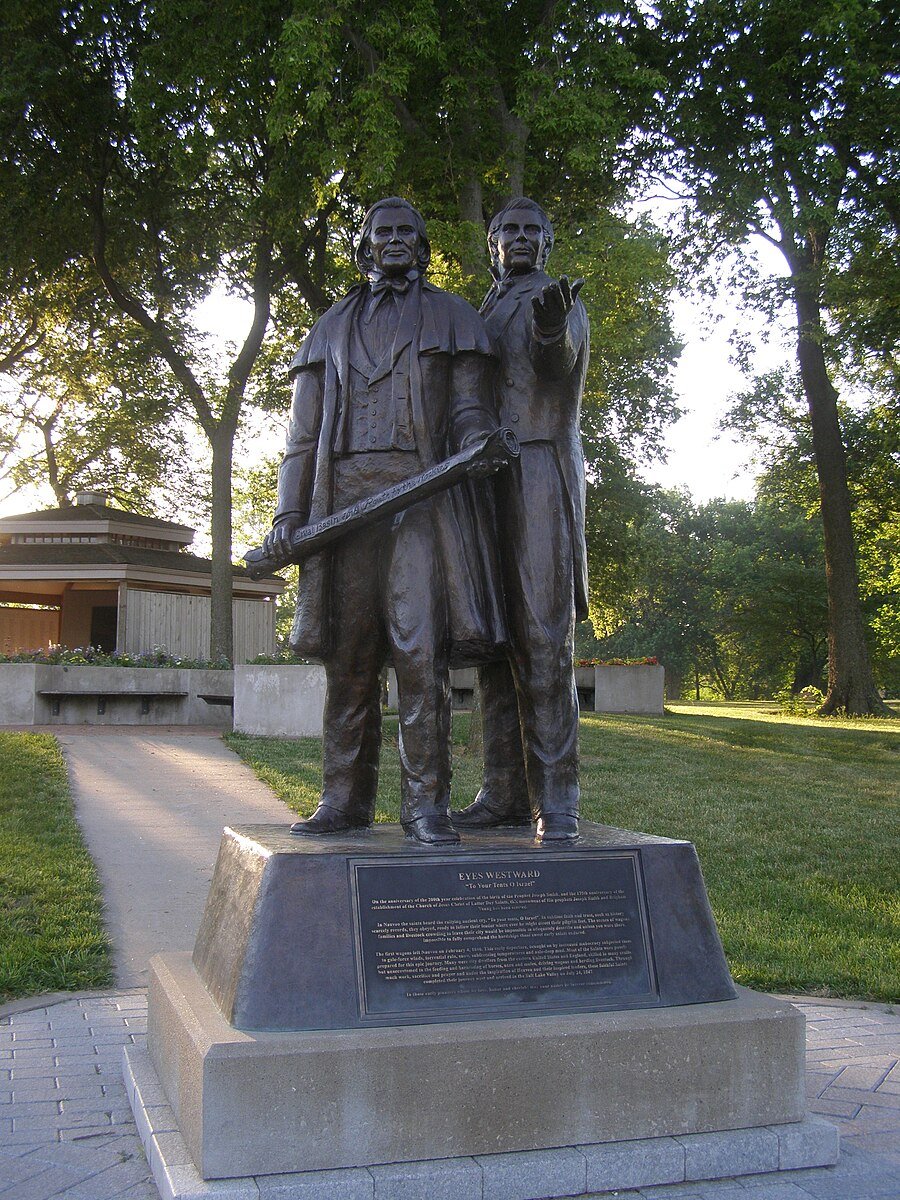
“Eyes Westward” — a statue of Joseph Smith and Brigham Young that is located in Nauvoo, Illinois (Wikimedia Commons public domain photograph)
We continue to work on our forthcoming series of short Interpreter Foundation video documentaries, Becoming Brigham. Here are links to three Becoming Brigham trailers that we produced for FAIR. The first two are thirty seconds in length, while the third is sixty seconds long:
We still need additional funding in order to complete the Becoming Brigham series as we envision it, and so, if you’re at all interested in helping this project come to full fruition, we invite you to contribute to it: “Donating to the Interpreter Foundation.” Donations — whether large or small — are not only welcomed but needed. We are entering into the biggest season of the year for charitable donations, so I want to get the Interpreter Foundation on your radar.
For online donations, nonprofits in the United States typically receive between 24% and 47% of their annual online revenue during the months of November and December. Approximately 30% of all annual charitable giving occurs in December, with about ten percent of all donations made in the last three days of the year. Indeed, a significant portion of year-end giving — about 5% of total annual donations — takes place specifically on 31 December. This year-end surge is no doubt driven by the spirit of the holidays, but it’s also driven by obvious tax considerations, since, under federal tax law in the United States, donations made by 31 December are eligible for tax deductions.
There are innumerable worthy causes out there. I realize that. Still, I hope that you will agree with me that the Interpreter Foundation is one of them. And, by the way: For the record, please note that, contrary to the continual insinuations and accusations of certain anonymous critics, I receive and will receive no income from either your donations or Becoming Brigham or any other Interpreter Foundation project. My wife and I are, ourselves, contributors to the Interpreter Foundation, both financially and, much more significantly, in terms of time and labor. We’re both volunteers and donors.
If you have interest or questions (or concerns), please contact me at [email protected]. If you merely want to insult me, though, feel free to send your rant to me via this address.
The Church’s humanitarian efforts are many and varied and are, of course, to be condemned in the strongest possible terms by all right-thinking people. (image from LDS.org)
And the Hitchens File is far from exhausted. Here’s yet another infuriating horror: “Local Mormon church donates over 70,000 lbs of food to Food Bank of Iowa.”
Moreover, if you become righteously indignant at such terrible theistic outrages as those that are mentioned just above, you might also derive a satisfying shiver of displeasure from these reports:





















 Ad-Free & Subscriber Log-In