


(Wikimedia Commons public domain photograph)
Christmas is coming in just thirty-six days! Sure, we still have Thanksgiving Day before us — in the United States, anyway — but Thanksgiving is a pretty modest affair. Obviously, it hasn’t yet been adequately commercialized. There’s only so much one can do to monetize bread stuffing and cranberries and pumpkin pies, and, well, turkeys continue to demonstrate their stupidity by failing to unionize. Anyway, where such delights were once fairly rare, required a lot of hard work and long hours in the kitchen, and celebrated a successful harvest, we moderns eat problematically well most days of the year. Most of us (in the United States) are scarcely lacking sufficient calories or access to desserts. Which makes a Thanksgiving meal relatively less special. Here, though, is some good advice and useful information for the holiday season:
“San Francisco Authorities Remind Everyone To Get Their Christmas Shoplifting Done Early”
“Costco Introduces Even Larger ‘Mormon Family’ Size”
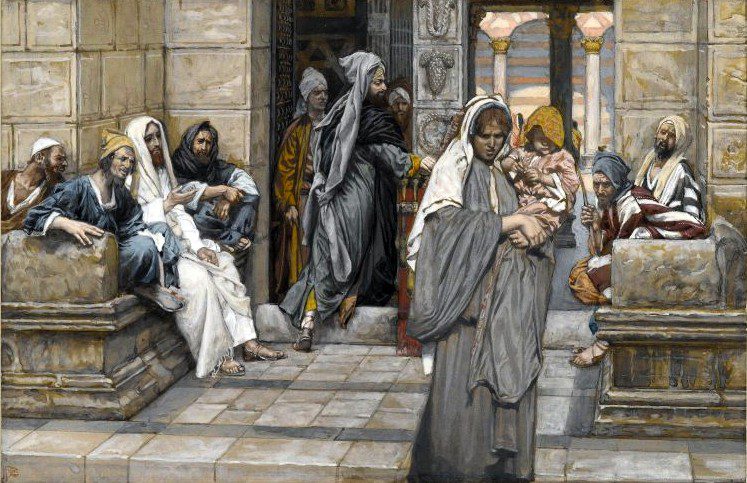
Whenever the Church of Jesus Christ of Latter-day Saints releases a report about its humanitarian efforts or issues a press release regarding, say, its donations to a hospital or a food bank or its efforts at disaster relief, some critic somewhere inevitably scolds the Church for its supposed boastfulness, citing this passage from the Sermon on the Mount:
Take heed that ye do not your alms before men, to be seen of them: otherwise ye have no reward of your Father which is in heaven.
Therefore when thou doest (ποιῇς) thine alms, do not sound (σαλπίσῃς) a trumpet before thee (σου), as the hypocrites do in the synagogues and in the streets, that they may have glory of men. Verily I say unto you, They have their reward.
But when thou (σου) doest alms, let not thy (σου) left hand know what thy (σου) right hand doeth:
That thine (σου) alms may be in secret: and thy (σου) Father which seeth in secret himself shall reward thee (σοι) openly. (Matthew 6:1-4)
It should not be overlooked, however, that the same New Testament Gospel of Matthew also contains this passage, which it attributes to the same Jesus as part of the same Sermon on the Mount:
Let your (ὑμῶν) light so shine before men, that they may see your (ὑμῶν) good works, and glorify your (ὑμῶν) Father which is in heaven. (Matthew 5:16)
It’s significant, in my view, that the repeated personal pronoun your in Matthew 5:16 is plural, not singular . By contrast, the relevant verbs and pronouns (σου and σοι) in Matthew 6:2-4 are in the second person singular. Even the King James English of Matthew 6:1-4 indicates a shift from the plural ye and your to the singular thou and thine, marking a clear difference between collective and individual. A distinction made in Islamic jurisprudence may be useful here: Muslim jurists have traditionally distinguished between individual obligations, which are incumbent upon each and every Muslim (fard al-‘ayn; فرض العين) and obligations that rest upon the community as a whole but not necessarily upon any given Muslim individual (fard al-kifaya; فرض الكفاية). In my reading of the counsel given by the Lord in the Sermon on the Mount, modesty with regard to one’s charitable efforts and donations is a fard al-‘ayn, an individual obligation, but isn’t a collective obligation or fard al-kifaya that is incumbent upon the Church as a whole.
Consistent with the above, it seems clear to me that the two passages, Matthew 6:1-4 and Matthew 5:16, are referring to two distinct things. The first warns us against showing off with the intent to gratify our personal vanity. 2 Nephi 26:29 is relevant to such a project, saying of the Lord that
He commandeth that there shall be no priestcrafts; for, behold, priestcrafts are that men preach and set themselves up for a light unto the world, that they may get gain and praise of the world; but they seek not the welfare of Zion.
But the Church of Jesus Christ of Latter-day Saints — like the Catholic Church and the Methodist Church and, for what it’s worth, like the Sierra Club, the International Red Cross, the Audubon Society, and the American Cancer Society — has no personal vanity, for the simple reason that it isn’t a person. Donors to the Church receive no ego-stroking for their tithes, which are given privately (even rather secretively), and they gain no individual praise or credit for any humanitarian acts performed by the Church. Apart from my bishop and our ward’s financial clerk, nobody besides my wife knows whether I pay or don’t pay fast offerings or contribute to the Church’s humanitarian funds. There is, thus, no spiritual danger for me, personally — no temptation to vanity or pride — in the Church’s grants to rural clinics, its disaster relief efforts, its provision of food and clean water to needy people, or its contributions to neonatal resuscitation in the Third World.
On the other hand, it’s helpful and (I can speak from my own experience here) it’s inspiring to Latter-day Saints to learn of the good things that their church is doing and that are being funded by their offerings. In that regard, such accounts are rather like a report to shareholders. (Ironically, the critics who denounce the Church for making its humanitarian efforts public are often the same people who demand more transparency from it.) And, since the Church is regularly maligned as driven solely by greed and as being indifferent to the plight of the poor and the needy, it is a service to the truth to make the actual facts public.
For there are many yet on the earth among all sects, parties, and denominations, who are blinded by the subtle craftiness of men, whereby they lie in wait to deceive, and who are only kept from the truth because they know not where to find it. (Doctrine and Covenants 123:12)
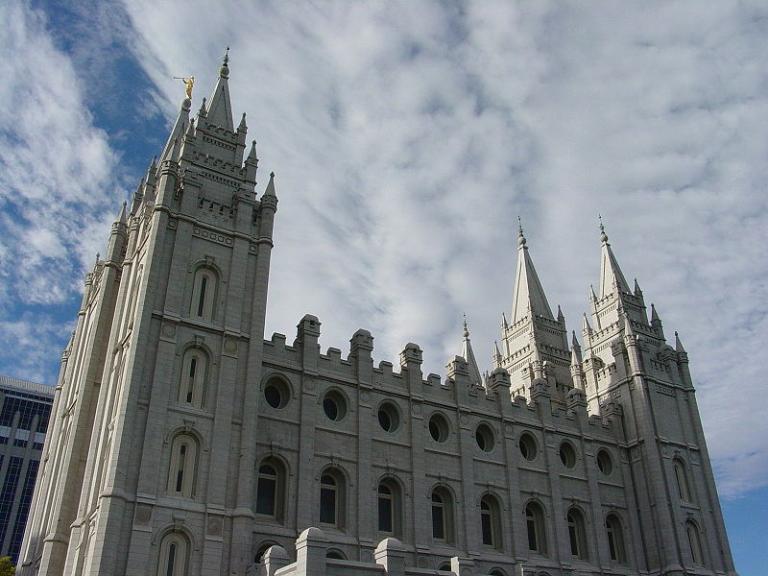
As opposed to the quest for personal glory and the desire for a personal reputation for sanctity and charity, I believe that it is the duty and obligation of the Church to let its light so shine before men, that they may see its good works, glorify our Father which is in heaven, and desire to join themselves with it.
And it shall come to pass in the last days, that the mountain of the Lord‘s house shall be established in the top of the mountains, and shall be exalted above the hills; and all nations shall flow unto it.
And many people shall go and say, Come ye, and let us go up to the mountain of the Lord, to the house of the God of Jacob; and he will teach us of his ways, and we will walk in his paths: for out of Zion shall go forth the law, and the word of the Lord from Jerusalem.
And he shall judge among the nations, and shall rebuke many people: and they shall beat their swords into plowshares, and their spears into pruninghooks: nation shall not lift up sword against nation, neither shall they learn war any more. (Isaiah 6:2-4)

Finally, here are a few items that I’ve retrieved from the Christopher Hitchens Memorial “How Religion Poisons Everything” File™:
- “Sharing the Savior’s Love at a Children’s Medical Center in Argentina: Elder Renlund visits Ricardo Gutiérrez Children’s Hospital in Buenos Aires, where the Church donated needed devices.” (It will be remembered that Elder Renlund, now a member of the Quorum of the Twelve Apostles, was a cardiologist prior to his call to serve as a General Authority of the Church.)
- “Church Responds to ‘Urgent Need’ in the Philippines After Typhoon Kalmaegi: Over 7,300 people have taken shelter in Church meetinghouses and leaders have activated emergency response plans”
- “Church Aids Nearly 50,000 After Twin Typhoons in the Philippines”
- ““Built Upon the Rock of Christ”: Faith, Hope, and Service After Hurricane Melissa: Caribbean Area President shares video”
- “Church Members in United States to Celebrate Nation’s 250th with Service and Gratitude”
- “‘Like the wise men of old’: Light the World Giving Machine initiative expands to 126 locations in 2025: ‘When we focus our Christmas activities on Him and give gifts of love and service as He did, we fill the world with more light,’ Elder Holland says”

And here are a couple of links that I found adjacent to the Hitchens File. Surely, Utah’s dominant religious faith has played a historical role in forming the state’s culture and continues to do so. Which is why sophisticates and the cognoscenti know my adopted home state as “Utard,” the center of the “Mor(m)on” or “Morgbot” religious world, and recognize it as something of a theocratic Hell on Earth:
- “Here’s where Utah stands when it comes to state debt: How do SLC and Provo rank in terms of debt per resident?” ““In almost every measure that you look at, Utah is among the healthiest states in the country,” said Mariana Trujillo, Reason Foundation’s director of government finance. “It is one of the least indebted states in the nation.””
- “Good news on campus: Utahns paying a lighter chunk of their paychecks on college than other states: Study reveals Beehive State students have to use less of their income on higher education than anywhere in the country”













 Ad-Free & Subscriber Log-In