


(I have been unable to find copyright information regarding this image of a work by a prominent contemporary LDS artist whom I admire, so, if anybody who holds copyright on it wishes to contact me, that would please me and put my mind at ease.)
A new article went up today in Interpreter: A Journal of Latter-day Saint Faith and Scholarship, representing the Foundation’s 698th consecutive Friday of publishing a journal article. (The Foundation was launched 699.5 weeks ago.) The new article is ““Upon All the Nations”: The gôyim in Nephi’s Rendition of Isaiah 2 (2 Nephi 12) in Literary Context,” written by Matthew L. Bowen:
Abstract: One of the most notable features of Nephi’s small plates rendition of Isaiah chapter 2 (2 Nephi 12) is the prominent expansion of the nations theme with two additional clauses with the word nations (Hebrew gôyim) that are not found in the Masoretic text (from which the KJV has been translated). Nephi’s text preserves the use of nations from Isaiah 2:2, 4 in 2 Nephi 12:2, 4, but also attests significant additional references to the nations in 2 Nephi 12:12, 14: “For the day of the Lord of Hosts soon cometh upon all nations, yea, upon every one . . . and upon all the nations which are lifted up, and upon every people.” These variants are consistent with—and may even be explained by—Nephi’s declaration of intent in 2 Nephi 25:3: “Wherefore, I write unto my people, unto all those that shall receive hereafter these things, which I write, that they may know the judgments of God, that they come upon all nations, according to the word which he hath spoken” (2 Nephi 25:3). This purpose in writing might explain additional textual variants in 2 Nephi 12–24 that pertain to coming judgments upon the nations, which is a dominant theme of the writings of Isaiah, which Nephi incorporated into this part of his record.
Professor Bowen’s article is accompanied on the Interpreter webpage by “Interpreting Interpreter: Nephi and the Nations,” which was written by Kyler Rasmussen:
This post is a summary of the article ““Upon All the Nations”: The gôyim in Nephi’s Rendition of Isaiah 2 (2 Nephi 12) in Literary Context” by Matthew L. Bowen in Volume 67 of Interpreter: A Journal of Latter-day Saint Faith and Scholarship. All of the Interpreting Interpreter articles may be seen at https://interpreterfoundation.org/category/summaries/. An introduction to the Interpreting Interpreter series is available at https:/interpreterfoundation.org/interpreting-interpreter-on-abstracting-thought/.
A video introduction to this Interpreter article is now available on all of our social media channels, including on YouTube at https://youtube.com/shorts/rUoWbBFBhcI.
The Takeaway: Bowen examines the Isaiah chapters in 2 Nephi, proposing that Nephi may have chosen and shaped those chapters as a way of promoting an expansive view of God’s relationship with the Gentile nations, working to prepare them for and help them avoid the judgments prophesied to befall them.

In the 4 December 2025 episode of the Interpreter Foundation Podcast, Martin Tanner discussed finding the Messiah in the Old Testament: “The Interpreter Foundation Podcast — December 4, 2025: Finding the Messiah in the Old Testament”
By the way, as we proceed through the month of December — which, in the United States, is the most important month for charitable giving — I hope that you’ll consider giving at least a small contribution to the Interpreter Foundation.
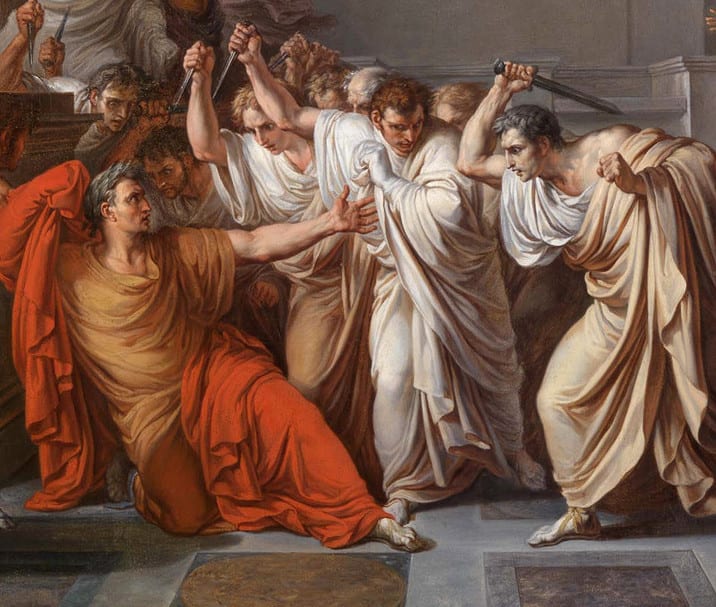
For the record: I wasn’t involved in this particular crime.
Some Roman tombs evidently bear the inscription NFFNSNC. You might be pardoned for imagining that NFFNSNC is the ancient equivalent of the QAnon motto WWG1WGA, but it isn’t. Rather, it stands for the Latin phrase Non fui, fui, non sum, non curo, which means “I was not, I was, I am not, I do not care.” The point, derived from Epicureanism, is that the deceased individual whose tomb it is didn’t exist prior to birth (which didn’t matter to him, he being nonexistent) and that he doesn’t exist after death (which doesn’t matter to him, since he doesn’t exist). There is no eternal reward, but there is also no eternal punishment, so the faithful Epicurean can accept life and death with complete equanimity.
Perhaps you imagined such a view of life and death to be modern and, thus, uniquely enlightened. Obviously, though, it’s not. But it is a self-consistent philosophy, in its way. Is it true, though? And, speaking of the general population as opposed to individual cases, will it provide sufficient incentive to motivate a moral life, let alone a life of sometimes self-sacrificial giving? Is it a sufficient basis for society? The late Rodney Stark’s brilliant 1997 book The Rise of Christianity: How the Obscure, Marginal Jesus Movement Became the Dominant Religious Force in the Western World in a Few Centuries offers some very useful insights into the latter two questions. I’m thinking, particularly, of his discussion of the starkly different reactions of Christians and pagans to the virulent plagues that swept the ancient Mediterranean world, which Stark, an eminent sociologist, says led to widely different rates of survival and, not coincidentally, to large numbers of Christian converts.
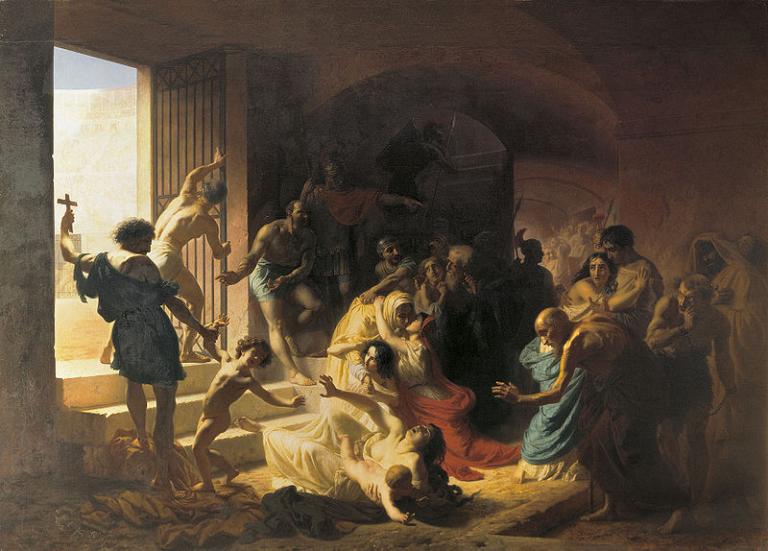
Wikimedia Commons public domain
Now, this is refreshing: “A former NFL quarterback keeps defending the Christianity of Latter-day Saints: Robert Griffin III keeps using that word ‘Christian’ to refer to BYU in his sports commentary, much to the chagrin of some respondents.” Incidentally, Griffin, who played college football for Baylor University, was the 2011 winner of the Heisman Trophy.

(Wikimedia Commons public domain photography)
You’ve probably heard this sixteenth-century Spanish Christmas carol before. Maybe, though, you had no idea what the lyrics meant. And, very possibly, you missed this unexpected version of it. My thanks to Eric Larson for calling the video to my attention.
Riu, riu, chiu
la guarda ribera
Dios guardó el lobo
de nuestra cordera
Dios guardó el lobo
de nuestra cordera.El lobo rabioso
la quiso morder
Mas Dios Poderoso
la supo defender
Quizo la hacer que
no pudiese pecar
Ni aun original
esta virgen no tuviera.Riu, riu, chiu…
Este que es nascido
es El Gran Monarca
Cristo Patriarca
de carne vestido
Ha nos redimido
con se hacer chiquito
Aunque era infinito
finito se hiciera.Riu, riu, chiu …
Pues que ya tenemos
lo que deseamos
Todos juntos vamos
presentes llevemos
Todos le daremos
nuestra voluntad
Pues a se igualar
con nosotros viniera.
Here’s an English version of the lyrics.
Riu, riu, chiu
The river bank is protected
God has kept the wolf
From our ewe lamb
God has kept the wolf
From our ewe lambThe rabid wolf
Wanted to bite her
But Almighty God
Knew how to defend her
He willed to make her
Unable to sin
Even original sin
This virgin did not haveRiu, riu, chiu…
The one who is born
Is the Great Monarch
Christ the Patriarch
Clothed in flesh
He has redeemed us
By making himself small
Though he was infinite
He became finiteRiu, riu, chiu…
Now we have
What we desire
Let us go together
To present him gifts
Let us all give him
Our will
For he came
As our equalRiu, riu, chiu…














 Ad-Free & Subscriber Log-In