

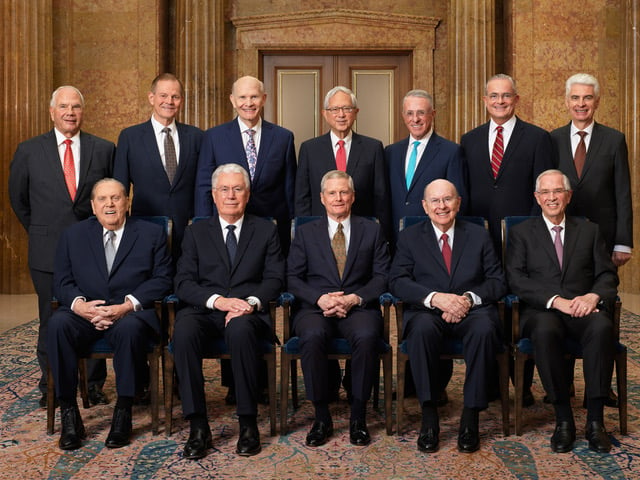
The new official portrait of the current Quorum of the Twelve Apostles was recently released, and I’ve shared it above. Which makes this a good occasion, I think, to say a bit more about the Twelve, both now and historically.
For one thing, I’m very happy with the Quorum’s growing internationalization. Among its members are a German, a Brazilian, a Briton, and a Frenchman — at least two speakers of German (one native), two speakers of French (one native), two speakers of Portuguese (one native), and one speaker each of Japanese, Chinese, Spanish, and Swedish.
The role of the Quorum of the Twelve Apostles changed dramatically between its initial organization in 1835 and the assassination of Joseph Smith on 27 June 1844. And then, through the events that followed the martyrdom in the summer of 1844, the Quorum assumed leadership of the Church of Jesus Christ of Latter-day Saints.
Just last evening, I saw a fierce denunciation of the Twelve as usurpers and frauds. It came from a man whom I take to be a former member of the Church, and he can cite scripture for his purpose. (Please compare Antonio’s comment at William Shakespeare, The Merchant of Venice, Act 1, Scene 3.) Sadly, a number of others — most likely also alienated members and former members of the Church — chimed in to endorse his position. But he’s wrong, grievously wrong, and he’s historically misinformed.
In my judgment, by far the best historical treatment of the rise of the Twelve to the leadership of the Church in 1844 is Ronald K. Esplin’s “All the Measures of Joseph”: The Succession of 1844,” which was published in Jeffrey M. Bradshaw, ed., Joseph Smith: A Life Lived in Crescendo (Orem: The Interpreter Foundation and Eborn Books, 2024). And, in this context, I also recommend the article by Jeff Bradshaw that immediately follows Ron Esplin’s magisterial discussion: “Dennison Lott Harris’ firsthand accounts of the conspiracy of Nauvoo and the transmission of apostolic keys.” (You can learn more about Joseph Smith: A Life Lived in Crescendo on the website of the Interpreter Foundation. And, by the way, it would make an excellent Christmas gift. Spread the truth.)
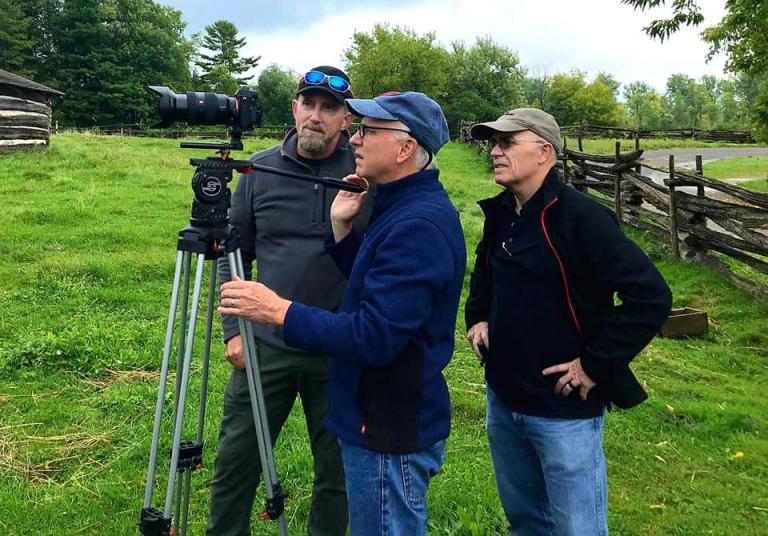
The Interpreter Foundation told the story of the 1844 succession crisis in its 2024 dramatic film Six Days in August. And we’ll shortly launch a series of short online video features, entitled Becoming Brigham, that will expand and comment upon that story and upon the leadership of Brigham Young and the Twelve. Here is the one-pager that we developed some time ago to explain Becoming Brigham to potential supporters:
“I’ll just reiterate here that we’re grateful for your work on this series and excited to contribute where we can.” Matt Grow, Managing Director of the Church History Department (Email April 23, 2025)
Most people are aware of Brigham Young as a pivotal figure in American religious and frontier history. But Brigham is also often misunderstood, seen as a larger-than-life caricature rather than as a man.
Who actually was Brigham? As a man, as a father, as a husband—as a prophet?
BECOMING BRIGHAM, a video web series, debunks fictions as well as providing sometimes surprising new insights into the real Brigham Young. In producing this series, we are working closely with Brent Rogers, Managing Historian of the Church History Department, and have thus far completed interviews with the following historians: Thomas G. Alexander, James B. Allen, Susan Easton Black, LaJean Carruth, Gerrit Dirkmaat, Brett Dowdle, Ron Esplin, Matt Godfrey, Casey Griffiths, Brittany Chapman Nash, Reid Neilson, John Peterson, Paul Reeve, and Lisa Olsen Tait.
Their insights into Brigham give a much fuller, richer picture of who he really was:
- LaJean Carruth: “Those of us who have worked with Brigham Young’s words, . . . we see a completely different man, a kinder man. A caring man. A loving man. . . . He wanted to serve God, and he strove with everything he had to lead the Saints.”
- Ron Esplin: “I came to know a man whose heart was with the Lord from the very beginning. . . . He believed in Jesus. He believed enough to follow a disciple of Jesus named Joseph Smith.”
- Lisa Olsen Tait: “I do think that Brigham Young, fundamentally at the core of his soul, wanted people to flourish . . . and the way that would happen was by embracing the gospel of Jesus Christ . . . . I kind of like Brigham Young, actually. I think he’s very down-to-earth. I think he’s very human.”
- Reid Neilson: “When I think about plural marriage, I cannot think of anything else in our history that has refined a people more . . . [it] forced the Saints, both women and men, to think, ‘Am I all in or not? . . . Was Joseph a prophet? Was Brigham a prophet?’ They had to put everything on the altar . . . .”
- Gerrit Dirkmaat: “And the people who knew these people best, like the people who knew Joseph, the people who knew Brigham, well, they’re the ones who are certain that they’re prophets.”
PROGRESS & PLANS
Over 40 episodes have been filmed thus far and are currently in post-production. Drawing from a list of almost 80 topics, many more episodes are planned as we explore the life and times of Brigham Young. This series is designed to help increase faith, and build testimonies of modern prophets and the restored Church.
“We had a first screening last night of four of the short Becoming Brigham documentary videos in their almost-finished form. I was very pleased. They’re interesting and well done and seeing them has increased my already high enthusiasm for the project.” Daniel C. Peterson, President of The Interpreter Foundation (Email August 2, 2025)
PROJECTED FUNDING NEEDS
Becoming Brigham was originally planned as 52 episodes at 15 minutes each. Now, with such high quality interviews and depth, combined with requests for additional content, the delivered episode count might actually be higher (same length at 15 mins), expanding and extending the potential for a significantly wider reach.
If you have any interest in Becoming Brigham, I hope that you’ll consider making a donation to the Interpreter Foundation for its support. (Although we’re very far into production of the series, additional funding is still necessary to bring it to final completion. And even “small” donations will help. You can, if you choose, expressly target your contribution to Becoming Brigham.) And I certainly hope that you will enjoy the series when it begins to appear at some point in the latter part of next month.














 Ad-Free & Subscriber Log-In