

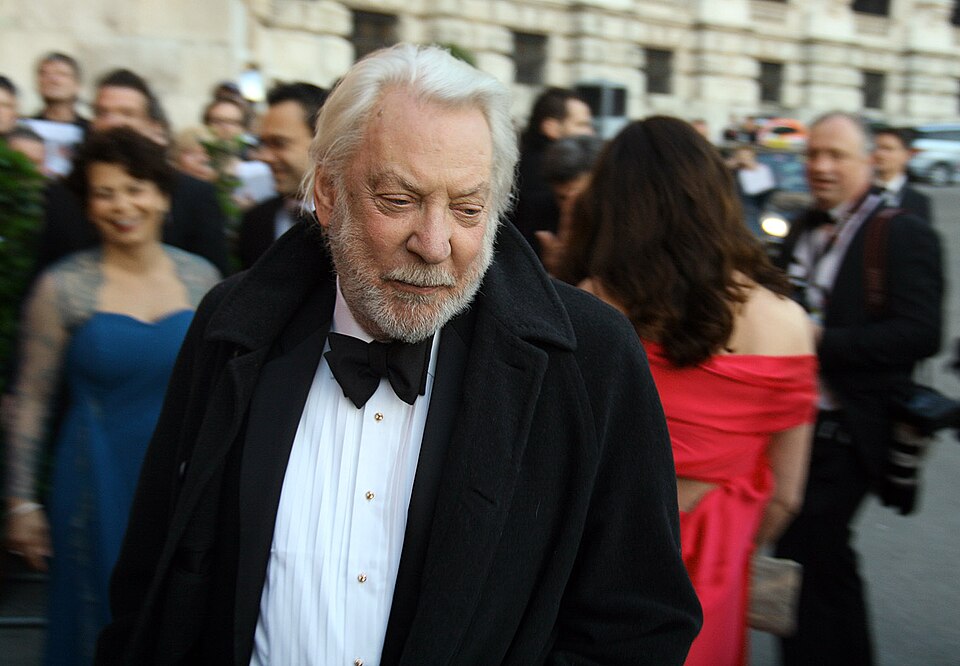
An unexpected story about the late actor Donald Sutherland showed up — unexpectedly — in my in-box yesterday, and I thought that I would share it with you:
In 1968, Sutherland was thirty-three, having experienced a career breakthrough in The Dirty Dozen just the year before. He went to Yugoslavia to film a World War Two comedy titled Kelly’s Heroes, with Clint Eastwood, Telly Savalas, Don Rickles, and Carroll O’Connor. (I haven’t seen the film since roughly about the time that it first came out in 1970, when I had just arrived at BYU. Truth be told, I had largely forgotten about Kelly’s Heroes until seeing this story, but now I want to see it again because I remember laughing uproariously throughout the movie.)
Anyway, Sutherland was to play a tank commander nicknamed “Oddball,” and his scripted involvement was only going to require a few days on the set. Somewhere along the Danube River, though, he had picked up the Pneumococcus bacteria, which ultimately left him in a coma.
Yugoslavia had been chosen as the location because it was one of the few countries in 1968 whose army still operated actual World War II equipment, such as authentic Sherman tanks and genuine Second World War weapons. Unfortunately, medical care in Soviet-bloc Communist Yugoslavia was also “vintage”; the hospital didn’t have the antibiotics that he needed and his odds of survival were low. He developed spinal meningitis, which attacked the protective membranes surrounding his brain and spinal cord. For six weeks, he hovered somewhere between life and death. Nancy O’Connor, the wife of costar Carroll O’Connor, visited him in the hospital, only to turn and run from the room, crying.
Curiously, this wasn’t his first encounter with serious illness. Beginning in his childhood, he had experienced polio and rheumatic fever and hepatitis and pneumonia and scarlet fever. And now he was facing bacterial meningitis.
Afterwards, Sutherland commented that he could hear everything while he was comatose. Every sound. Every conversation. He would later advise people, when they visited patients in a coma, to talk to them. Sing to them. They’re listening, he said. At least, he had been.
But that’s not all he said. Over the next decades, repeatedly, he gave the same account. He would evidently tell the story with wonder in his voice, with the sense that he had caught a glimpse of something fundamentally important: “I saw the blue tunnel,” he said. “And I started going down it. I saw the white light.”
This was, recall, 1968 — which was seven years before Raymond Moody coined the term near-death experience in his bestselling book Life after Life and had reported a “tunnel” as a common feature of many NDEs.
Sutherland recalled that he knew he was dying, and that it felt very peaceful. “Such a tempting journey,” he apparently later told Smithsonian Magazine. (I need to track this interview down. It may date to 2015.) “So serene. No barking Cerberus to wake me. Everything was going to be all right.” “I didn’t want to go,” he admitted, “but it was incredibly tempting. You just go, ‘Aw, shit man, why not?'” “And then,” he said, “just as I was seconds away from succumbing to the seductions of that matte white light glowing purely at what appeared to be the bottom of it, some primal force fiercely grabbed my feet and compelled them to dig my heels in.”
He eventually began to recover — MGM flew him from Yugoslavia to Charing Cross Hospital in London,give him better facilities, better antibiotics, and a better chance — but the long-term effects of severe bacterial meningitis stayed with him through filming Kelly’s Heroes and beyond. Also in 1970, he appeared in M*A*S*H. In 1971, he starred with Jane Fonda in Klute. Later, he played in Invasion of the Body Snatchers, Animal House, Ordinary People, Oliver Stone’s JFK, and, eventually, as President Snow, in the Hunger Games franchise. He died at age 88 in June 2024, of chronic obstructive pulmonary disease

Since 2014, Interpreter: A Journal of Latter-day Saint Faith and Scholarship has published an invited essay every year both on Good Friday and on the Friday closest to (but not after) Christmas Day. We’ve allowed writers wide latitude on these. Some have been short; some have been fairly lengthy. They can be academically oriented or they can be personal and devotional, as the author chooses.
Our most recent Christmas essay appeared just this past Friday. It was written by Shirley Smith Ricks: https://interpreterfoundation.org/journal/christmas-stars-inviting-us-to-come-to-christ
Here are links to some of the other Christmas essays that we’ve published thus far; I intend to post links to the remaining Christmas essays in a future post::
Elder Spencer J. Condie provided the 2018 Christmas piece: https://journal.interpreterfoundation.org/christmas-in-transition-from-figgy-pudding-to-the-bread-of-life/
The Christmas essay for 2019 came from Kristine Wardle Frederickson: https://journal.interpreterfoundation.org/musings-on-the-birth-of-the-savior-jesus-christ/
Cherry Bushman Silver contributed the 2020 Christmas essay: https://journal.interpreterfoundation.org/christmas-as-devotional-a-time-of-commitment/
Unfortunately, Daniel C. Peterson furnished the 2021 Christmas article (as a last-minute substitution): https://journal.interpreterfoundation.org/christmas-and-a-condescending-god/
David F. Holland authored our 2022 Christmas piece: https://journal.interpreterfoundation.org/puritans-pagans-and-imperfect-christmas-gifts/
Kent P. Jackson contributed the essay for Christmas 2023: https://journal.interpreterfoundation.org/glory-to-god-in-the-highest/
Don Bradley provided our 2024 Christmas offering: https://interpreterfoundation.org/journal/ring-in-the-christ-that-is-to-be-fulfilling-the-pattern-of-his-life
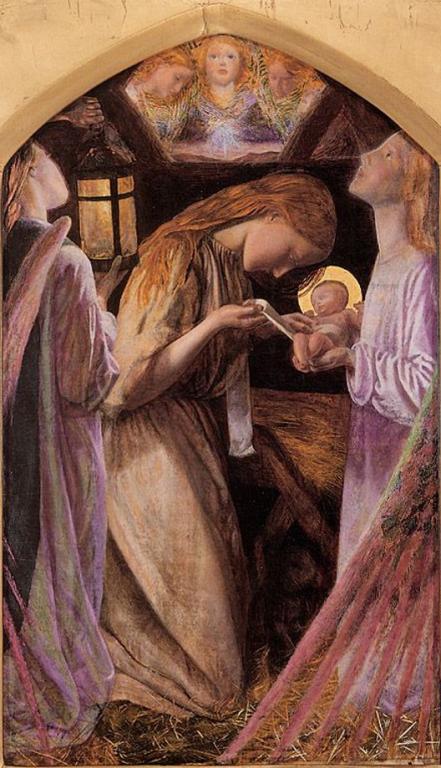
Wikimedia Commons public domain image
Holiday traditions vary from culture to culture, country to country, and family to family. Today, on the last Sabbath day before Christmas, my Mini-Stalker felt moved to celebrate the season of good will by posting an image of me to which he’s attached a made-up quotation that’s intended to make me look bad. And, after all, why not? What could possibly be more appropriate to the spirit of Christmas than publicly maligning another person?
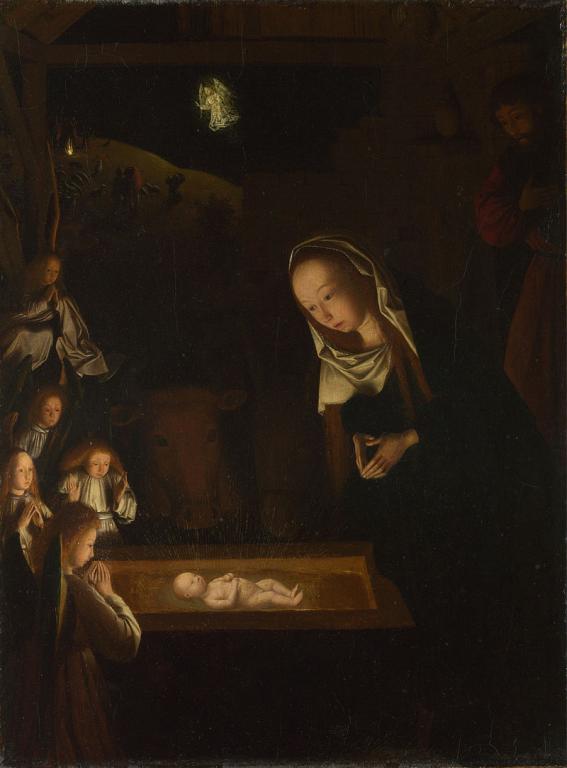
(Wikimedia Commons public domain image)
My chosen piece of Christmas music for today is “O Holy Night,” which was originally created in mid-nineteenth-century France by Placide Cappeau and Adolphe Adam. Here is a powerful English-language performance of the song by The King’s Singers, backed by the Tabernacle Choir and the Orchestra at Temple Square: https://www.youtube.com/watch?v=NU2TlwcH3h4
I have always found one particular passage from John Sullivan Dwight’s canonical English version of “O Holy Night” — strictly speaking, it’s not a translation but a recreation — to be specially stirring:
Truly He taught us to love one another;
His law is Love and His gospel is Peace;
Chains shall he break, for the slave is our brother,
And in his name all oppression shall cease.
May it soon be so.













 Ad-Free & Subscriber Log-In