

It’s Friday! So, as has happened on many hundreds of Fridays before, there is a new article on the Interpreter Foundation website: “From Wilderness to Covenant Threshold: Land, Literacy, and Religious Readiness in the Book of Mormon,” (Interpreter: A Journal of Latter-day Saint Faith and Scholarship 67 [2025]: 401-424), written by John E. Cochran II and Joseph D. Cochran:
Abstract: Using a case study from the Book of Mormon, this article explores how divine preparation can create the conditions for covenantal receptivity. Focusing on the Lamanite transformation during the mission of the sons of Mosiah, we propose that their readiness to receive the gospel reflects a “covenant threshold.” This is defined as a moment when spiritual soil, shaped by both divine and social forces, becomes capable of receiving a covenant. Drawing on Alma 13:24, which describes angels preparing hearts ahead of the gospel’s arrival, we examine how developments in land use, record-keeping, and communal organization are portrayed as signs of gospel readiness. Developments such as the spread of literacy and the influence of Nephite religious frameworks are treated here not as prerequisites for faith, but as signs of a broader readiness, cultivated over time. We do not claim these elements are universally necessary for covenantal engagement; instead we observe how the Book of Mormon links spiritual receptivity to changing conditions in this particular scenario. Our interdisciplinary approach draws from Mesoamerican anthropology, covenant theology, and narrative analysis—deferring to the scriptural text as primary. In framing societal transformation as one mode of divine cultivation, we offer a model for interpreting how God prepares peoples, communities, and individuals to receive him.
And I would like to call your attention to another article, as well. It’s from one of the most consistently original and interesting historians currently devoting attention to the story of the early Restoration: Donald Patrick Bradley Sr., “Were Nephi’s Small Plates Contained in Mormon’s Gold Plates?” BYU Studies 64/4 (2025): 38-57. I share here a few passages from Don’s article to give you a glimpse of the intriguing argument that he is making:
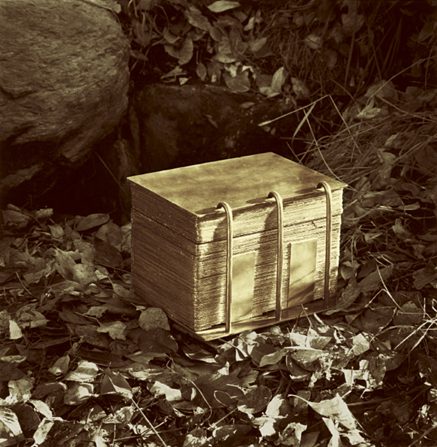
Latter-day Saints have generally visualized the relationship of Mormon’s plates and Nephi’s small plates as two segments of a single record, bound together into one book by a shared set of rings. I will argue in this article that this visualization may also be faulty—that Mormon’s plates and Nephi’s small plates were not bound together into a single book but were utilized separately and sequentially by the Prophet Joseph Smith in translating the Book of Mormon. Evidence pointing to the model that the small plates and Mormon’s plates were separate records may be found in the Book of Mormon text and in sources from the early history of the Church. (40-41)
In addition, the timeline of the Book of Mormon’s translation and the associated exchanges of plates between Joseph Smith and the angel Moroni similarly suggest that Joseph used two distinct sets of plates in succession to translate the Book of Mormon. I will argue from historical sources that when Joseph completed his work with Mormon’s set of plates at the end of May 1829, Joseph returned Mormon’s plates to the angel before leaving Harmony, Pennsylvania. Joseph’s remaining translation work, carried out in Fayette, New York, was exclusively from Nephi’s small plates, with no need for him to further access the plates of Mormon that he had returned to the angel. This article will argue that the model of two separate sets of plates best accounts for both the textual and the historical data. (41)
If Nephi’s small plates and Mormon’s plates were not bound together, this suggests the possibility that our present Book of Mormon text was translated from two independent sets of plates—that is, from two distinct records that were not ringed together into a single set. (45-46)
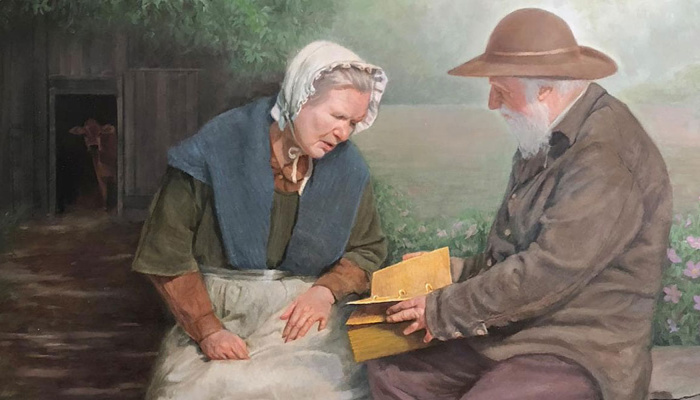
If accepted, Don Bradley’s thesis puts the experience of Mary Musselman Whitmer with the mysterious messenger who showed her a set of golden plates into a quite different light:
What plates did he bring? The plates Joseph needed at this point were those he had not yet translated—the small plates of Nephi. The messenger, who had been headed to Cumorah, brought these plates from Cumorah to Fayette. The messenger would thus have brought the small plates right when they were needed—just in time for Joseph to translate them. . . .
Mary Whitmer’s encounter with the heavenly bearer of the plates has typically been interpreted as a purely personal experience given to her for her own comfort and edification but with no spiritually substantive role in the Book of Mormon’s coming forth. Yet Mary Whitmer’s experience appears to have had just such a role.(53, 54)
While interpreters of the Book of Mormon have sometimes read into the Words of Mormon that Nephi’s small plates were bound with the plates of Mormon, the text does not say this. Indeed, the textual data of the Words of Mormon and the title page are at least as well explained—if not much better explained—on the model that Nephi’s small plates were simply placed with, rather than bound with, the plates of Mormon. Historical sources and the Book of Mormon’s translation timeline also align with this model, indicating that Joseph Smith returned the plates to the angel just when we would expect if those plates contained only Mormon’s record, not Nephi’s small plates. (55-56)
Mary Whitmer’s experience with the plates is depicted in the 2022 Interpreter Foundation docudrama Undaunted Witnesses of the Book of Mormon., which is currently available for viewing at no cost. See also:
- “Another Account of Mary Whitmer’s Viewing of the Golden Plates,” Interpreter: A Journal of Mormon Scripture 10 (2014) : 35-44.
- Witnesses of the Book of Mormon—Insights Episode 29: “Women Witnesses–Why and Why Not?”
Posted from St. Louis, Missouri











 Ad-Free & Subscriber Log-In