

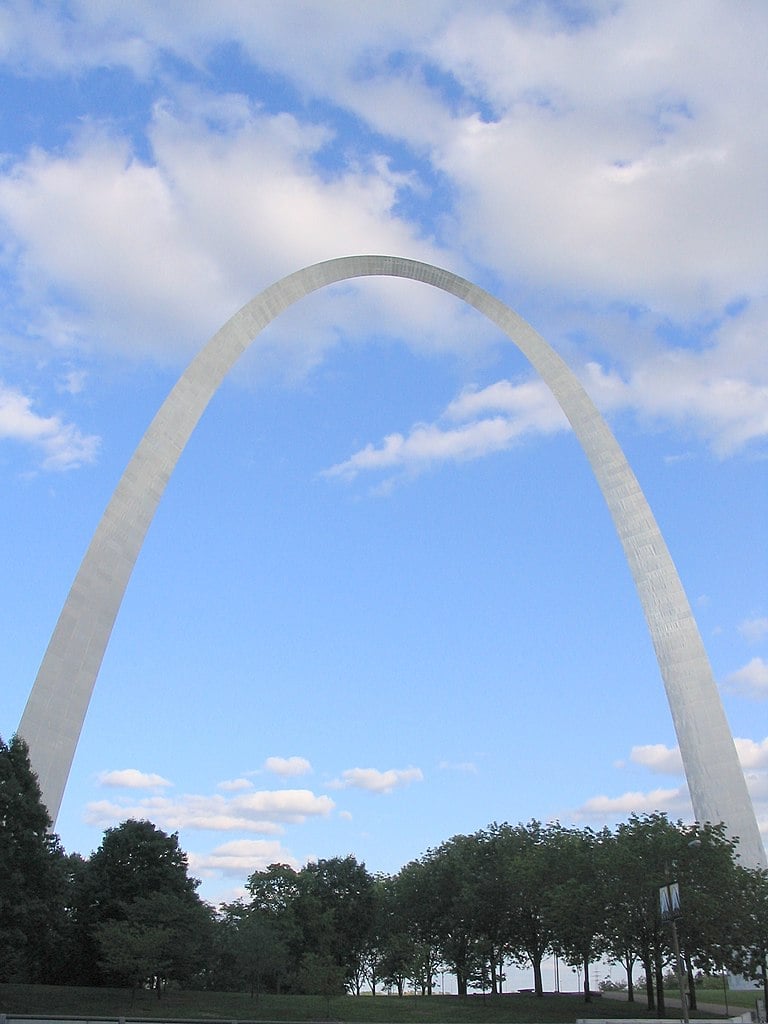
Well, thanks to a mechanical problem with one of the aircraft in the Delta Airlines fleet, we were able to add an extra day to our filming expedition, spending an unplanned Friday night in St. Louis. In the, umm, spirit of St. Louis, here is Judy Garland’s “Meet Me in St. Louis.” Please ponder its timelessly immortal lyrics.
1. Come, come, ye Saints, no toil nor labor fear;But with joy wend your way.Though hard to you this journey may appear,Grace shall be as your day.’Tis better far for us to striveOur useless cares from us to drive;Do this, and joy your hearts will swell—All is well! All is well!2. Why should we mourn or think our lot is hard?’Tis not so; all is right.Why should we think to earn a great rewardIf we now shun the fight?Gird up your loins; fresh courage take.Our God will never us forsake;And soon we’ll have this tale to tell—All is well! All is well!3. We’ll find the place which God for us prepared,Far away in the West,Where none shall come to hurt or make afraid;There the Saints will be blessed.We’ll make the air with music ring,Shout praises to our God and King;Above the rest these words we’ll tell—All is well! All is well!4. And should we die before our journey’s through,Happy day! All is well!We then are free from toil and sorrow, too;With the just we shall dwell!But if our lives are spared againTo see the Saints their rest obtain,Oh, how we’ll make this chorus swell—All is well! All is well!
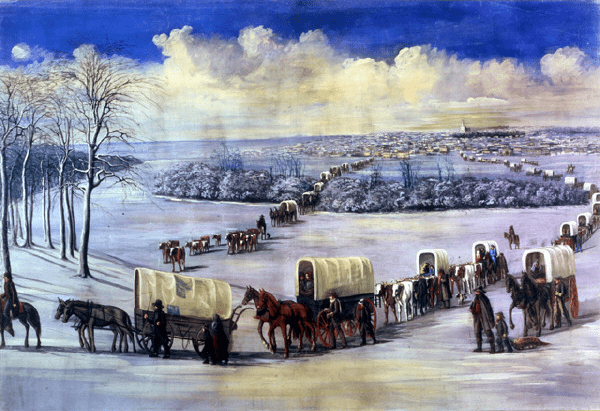
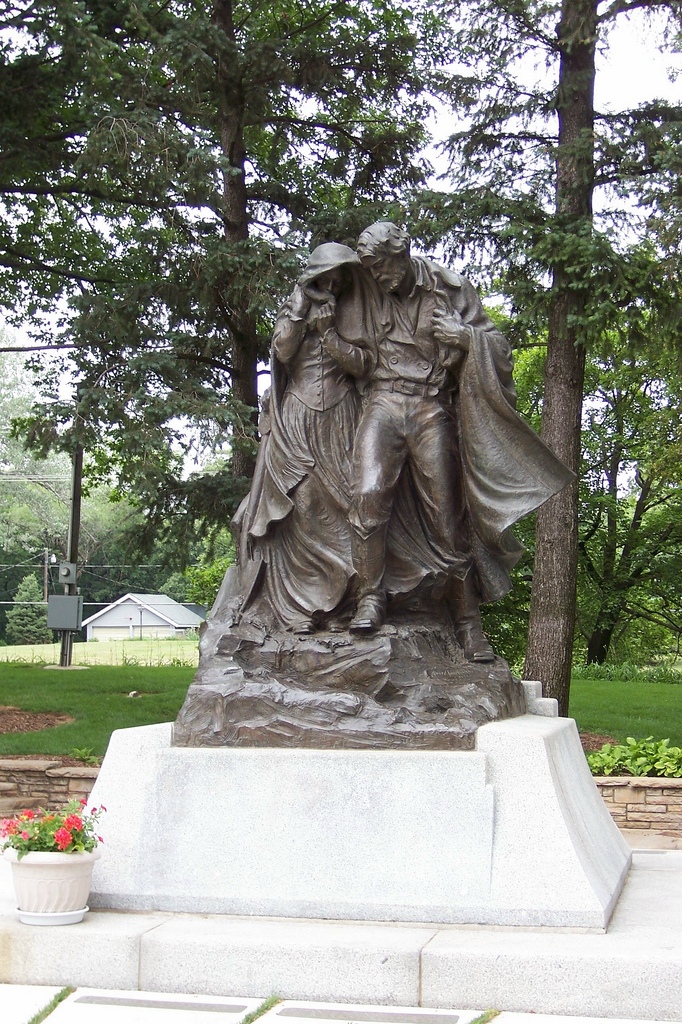
I’ve just watched a beautifully illustrated performance of Come, Come Ye Saints by the Tabernacle Choir. Perhaps I’ve been more affected than I realized by spending the past several days in Nauvoo, in and around the surviving homes of those who abandoned them (and their temple, and the graves of their martyred Prophet and Patriarch, for exile in the west, but I found myself actually tearing up as I watched the accompanying video. It’s just five minutes in length.
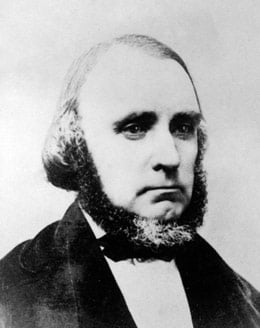
After staying in the Valley for a short while in 1847, William Clayton returned to Winter Quarters in the fall and compiled a book from the detailed entries that he had made in his diary during the journey. His entries included data from a device that Elder Orson Pratt of the Quorum of the Twelve had designed and that Appleton Harmon had constructed during their 1847 expedition. They called it a “roadometer.” Like a modern odometer for measuring mileage, it was mounted on a wagon wheel.
Clayton was assigned to help organize efforts in St. Louis, where he was aided by the city’s relative tolerance and cosmopolitanism. While there, in order to aid the pioneers, he supervised the printing of The Latter-Day Saints’ Emigrants’ Guide: Being a Table of Distances, Showing all the Springs, Creeks, Rivers, Hills, Mountains, Camping Places, and all Other Notable Places, From Council Bluffs, to the Valley of the Great Salt Lake . . . . The Whole Route Having Been Carefully Measured by a Roadometer, and Distance from Point to Point, in English Miles, Accurately Shown (St. Louis: Mo. Republican Steam Power Press, Chambers & Knapp, 1848).
The book lists the names and occasional locations (giving latitudes in degrees, minutes, and seconds, in figures provided by Orson Pratt) of prominent points, the distances in miles between the points listed, the distance from Winter Quarters, and the distances from Great Salt Lake City. Thus, an emigrant reading the guide always knew how far he had come, how far he needed to travel to the next camp site, and how great a distance remained to the Valley of the Great Salt Lake. Sometimes, it even provides altitudes that had been calculated by Elder Pratt.














 Ad-Free & Subscriber Log-In