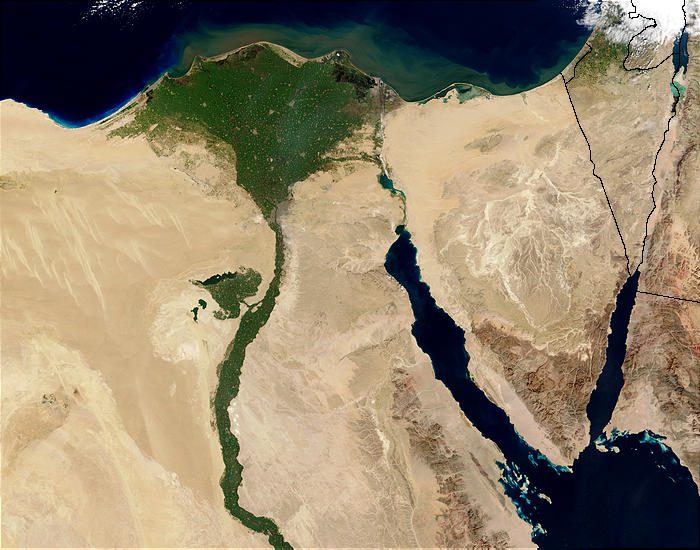
Against the barren desert of northeastern Africa, the fertile valley of the Nile River runs northward through Egypt. In this image, the city of Cairo can be seen as a gray smudge where the river widens into its broad fan-shaped delta. Other cities are dotted across the green landscape, giving it a speckled appearance. Where the Nile empties into the Mediterranean Sea (top) the waters are swirling with color, likely a mixture of sediment, organic matter, and possibly marine plant life. Farther west, the bright blue color of the water is likely less-organically rich sediment, perhaps sand. East of the delta lies the arid Sinai Peninsula, whose pointed tip is home to rugged mountains, some as high as 8,600 feet. The lattice work of pale lines marks the paths of ephemeral rivers. The Sinai Peninsula intrudes into the Red Sea. Farther east are Israel, Jordan, and Saudi Arabia. At top right is the disputed territory of the West Bank. (Wikimedia Commons NASA public domain image)
“Muhammad, upon whom be peace” in Arabic calligraphy (Wikimedia Commons public domain image)
I’ve recently been asked a number or questions about Islam and the Qur’an and, in one case, I’ve been asked to respond to an implicit challenge. I’ve fallen behind in replying to them, so I’ll try, right now, to answer two of the questions:
Does Surah Al-Bayyinah provide evidence that Muhammad was sent by Allah and that his message is true? Are Jews and Christians who reject this evidence held accountable?
Surah 98 (al-Bayyinah) certainly assumes that Muhammad was sent by God, that his message is true, and that unbelievers (ٱلَّذِينَ كَفَرُوا۟) among the People of the Book (e.g., Jews and Christians) and among the polytheistic pagans will ultimately be accountable for their unbelief. In this regard, the idea is precisely analogous to that among most Christians that people who fail to accept the message of Christianity, which is assumed to be true, will be held accountable for their unbelief.
The crucial term here, I think, is kufr (typically translated as “unbelief”) and its related verb forms. What does kufr mean? I don’t have space or time here to lay out my evidence and my reasoning, but my sense is that believing Christians and Jews cannot really be kafirs (“unbelievers”). I’ll expand upon that contention elsewhere. It’s also the case that, at many places, the Qur’an declares that believing, practicing Christians need not fear regarding their eternal fate.
Is Surah Al-Ahzab correct when it states that Muhammad was the final prophet?
I assume that the specific verse in Surah 33 (al-Ahzab) to which this question refers is 33:40, and particularly the phrase in which Muhammad is described as the خَاتَمَ ٱلنَّبِيِّـۧنَ or “seal of the prophets.” Most Muslims today take that phrase to mean that, yes, he was the last of them.
However, I don’t believe that it needs to be so understood. The term خَاتَمَ (khatam) or “seal” refers to the kind of seal on a jar or on a “sealed” letter that guarantees the integrity of the contents of the jar or the letter (i.e., that the container or envelope hasn’t been opened, that the contents haven’t been tampered with but are authentic and pure). Thus, Muhammad is the guarantor — by reason of the Islamic belief that his preaching agrees with theirs — of the authenticity of the messages of prior prophets (for example, of Abraham and Moses and Jesus). It doesn’t necessarily entail that he is the last of them. This reminds me a bit of the statement given by Joseph Smith and Sidney Rigdon early in their account of their great vision of the three degrees of glory:
And now, after the many testimonies which have been given of him, this is the testimony, last of all, which we give of him: That he lives!
For we saw him, even on the right hand of God; and we heard the voice bearing record that he is the Only Begotten of the Father. (Doctrine and Covenants 76:22-23)
The point of what Sidney Rigdon and Joseph Smith wrote in those two verses is not that they are the last who will ever testify of Jesus Christ, or that no subsequent testimonies will ever be given, but that theirs is the latest in a series of such testimonies and that their witness confirms the truth of the witness borne by those who have testified before.
Just thinking of what might have been: A sunset near Kailua Kona on the Big Island of Hawaii (Wikimedia Commons public domain photograph)
Well (sigh), my wife and I were supposed to be on a plane right now, headed for Kona, on the Big Island of Hawaii. Until yesterday. It’s the second trip to Hawaii that we’ve canceled out of for this year. (We have no other planned.) Life is tough. We had reasons, but, well . . .
Incidentally, neither trip would have been funded by the Interpreter Foundation or by befuddled donors to the Interpreter Foundation.
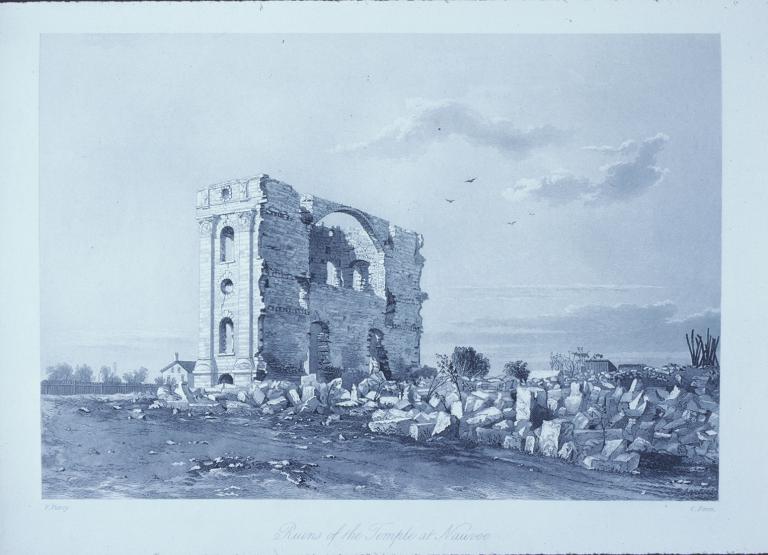
“The Nauvoo Temple in Ruins,” by Frederick Piercy (1853) (Wikimedia Commons public domain image) Is this the future of the Church of Jesus Christ of Latter-day Saints as a whole? Some appear to hope so.
I read in some quarters the repeated (and, often, very happy) claim that the Church of Jesus Christ of Latter-day Saints is collapsing, that it’s hemorrhaging members, and especially young members) at a catastrophic rate. And, certainly, we all know people who have forsaken their covenants and left the Church, and we all know families who suffer from the disaffection of loved ones. Moreover, any loss is a tragedy, an occasion for sadness. Apostasy isn’t anything to be blithely dismissed.
But the numbers don’t actually suggest that the Church as a whole is fading away, let alone that it’s in free-fall:

















 Ad-Free & Subscriber Log-In