

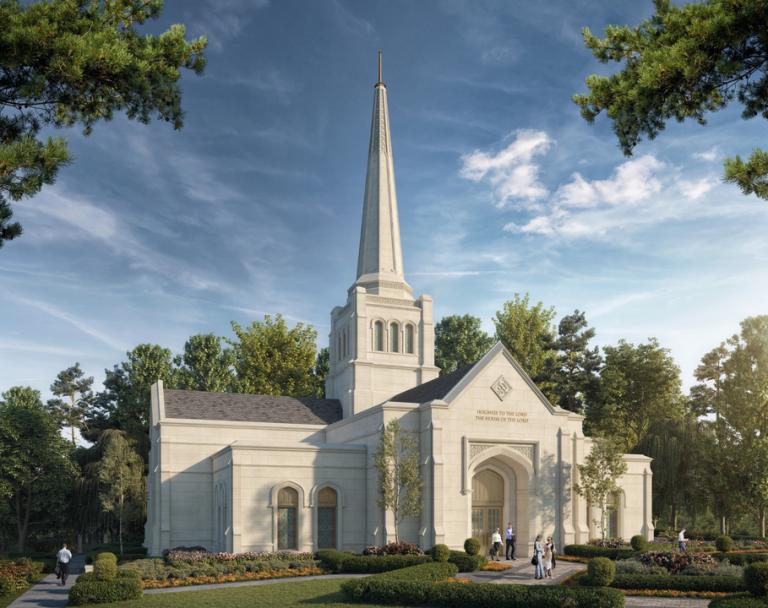
Next month, along with Kristine Wardle Frederickson of the Interpreter Foundation’s board of directors and the well-known English Latter-day Saint tour guide Peter Fagg, my wife and I will be accompanying an Interpreter Foundation study tour in England: Church History and Great Britain with the Interpreter Foundation 2026.
I’m pleased, in that light and just generally, to be able to note that Peter’s Standing on the Shoulders of Giants: Book 1: LDS Preston is now available as a Kindle book on Amazon:
The City of Preston was incorporated in 1179 and remained a quiet market town until the industrial revolution. In the late 1700’s the rich were making millions from cotton whilst the poor encountered shocking working conditions and insanitary accommodations. They were being exploited for gain.
Into this turmoil of commerce and industry arrived seven missionaries from Ohio, spokesmen for the Church of Jesus Christ of Latter-day Saints. They offered solace and peace to the hearts of the hopeless and the downtrodden. They baptised thousands and saved many from a life of miserable servitude.
Later thousands of converts from the UK and elsewhere would travel with the Church to the USA and settle in the young America.
Standing on the Shoulders of Giants will, I think, be of great interest not only for those who will be joining us on our tour of England but for other Latter-day Saints who have visited the United Kingdom or who plan to visit it in the future, for those who served missions there or who have British ancestry or who simply have an interest in Latter-day Saint history, the beginnings of our international missionary work, the story of Brigham Young and others among the early apostles of this dispensation, and so forth.
Speaking of which, all of the currently-released installments of the Interpreter Foundation’s series Becoming Brigham (along with some other supporting materials) are accessible at no charge at becomingbrigham.org.
Also connected, in a way, with May’s tour: I will, if plans hold, be teaching at BYU’s Education Week this coming August, doing so for the first time in quite a number of years. (My excuse for not having participated in Education Week for a while? Well, it’s, umm, not very flattering to me: Sometimes, I’ve had scheduling conflicts for August. Mostly, though, it’s because I’ve simply forgotten to propose anything: The deadline for proposals comes surprisingly early and, year after year after year, I’ve missed it because I just wasn’t thinking about Education Week. And then, when I did think about it, the deadline was already past. This year, though, I got my act together and proposed the following series of lectures, which was accepted:
Series Title: “After and Before the Apostles: Highlights from British Christian History between Dispensations”
Class 1: Christianity comes to the British Isles
- The “tunnel” of the second century: Christ’s church enters the “tunnel” and emerges at the other end as a very different organization.
- The rise of the monarchical episcopate and of monasticism
- The legendary background of British Christianity, including Joseph of Arimathea, King Arthur, and the story behind William Blake’s “Jerusalem”
- Ireland’s monks
- Augustine and the See of Canterbury
Class 2: Figures from the History of British Monasticism
- Anselm of Canterbury
- Caedmon
- The Venerable Bede
- Julian of Norwich
- Thomas Becket (aka St. Thomas of Canterbury)
Class 3: Stories from the English Reformation
- Henry VIII and his marriages
- The Dissolution of the Monasteries
- Mary I (aka “Bloody Mary”)
- The Oxford Martyrs
- Elizabeth I
Class 4: Dissenters from the Church of England
- John Milton
- John Bunyan
- Oliver Cromwell
- John Newton
- William Wilberforce
- John Wesley and Charles Wesley
- Isaac Watts
- John Henry Newman and the Oxford Movement
- George Fox and the Quakers [Pendle Hill]
Now, on a quite unrelated note: Some time ago, I read a book by Marlene Bateman Sullivan entitled Visits from Beyond the Veil: True Stories of Angelic Visitations (Springville, UT: Horizon Publishers, 2002, 2008). I think, since I was originally supposed to be in Hawaii right now, that I’ll share a story from the book. It seems to have occurred on Oahu, with the reference to “Hawaii” alluding to what we now often call “the Big Island,” and it plainly happened when Hawaii was still a relatively backward place, well before the Hawaiian Islands became the tourist paradise that they became especially after the Second World War:
A severe smallpox epidemic broke out on an island near Hawaii in June of 1853. Benjamin Franklin Johnson was serving as a missionary on the island, and stated that when missionaries from other churches learned about the epidemic, they promptly left the island. Many of the doctors also fled.
Although Elder Johnson had not been protected by vaccination against this disease, he said, “Brother Lewis [the mission president] Brother Farrar and I were still together in the city, and we agreed that by the help of the Lord we would stand by each other, and stay with the native saints. Unlike the others, I had no apparent protection, but I felt I was in the line of duty, and in the hands of the Lord, and that I could not afford to desert my post and leave the native brethren alone in their affliction.”
Reading this account, I couldn’t help thinking of the suggestion given by the late sociologist Rodney Stark in his fascinating 2011 book The Triumph of Christianity, that the plagues of the second and third centuries Mediterranean world were pivotal to the rise of Christianity, which grew because Christians, motivated by their faith, provided superior care for the sick. (To the extent that they could, centuries before the emergence of modern scientific medicine, vaccination, and the like.) While pagan populations — including pagan physicians — fled the densely-populated and plague-ridden cities, Christians tended to remain. And their charity and nursing increased survival rates, showcasing their hopeful faith and leading to mass conversions, and making the plague a catalyst for Christianity’s eventual dominance.
The missionary admits, “But there were trials before us. As soon as some of the natives began to die with smallpox, it struck the people as a panic . . . and before we were aware of it almost the whole native population was sick, dying or lying dead. Such was the terrible condition of the city that State’s Prisoners were pardoned on condition they would assist in burying the dead. At first the health officers took them to hospitals or pest houses, and to escape this many fled to the mountains and died in some by-place.
“Accompanying Brother Lewis to the hospital at one time to look after some of our brethren the stench from the dead and dying so overcame me that I was helped from the room to the open air. And going from house to house among the sick we found in yards where perhaps twenty had lived, now not a soul alive, while some of the dead were still unburied. Often in one day we used two quart bottles of oil in anointing the sick, for we ministered to all who asked us, feeling they were all our Father’s covenant children.
“I cannot describe the piteous sights we often witnessed. On one occasion coming to a house where lay upon the mats a man and boy too swollen to be recognized, as we ministered to the man he seemed to revive and tried to talk, and I felt sure it was one of our brethren. . . . All the rest of his family were dead and he was nearly gone. So went most of our dearest and most zealous brethren and friends — our most active help in the ministry — and my heart wept, and my whole soul cried out to the Lord for that poor people. I was in great affliction, and marveled that the Lord would permit all his most faithful servants to die, so dear to us, and whose help we so much needed.”
Finally, Elder Johnson received a spiritual manifestation that enlightened his mind and helped him to see a more eternal perspective.
He records in his journal, “I pondered the subject prayerfully until the light of the Lord shone upon my understanding, and I saw multitudes of their race in the spirit world who had lived before them, and there was not one there with the priesthood to teach them the gospel.
“The voice of the spirit said to me, ‘Sorrow not, for they are now doing that greater work for which they were ordained, and it is all of the Lord.’ So I was comforted, knowing that through the Spirit of Elijah, the hearts of the children were now being turned to the fathers in the Spirit land. Of the 4000 who died in the vicinity of Honolulu, some 400 had received the gospel, including the most efficient and the very best of the native saints.” (78-79)
Elder Johnson’s account suggests one possible way of coming to grips with the loss of people we love and value, as well as a way in which the Lord can turn even tragedies to blessings.
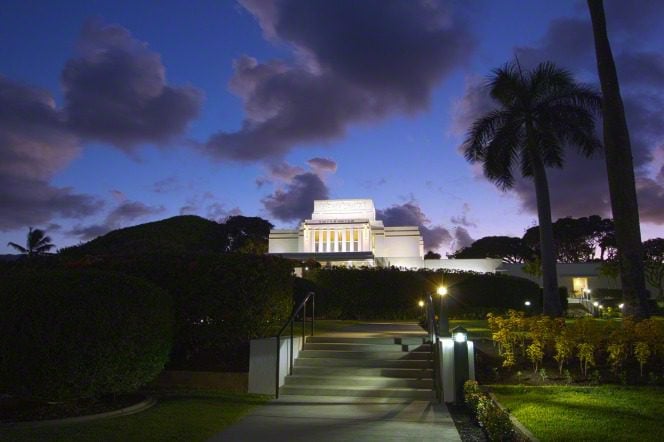
Incidentally, the first Latter-day Saint temple in Hawaii — in Laie, on the northern shore of Oahu — was dedicated in 1919. (It was also the first Latter-day Saint temple constructed outside of Utah.) A second Hawaiian temple, on the Big Island, was dedicated at Kona in January 2000. It is currently closed for extensive renovation and expansion. A third temple, in Kahului, on Maui, is in the planning stages. And a fourth Hawaiian temple, the second on the populous island of Oahu, has been announced for the city of Honolulu itself.
The work of the redemption of the dead is well underway in those beautiful islands. The Spirit of Elijah will soon be active there as never before.











 Ad-Free & Subscriber Log-In