

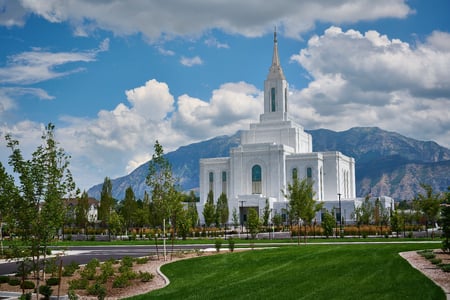
This weekend was our stake conference. It was a big one, too: Our long-time stake presidency was released and a new presidency was announced. Our visiting authorities were Elder Michael Cziesla, a General Authority Seventy from Germany, and Elder Helton C. Vecchi, an Area Seventy originally from Brazil. Once again, I was struck by the increasing internationalism of the Church of Jesus Christ of Latter-day Saints. When I was younger, a Utah stake conference presided over — and a new Utah stake presidency selected — by a German and a Brazilian would have seemed fantastical. (I still recall the dedication of the Meridian Idaho Temple back in November 2017 by President Dieter F. Uchtdorf [from Germany], who was accompanied for the assignment by, among others, Bishop Gérald Caussé [of France, then the Presiding Bishop of the Church and now a member of the Quorum of the Twelve]; Elder Ulisses Soares [from Brazil, then of the Presidency of the Seventy but now a member of the Twelve; and Elder Edward Dube of the Seventy [from Zimbabwe]).
It was a very good stake conference. I’ll mention a couple of highlights:
During the Saturday evening session, a woman spoke who had been out of the Church for fully twenty-five years, a quarter of a century. Her life was filled with adversity, suffering, depression, and failed relationships. One of the factors that brought her back was the Book of Mormon. Challenged to read it, she has fallen in love with it — reading it five times through during the past year. I was struck by the contrast between her view of the Book of Mormon and a characterization of it that I also encountered on Saturday, from a sneeringly derisive critic, as “a rancid slice of baloney . . . a butchered, crappy, incoherent narrative.”
And I was pleased to hear Elder Cziesla quote during this morning’s session what has, over the past two or three years, become one of my very favorite scriptural passages:
And moreover, I would desire that ye should consider on the blessed and happy state of those that keep the commandments of God. For behold, they are blessed in all things, both temporal and spiritual; and if they hold out faithful to the end they are received into heaven, that thereby they may dwell with God in a state of never-ending happiness. O remember, remember that these things are true; for the Lord God hath spoken it. (Mosiah 2:41)
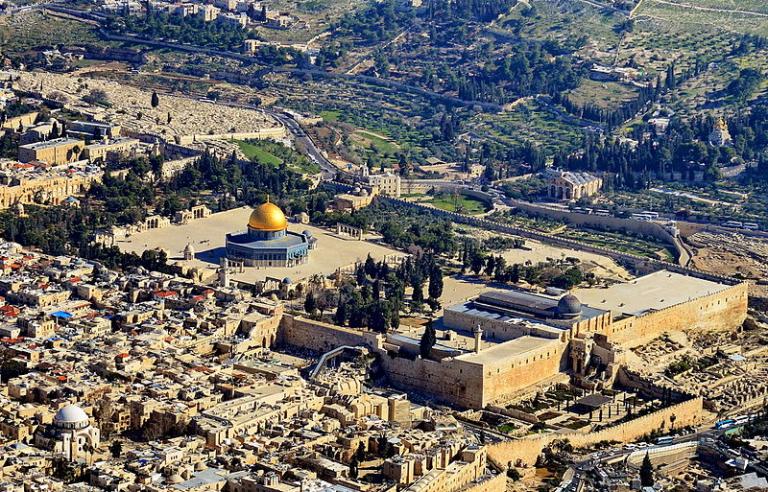
The Church of All Nations and the Garden of Gethsemane can be seen in the background.
On a sunny afternoon nearly fifty years ago — before my marriage, during my first residence in Jerusalem — I found myself seated in the traditional Garden of Gethsemane. I was there by myself, as I recall, reading in the scriptures and looking westward up at the massive sixteenth-century city walls built by the Ottoman sultan Suleiman the Magnificent, toward the Temple Mount and the Dome of the Rock.
Suddenly, I saw a long column of powerful Israeli military trucks heading slowly from the north to the south along either the Ophel Road or the Jericho Road. (I no longer quite remember which it was.) They were pulling massive trailers, each one carrying a huge Israeli tank.
Now, I want it to be unmistakably clear that I’m not trying to make a political point here. Especially for an Arabist, I’m actually fairly sympathetic to Israel (though not uncritically so), and I’m completely opposed to the soft anti-Semitism that has lately cropped up in certain sectors of what used to be called the American conservative movement, which rail against Israel, claim to see evil Israeli conspiracies behind the war against Iran (to say nothing of the assassination of Charlie Kirk), and, in some places that I’ve observed, are overtly anti-Jewish.
Still, it hit me powerfully that afternoon in the Kidron Valley, at the foot of the Mount of Olives, where Latter-day Saints believe that Jesus began working out his atonement for the sins and sorrows of humankind, how those armored military vehicles, engines of deliberate death and destruction, illustrated with painful clarity our desperate need for an atoning Redeemer.
What a mess we humans have made of this world!
In the premortal realm, according to Latter-day Saint belief, we all knew and worshipped God as our Eternal Father and accepted his plan, the divine plan of happiness by which his children could obtain a physical body and gain earthly experience. The goal was, and is, to progress toward perfection and, ultimately, to realize our divine destiny as heirs of eternal life. As William Wordsworth put it,
Our birth is but a sleep and a forgetting:The Soul that rises with us, our life’s Star,Hath had elsewhere its setting,And cometh from afar:Not in entire forgetfulness,And not in utter nakedness,But trailing clouds of glory do we comeFrom God, who is our home.
Yes, we came into this world to be tried and tested and to gain experience by confronting pain, loss, temptations, and trials. But we came “trailing clouds of glory” from our home with loving heavenly parents. We are the ones who passed the test of our First Estate. And yet look at what we’ve made of this world! We cheat and and defame and injure and hate and kill each other. We’ve made our world into a place that is too often reminiscent of William Golding’s horrific 1954 novel, Lord of the Flies.
I think, yet again, of A. E. Housman’s “Easter Hymn,” which was left among his unpublished poems at his death in 1936. I quote it every year in the days leading up to the anniversary of Christ’s resurrection, but it’s also sadly relevant to my thoughts here today:
If in that Syrian garden, ages slain,
You sleep, and know not you are dead in vain,
Nor even in dreams behold how dark and bright
Ascends in smoke and fire by day and night
The hate you died to quench and could but fan,
Sleep well and see no morning, son of man.But if, the grave rent and the stone rolled by,
At the right hand of majesty on high
You sit, and sitting so remember yet
Your tears, your agony and bloody sweat,
Your cross and passion and the life you gave,
Bow hither out of heaven and see and save.
Along with being a fine English poet, Housman was an eminent classicist who was affiliated with the University of Cambridge. That explains his reference to a “Syrian garden”: In classical times, the term Syria often referred to the area that is covered today by the modern nation-states of Israel, Jordan, and Lebanon, as well as Syria itself.
What led me to this reminiscence is a heartbreaking story related in one of the recent comments posted to this blog by a commenter who calls himself “Axel Being Civil.” I know nothing of the story beyond his telling of it, but I find it sadly plausible and I have no reason to doubt it. Political views are ultimately irrelevant here; it’s tragic:
There’s a man in Syria by the name of Hamad al-Jalib. On Wednesday of last week, he was working as a conceirge in Ain Mreisseh, in Beirut, Lebanon. That was the day a series of airstrikes hit the city, killing hundreds of people. al-Jalib was, at the time, off picking up fuel canisters for the building. It is the only reason he survived. His wife, his 12-year-old daughter, and his 13-, 14-, and 17-year-old sons, along with his pregnant daughter-in-law and three other relatives were all killed in the bombing. He has another daughter, just ten years old, who has as of now not yet been located, alive or dead.
Come what may, he has to live the rest of his life without them. The pain is unimaginable. The loss… Unthinkable. I can scarcely imagine what it is like to just… Be left with that absence. To have had people around you that you love and care about, who mean the world to you, whom you get up for each day, who give you the strength to get through your struggles, and then to just… Not.
We need a Savior. We’ve made a thorough mess of things by ourselves,












 Ad-Free & Subscriber Log-In