

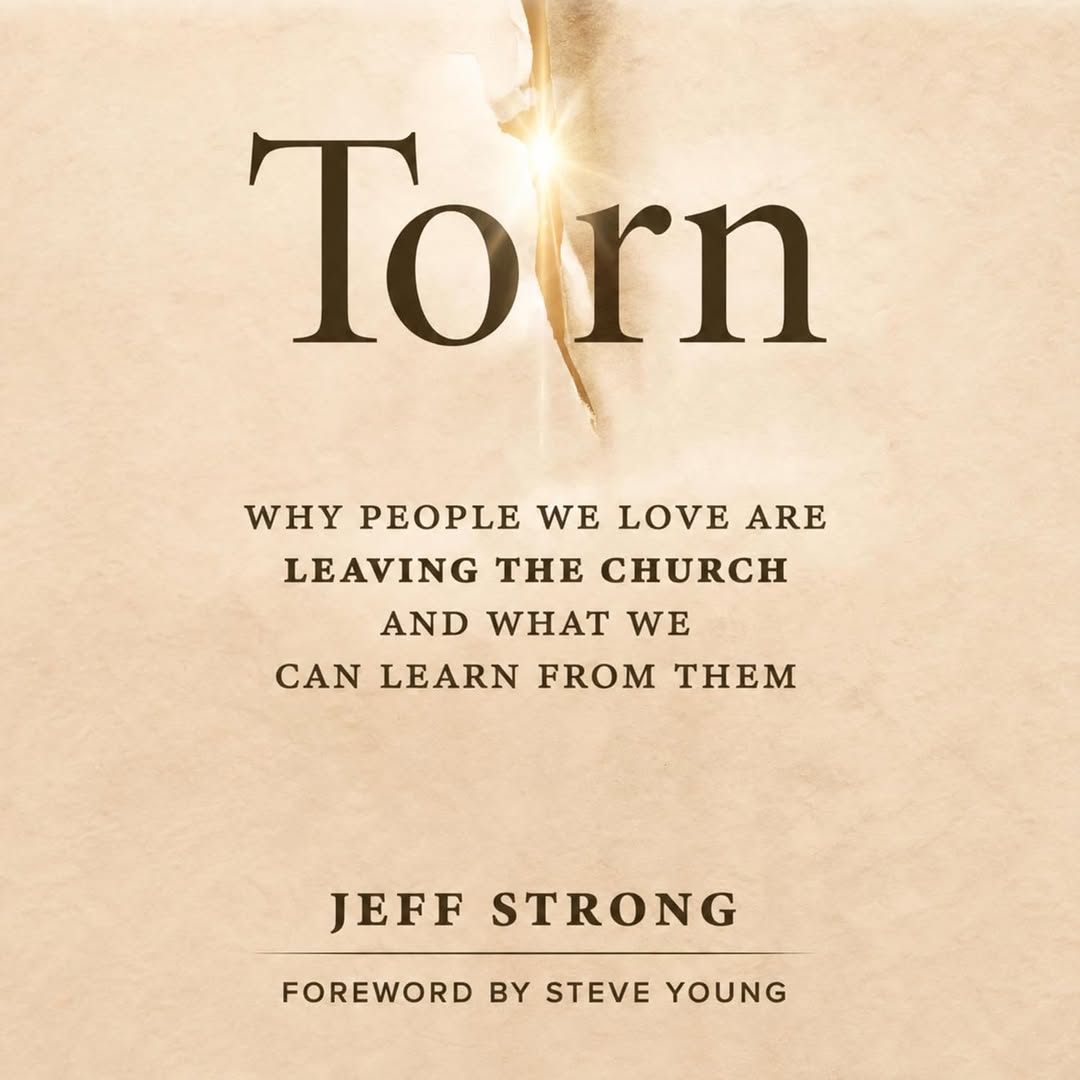
Torn Between the Restoration and the Gospel of Relativistic Empathy
Jeff Strong’s Torn is gaining massive attention in LDS circles, starting with strong promotion from the Faith Matters organization, which has always shared the book’s aim to soften the moral demands of Christian faith in order to accommodate a late-modern sensibility of relativistic acceptance.I will be analyzing this book in more detail, together with Brother Strong’s appearances in Faith Matters videos. But for now it is sufficient to consider with just a little critical attention the Foreword to the book provided by football-great-turned-LDS-progressive Steve Young. Young’s touting of Strong’s argument makes perfect sense, since Torn flows perfectly into the channels of thought already prepared by Young’s The Law of Love. Young’s foreword tells us all we need to know about the direction and implications of Strong’s project. And it is definitely a project, an attempt to shape our understanding of the Restored Gospel in order to reduce its necessary tension with the idol of extreme individualism that rules the present age. To avoid being “torn,” Young and Strong would have us be . . . soft.Young’s (and Strong’s) premise is that we must consider those leaving the church to be in the right so that we can learn from them. Any consideration of the possibility that dissidents might be in the wrong and not always necessarily the best judges of their own choices is dismissed at the outset. The dissident or estranged is always perfectly innocent and even wise. Meanwhile, any members who would question the soundness or the rightness of decisions to leave are quickly classified as “country club” false-Christians who are obsessed with “gate-keeping.” Any attempt to understand falling away that fails absolutely to respect the “unique journey” of every individual is dismissed as “transactional” thinking, that is, to a style of belief that links eternal rewards with obedience to law, to meaningful standards of moral agency, and to eternal standards of exalted character.All concern for such standards and rewards dependent upon individual qualification is rejected as “fear-based thinking.”We are told that “the data” (self-selected survey results) prove that sin or laziness (including, I would add, unhealthy attachment to worldly goals and ideologies) cannot be significant factors in the abandonment of covenants, since of course these are not the kinds of reasons self-reported by those who apostatize or fall away. All “guardrails for others’ growth” (or for one’s own) are ridiculed as “living by checklists and merit-badge theology.” All we need is “love” — a love divorced from accountability and concrete factors of moral and spiritual growth. The Beatles weren’t wrong, for Young, and for Strong: All We Need is Love. “No Agenda, no expectations, no transactions.”Or course these analysts of our “torn” condition are right to remind us of the need to love and to listen to those for whom Church affiliation and practice has become uncomfortable or intolerable. But true Christian love must never be divorced from virtue and accountability. If that statement makes me a “transactional country-club Christian” in the eyes of our new reformers, then so be it. I will not be “torn” between the gospel’s beautiful vision of redemption and exaltation and the relativistic empathy that now passes for “love.”(I posted this yesterday on X, and it’s received a lot of attention. I need to learn to cross-post simultaneously to X & Facebook.)
So that I’m not misunderstood — though, realistically, not being misunderstood is an Impossible Dream for me, since I’m obsessively monitored and critiqued by a small and anonymous online cabal for whom misunderstanding me daily appears to be a duty modeled on George Orwell’s Two Minutes Hate — I want to state, explicitly, that I believe that we should listen carefully to those who leave the Church, and that we should treat them kindly and with charity. Each case of disaffiliating from the Church and Kingdom of God, each loss of faith and trust, each abandonment of solemn covenants is a tragedy. The heavens weep over them, and so should we. The ramifications extend forward into the eternities as well as into the indefinite future here in mortality.
So I’m sympathetic to the project that has apparently been undertaken by Jeff Strong and Steve Young — but I’m also worried by the concerns expressed by Brothers Hancock and Ellsworth. The dangers of both the Scylla of judgmental rigidity and the Charybdis of relativistic assimilationist are real, and serious.

Deseret News: “Sens. Lee and Curtis question new Pentagon designation for Latter-day Saints: Curtis said he would ask the Pentagon for a correction after the subhead ‘Christian’ was left off of the designation for the church” Some have been crowing about this decision from Pete Hegseth and the Department of Defense. I can’t say that it really surprises me, stupid and offensive though it is.

Posted from Twin Falls, Idaho














 Ad-Free & Subscriber Log-In