

The Institute for Family Studies and the Wheatley Institute released the groundbreaking survey by Jean M. Twenge, Jenet Erickson, Wendy Wang, and Brad Wilcox called “In Pursuit: Marriage, Motherhood, and Women’s Well-Being.” You can read the survey’s summary findings here: In Pursuit: Marriage, Motherhood, and Women’s Well-Being. I shared initial thoughts about the survey here: Married Mothers Are Happiest a New Study Concludes
The survey found that more married women with children report being ‘very happy’ than any other participant group. Unmarried women with children were the next happiest group. Married without children were next, and unmarried women without children reported being ‘very happy’ at the lowest percentage.
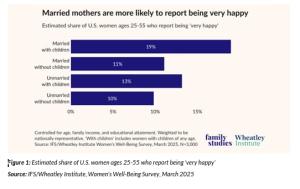
Married women are also more likely than unmarried women to say that life is enjoyable most or all of the time: 47% of married mothers and 43% of married childless women say life is enjoyable, compared to 40% of unmarried mothers and 34% of unmarried childless women.
An Interview with Jenet Erickson

I had the incredible honor to chat with Jenet Erickson about the study’s findings and her perspective on motherhood’s influence on women’s well-being. Jenet is an adjunct professor in the School of Family Life at Brigham Young University and Research Fellow of the Wheatley Institute. Her contribution to her field includes numerous publications and speaking engagements. I was grateful for our Zoom interview.
My lens into the survey is as a married woman without children (the 3rd ‘very happy’ group), so I asked Jenet Erickson to describe some of her findings in ways I could understand. And she did.
The study opposed societal expectations that unmarried women without children are happiest. We started there.
What do you feel is the gain or benefit for society to say that unmarried, childless women are happiest?
Jenet Erickson: I don’t know how society benefits from that because really everything points to the fact that these strong core relationships—marriage and children, commitment, devotion—are really the foundation of society. We just can’t deny that that matters. But I think what’s happened is this strong decades-long, maybe even centuries-long, orientation to individualism that then kind of rewired things because you no longer have to marry for economic purposes.
You don’t have to have children for economic purposes. And so that is not the framework in which people are making that decision anymore. And with an individualistic orientation that would say really the essence of life is me as an autonomous person, being able to choose for myself what I want, when I want it, how I want to see it. I’m the authority of truth. That’s our zeitgeist in the current day.
And then you have social media. I would say it’s interesting that when I was a student at the University of Minnesota, teaching in my PhD program, very few women identified as feminist. But something happened in 2014, 2017, that we saw this uptick in our young adult women as feminists, and I think it’s all happening together.
You have men not as marriageable, especially our working-class men. Women are achieving at higher rates educationally and are able to buy houses. And we have this group of men not working, not achieving education. And so there’s a sense that men are not marriageable. So women decide to go it alone.
Social media gives people this picture of the good life, a very concrete picture of the good life. So now women say, “I want this and I want that.” Where in the past, you didn’t have those images. You had a sense of what a good life looked like, but you didn’t have this concrete picture that you thought defined it. And so social media is distorting what leads to happiness in a very real way.
So the imaging of the good life, along with the individualism, along with this kind of withdrawal of men and less marriage—a drop of 60% in the marriage rate—then I think you have this combination to think that life is better without marriage and children.
47 % of married women with children reported being “very happy.” Were you surprised by that percentage? Was it low to you? Was it high to you?
Jenet Erickson: When we first released this study, someone responded and said, “Wow, it looks like so many people are not happy.” And we had to clarify that this is the “very happy.” But even when you include the “somewhat happy,” it’s married mothers and mothers who are unmarried who are more likely to be “somewhat happy” and “very happy” than are unmarried women, which is so interesting.
I don’t know that I was surprised by the “very happy” when you include the “somewhat happy,” but it does seem to suggest that marriage and motherhood launch people into a greater likelihood of “very happy.” It’s a different experience than just being pretty happy with things being OK, satisfied. It’s a different level, I think, of well-being.

Would you say that the same proportion of married mothers around you personally would say they’re “very happy?”
Jenet Erickson: I think so.
There’s this interesting discrepancy because you have women talking about how hard motherhood is, and it is exhausting. And our study found that no one is saying what’s really happening with meaning and purpose. That is completely different than what’s happening in the career world.
The world says the good life is free of the loss of personal space. It’s free of the exhaustion. It’s free of the needing to get up over and over again to care for someone else. It’s free of those things that feel difficult to us.
And in our current image world, it can completely obscure the whole thing that comes with marriage and family, which is I matter to these people so much in a way that nothing else can create—I am needed. And I have purpose. And I have meaning and an experience of connection and belonging that is actually hard to come by in our current world.
In the study, you use the word “meaning” as a word that women associate with motherhood. And is that the way that you envisioned that definition—of giving and caring for other people who relying on you, and finding purpose and joy through that? What do you think “meaning” meant to most of those surveyed?
Jenet Erickson: We need to do qualitative interviews to get at how they would describe it. But someone recently has. We have that Catherine Pakaluk, Hannah’s Children—that’s in-depth questioning interviews of women who have five or more children—and they’re clearly different in the culture, right?
But I think what is so powerful is in the language of these women, you hear them describe the experience of transcendence that is inherent in having another life—they don’t use big academic words, but they talk about how motherhood takes them to a different level of experience: I matter to know and love at that level, to be that able to witness another’s life, and have them know and love you, to literally be an infant’s entire world.
That is what a mother is. She is their entire world. There is not a world outside of her. And to be that with all the burden that is is profoundly meaningful.

And I think that’s why our unmarried mothers are “very happy.” This is the group we’ve been so worried about, the mothers who are unmarried, that are doing it alone, and they are struggling. And yet in terms of their sense of meaning and even enjoyment, they’re higher in purposefulness. They’re way higher than single women and married women without children. So children are clearly doing something to the experience of meaning and purposefulness.
A lot of my friends and family members are reaching that empty-nest stage and are looking for purpose and meaning. When I read your survey, I started thinking about those women. Maybe the reason they’re searching is because suddenly they don’t have that symbiotic relationship with a child at home who is depending on them for everything. Did you find the older women with children are finding a new purposeful version of themselves after their children leave home?
Jenet Erickson: I don’t think there’s any way there can’t be a transition in that intensive mothering experience because I think wise people would say it’s important that your sources of identity are varied.
As a mother, that’s an important identity, but also as a contributor in your community and also as a sibling to other people. That’s actually easier when you transition out of having children in the home if you have those multiple kind of experiences of identity than if it’s only motherhood that’s defining.
But having said that, it’s so defining in a sense that I don’t think that there is a transition in the day-to-day sense of caring and being needed. That’s a psychological experience in growing. And I think identity is being formed all across our lives, right? Changing and being formed that way.
We don’t talk enough about adult development that way. There’s identity going on all the time for us, but it’s just to say motherhood’s a significant source of identity. And motherhood brings purpose at a time when people are experiencing a crisis in meaning and identity.
I was really interested in your groundbreaking study about physical touch, well-being, and happiness. Why do you think that physical affection is such a major driver of women’s happiness? Why does it matter so much to our well-being? And does it matter who does the touching?
Jenet Erickson: So first, it seems like we are in a time of literal touch hunger because the disconnection physically from other human beings—if you have a drop in the marriage rate of 60%—we have new data about increased sexlessness among couples. People are having much less sex, but even married couples are having much less sex than they were in the past.
And so it does seem like we’re at a time that is pushing people away from physical touch. And if we looked at just development from infancy, you cannot develop as a human being outside of relationship. You can’t develop in healthy ways.
The brain actually depends upon attachment in order for those wirings to to be stabilized in healthy ways, to grow in healthy ways. And so that relationship itself is grounded in touch. So it’s eye to eye, body to body. It’s breast to mouth. It’s all grounded in touch, and I think that’s because we are embodied.
But our tech world creates so much experience that detaches us from the body, because you’re connecting via the Internet, you’re connecting with that AI.
A student was just saying it’s much easier for her little brother to talk to his AI bot than to his friends at school. And this AI bot will always listen to him and all of that, right? But we can see even from the AI data, even when people are connecting, it actually isn’t giving them what they need. So they’re more depressed than before, or it creates an emptiness.
And I think it’s because it’s not embodied. It’s why Jonathan Haidt would say you have to have embodied synchronous interactions for human development to happen because we actually are embodied.
And so I do think our world just pushes away from physical touch like the embodiment experience, but we desperately need it. And it’s why touch is going to increasingly be linked to happiness, because there’s so much less of it in a sense. So physical touch is going to be a growing distinguisher in well-being, I think.
As you’re saying that, I’m just even thinking about the importance of ministering to the one. There are so many things that we’re taught in our principles and doctrines of the church that help battle this. And even as a member of Relief Society—and I’ve seen the same pattern over the years—women need a chance to talk, and speak, and a voice, and someone to listen with open arms. So it’s fascinating to think of this in the Gospel context.
Jenet Erickson: Yes, yes.
With knowing all of this information about how we rely on touch, I would love to know your thoughts about why it is so important that we have Heavenly Parents who are resurrected. Does their embodiment matter to our psyche? Do you see that influencing our progression?
Jenet Erickson: We have the most radically pro-body, pro-sexual intimacy theology anywhere in the world, and we see Eve as a glorious Mother Eve for choosing the embodiment of all of us and making that possible. And so it does feel like we have this untapped truth—that if at any time in history it was needed is right now—to say that in our progression, we had to have a body in order to continue to grow.
As we learn in the Doctrine and Covenants 93, the body and the spirit united eternally are fundamental to joy. So that should tell us the pleasure of the body within bounds, the experience of touch, this physical reality is divine and eternal. To hug another person, and feel them, and feel their breath, this brings pleasure to us, and joy to us is eternal. And I just think we have this incredible theology about the body, unlike any other faith.
And so we need to tap into valuing it more, right?
Just sexual intimacy within marriage being fundamental, our touch of children, and contact with one another.
The research shows that holding the hand of a spouse is what’s linked to decreased stress, increased oxytocin, and increased sense of well-being. So it does matter who it is that’s touching you.
And I know that mothers are in this really interesting space where there’s nothing quite so beautiful as the smell of this baby and snuggling with this baby. But then they’re two years old, and they’re putting their nose all over you and Cheerios, and all of a sudden there’s that discomfort part where there isn’t a personal space boundary. And so I think it all kind of comes together.

But in the mourning of women, there’s this hunger to be within that embodied connection.
And I think that is eternity. We will have the eternal experience of God the Father and God the Mother, His eternal embodiment, and bringing to pass the embodiment of others spiritually and then physically.
I read your study and then attended the temple thinking about how even in that enactment—whether someone thinks it’s metaphorical or literal—we see the Father touching and reaching for and embracing us as we go through that endowment journey. Noticing that Divine touch as part of relationship and joy was such a beautiful connection that I hadn’t thought about so deeply before. So thank you.
Jenet Erickson: Yes, yes, yes.
That is so beautiful because the temple is filled with actual experience of touch, right? And that He and the scriptures are filled with embrace. There’s so much reference to the physical experience of being held, and loved, and cared for. So yeah, beautiful.
I could picture Michelangelo’s Sistine Chapel, right? That image of God and the touch. That’s what makes it so exquisitely beautiful, because they were just coming to understand the body in that Renaissance valuing of the human. And so you see not a distant God, but a touching body-to-body God. And that I think that’s what makes it so compelling for us.
What is the question that you wish people who talked to you about your study would ask you?
Jenet Erickson: It feels like many people wonder how this message became so different than the cultural message about relationships and mothering. All of that is so different than what we’re seeing in the research, and there’s a lot to unpack with that. I think that we have. But I think what we’re all trying to figure out is how can it be so stretching and difficult and uncomfortable and at the same time so deeply meaningful and deeply enjoyment?
And what’s that?
So I think that interesting book, The Sweet Spot where he writes about how as humans, we think the whole objective is just pleasure and a pain-free life. But in fact, humans are always pursuing things that actually are uncomfortable because of deep meaning, whether it’s running a marathon, or hiking a difficult mountain, or fasting, or these kinds of things that human beings do because it’s like breaking through the mortal self that just wants pleasure.
When we break through it, we find the transcendent. And that’s what marriage and children offer. It pulls us way outside ourselves into the meaning and connection with another soul at levels that are different than other human experiences.
How do we reconcile the fact that this is uncomfortable, and my image on Instagram or whatever seems different than this body and sweats helping care for another spit up? And why is that so fundamental that the two go together, that the sacrifice of it and the joy are all bound up together? And it’s about life—valuing life.

I’ve thought about your own personal journey through this interview. I have listened to you speak about how you married a little bit later, you experienced infertility issues, and you have two children now. Could you speak about how you saw yourself in the study?
Jenet Erickson: That’s kind of you to ask that. Because I think when I became a mother, I had all these dreams about how wonderful I was going to be. I just thought I’d waited a long time, and I felt like “I’m not good at this.”
I get too anxious. And I’m too intense. And sometimes there was pain about my failure to better enjoy and better love. And I think that persisted for some years. I talk about the meaning and power of motherhood, but I am struggling to find the joy that I know is inherent to it.
And this is what I can say this many years into it: I do think people are different in the way they can tap into that joy that’s there along the way, but the depth of meaning of it, to think that these precious children who I try to love and fail at doing, and yet we’re bound together and see one another and know one another on our journeys of learning—my journey of learning and their journey of learning.
And my husband, right? The ups and downs, the joy and meaning, and also the weight, right? I didn’t know this was you, and now I know this is you. And there’s learning in that. And just how do you even describe its meaning in your life?
So, I’ll tell my students about this talented writer for The Washington Post.
People would say she knew everything better than anyone else about what was going on inside the Beltway in the DC, like the politics, all of that. She was a very skilled journalist. She gets diagnosed with terminal cancer, and the last post that she writes is not about anything going on in the political world there. It’s about her two children. She’d helped them get ready for Halloween.
And what you hear in it is like she faced that moment of learning what really is the essence in your life. And it just boils down to these core relationships. That’s what it boils down to. This is what you want around as you’re passing away.
This is where everything—and that means the failure and the difficulty, and the pain of it, and the not having loved better, and also the love and the joy and the memories, and all of it. It’s all bound up together in this story of unparalleled meaning.
And I think that’s what God is. That’s what they do. And they’re inviting us into that experience.
















 Ad-Free & Subscriber Log-In