

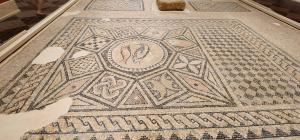
During the winter of 2024, an ad from the Museum of the Bible crossed my Facebook feed. It described the Megiddo Mosaic on display in Washington, D.C. I immediately clicked on the ad to learn more. I read about how this mosaic floor, found in Megiddo and dated to 230 AD, represented the oldest archaeologically discovered floor in Christianity and the first evidence of Jesus being called God. The tiny tesserae created exquisite designs, symbols I recognized from my worship of Jesus Christ.
I am a tactile experiencer. I mean this blog is called My Tesserae for a reason. While I delight in symbols and abstract thought, experiencing both tangibly is my favorite form of discovery. Jesus lived in Jerusalem? I went to Jerusalem as soon as I could to engage all of my senses in discovery and worship. My faith’s eyes are wide open, eager, and curious.
I talked to a dear friend I met in Arabic class at Brigham Young University to see if she’d like to join me for a quick weekend trip to see the mosaic. She did! We talked about coordinating with some of our other friends from class for a girls’ trip. The Megiddo Mosaic expedition would be at the Museum of the Bible until July 2025.
And then our house caught on fire, all plans changed, and my life revolved around the minimal basics and getting our lives back to normal. July 2025 came and went. I really felt bummed to miss the exhibit, but knew what my priorities had to be at the time.
Fast forward to March 2026.
I’d been assigned to host a Saturday speedpuzzling tournament at George Mason University in Fairfax, Virginia—what a super fun and engaging part-time job. As I planned my itinerary, I mused that I wished it had been before the Megiddo Mosaic exhibit left Washington in July 2025 and then didn’t think of it again.
On Sunday night, after dropping my coworker off at the Dulles Airport and walking along the Potomac River, I plopped on the hotel bed, ready for sleep and a calm Monday morning before heading to Dulles myself.
Suddenly, the mosaic popped to mind again. Just look. What? Just look, the prompting persisted. I googled.
Stunned, I read that the exhibit was STILL available and for free! I learned later when I asked a docent that the museum moved the exhibit from the exhibit floor to a space on the museum’s main floor, where it remains until December 31, 2026.
Stunned, I sat straight up on my bed. I searched the museum’s location and parking situation. The museum recommended parking lots and using public transportation. I had a rental car, but didn’t feel good about using it for driving into D.C. for a personal quest. The bus and metro trip from my hotel was two hours one way. I didn’t know if I had four hours in me. What if something happened?
I talked to Anthony about it because I was still so surprised the exhibit was still available! But exhaustion hit, and I had other part-time jobs to work on. The four-hour ride seriously deterred me. I read everything on the website and decided it was okay to not go.
During the night, I awoke with different thoughts and memories—
how excited I felt to learn about the mosaic, how I’d prayed with excitement to see it in person, how my boss assigned me to that location, how it was a gift from God.
All of those logistics were a gift from God…for me…because I wanted to see an ancient floor and had talked to the Lord about it in delighted anticipation.
Check the metro line. Skip the bus, just look at the metro.
The metro stop was two miles from my hotel! This route was direct and only 40 minutes!
Work will always be there for you to do. This will not.
I packed quickly, checked out of the hotel, and drove to the metro, arriving 10 minutes before it left the station. The metro stanchions took a credit card, so I didn’t need to find a ticket booth or ticket vending machine, and easily found the escalator to the platform. As I boarded the subway, I called Anthony. He laughed at my excitement and wished me a good journey.
The Museum of the Bible
As I exited the metro station, I realized that the Museum of the Bible was on the same city block; I just needed to walk around to the other side for the entrance! How easy! A five-minute walk found me at the entrance.
The museum employees were seriously the most cheerful and helpful folks I’ve ever seen at a public place like that. They added to my joy and added their enthusiasm for my enthusiasm to my enthusiasm. What a fun moment.
A few families were in the space as I entered. But after a few minutes, I found myself alone in the exhibit until joined by someone as I prepared to leave.
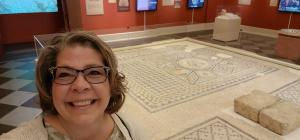
So in this bustling museum, I had 30 minutes at the Megiddo Mosaic alone. It was a gift.
Ancient Music
In an instant, I knew why I needed to see the exhibit in person. Along with the floor, archeologists found papyrus with musical notations. They recreated the music, and it played in the exhibit. I walked into the room, and the music stopped me. It felt ethereal, ancient, holy. It moved me. I’ve since searched for the music online to no avail.
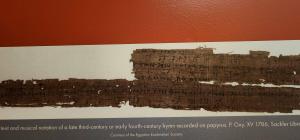
With the music on repeat, I eagerly turned to explore the exhibit. In the relative stillness, impressions came, answering a few questions I’ve had on a shelf. When those flashes of insight come, the answers are so obvious. I’m grateful for a Lord who answers my questions.
From the Megiddo Mosaic Exhibit
The Megiddo Mosaic Inscriptions
Worship to “God Jesus Christ”
Journey back in time 1,800 years ago to the land of Israel during the Roman Empire. Discover the story of faith that united a Roman centurion, an artist, and five women, inspiring them to create a spectacular mosaic floor and provide a table for worship dedicated to “God Jesus Christ.” This dedication is now the earliest archaeological evidence of Jesus being called God.
Gaianus, Roman centurion
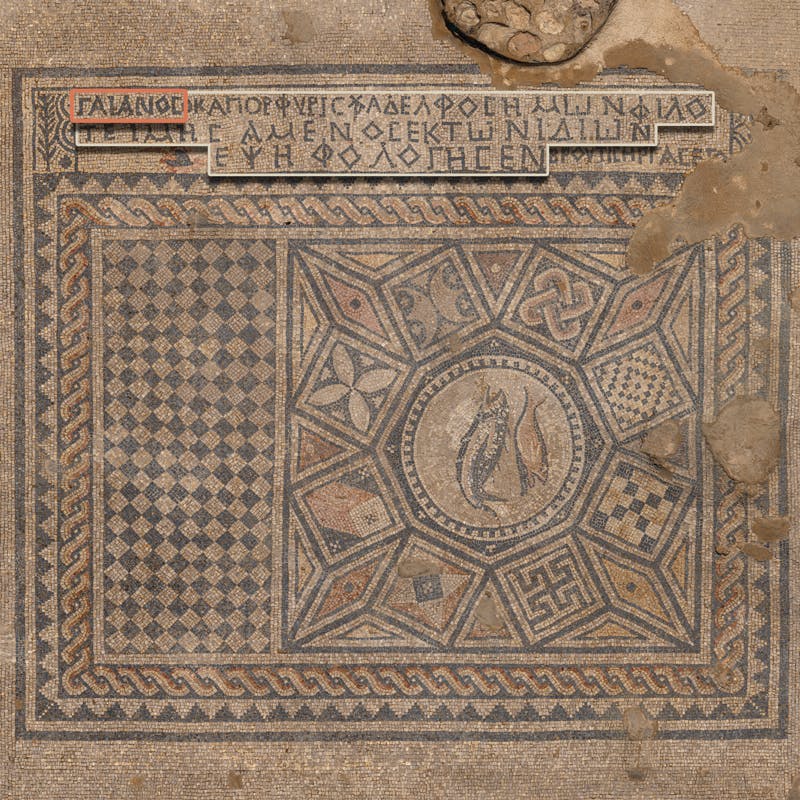
“Gaianus, also called Porphyrius, centurion, our brother, has made the mosaic at his own expense as an act of generosity.”
Gaianus is a Latin name, but his colloquial name, Porphyrius, is Greek. This could indicate that he came from one of the eastern provinces. The fact that he did not use his full Roman name may also indicate that Gaianus dedicated this mosaic in a personal, rather than an official, capacity. While “brother” is the common way Christians have always referred to each other, it is not certain that Gaianus was a Christian.
In this artistic rendition of Gaianus, he holds a vitis, a symbol of his rank as centurion.
Brutius, the mosaic artist
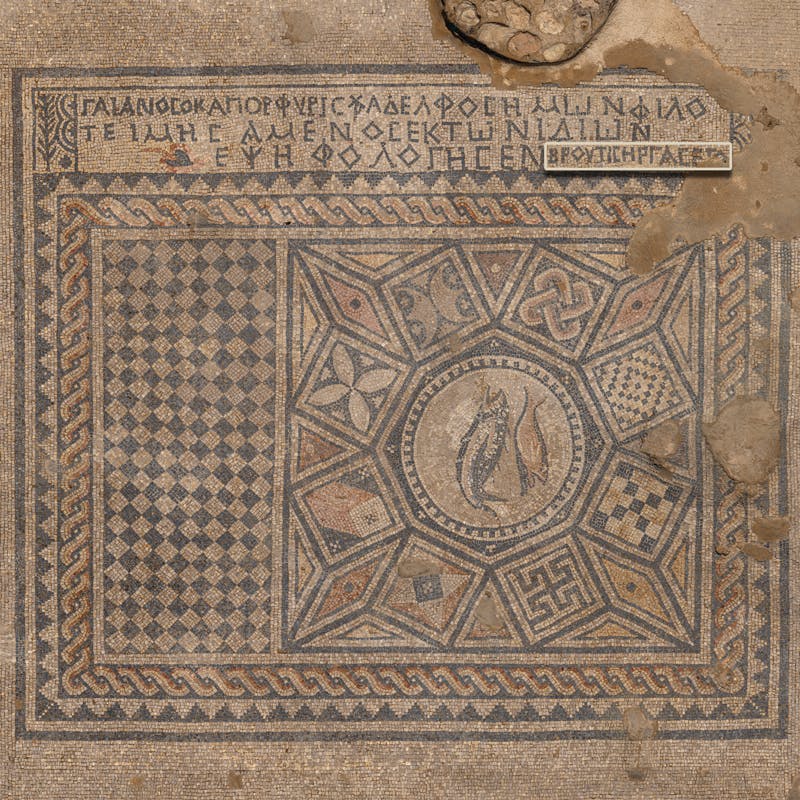
“Brutius has carried out the work.”
The artists who created mosaics were a skilled workforce in the Roman Empire. Despite the practical and decorative value their work brought to Roman structures, only about 100 of them signed their work. The specialized work of mosaicists was often broken into categories. Pavimentarii prepared the ground, which had to be carefully leveled. Pictors often drew the chosen design on the final layer of plaster. Then, a tessellarius would lay the stone tesserae to create the mosaic. Brutius was likely the tessellarius of the Megiddo Mosaic.
Learn more about the mosaics here.
“The God-loving” Akeptous & “to God Jesus Christ”
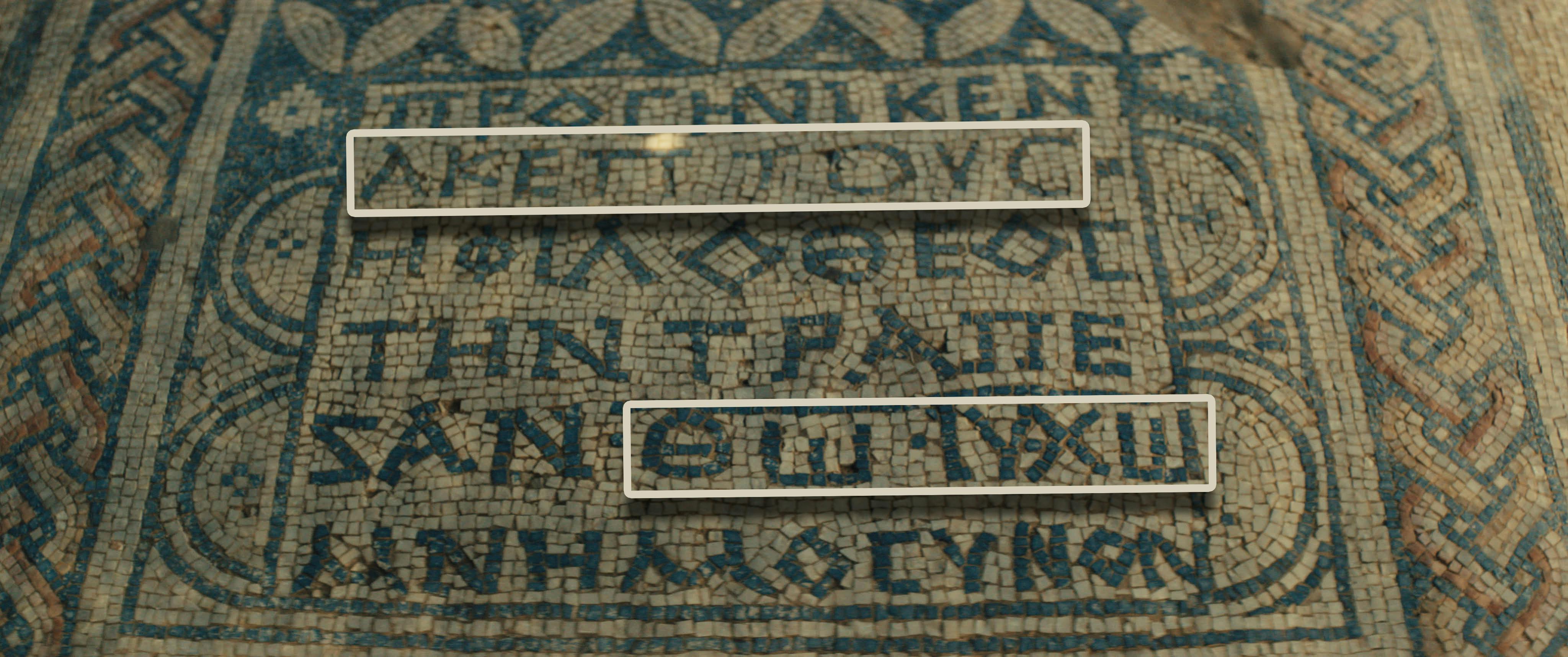
“The god-loving Akeptous has offered the table to God Jesus Christ as a memorial.”
The inscription tells us Akeptous donated the table, the focus of the room. She may have been a woman with financial resources and social standing. She is called philotheos, “God lover.” The table stood at the center of the room and was likely used in the celebration of the Eucharist, or Lord’s Supper. The phrase “to God Jesus Christ” uses abbreviations for each word marked with a line over the top. These abbreviations are known as nomina sacrum.
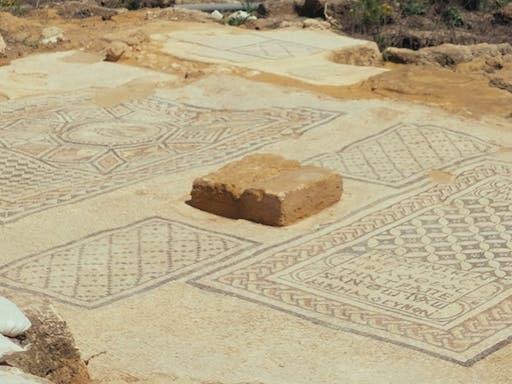
Primilla, Cyriaca, Dorothea, Chreste, women of significance
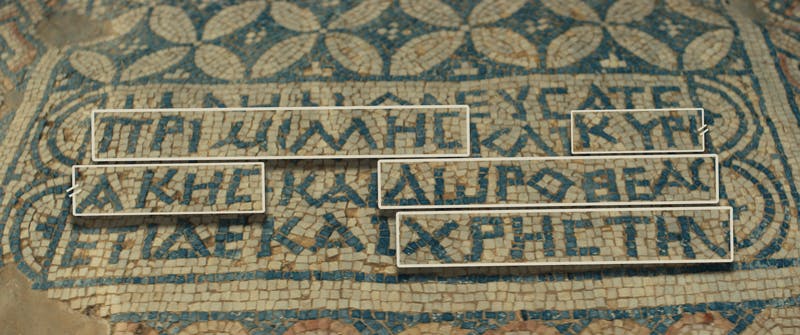
“Remember Primilla and Cyriaca and Dorothea, and lastly, Chreste.”
The wording of this inscription is unusual in that, typically, the request is that God remember individuals. Here, the community itself is called to remember these women. Nothing else is known of the women mentioned here. While they were clearly important to the community, the inscription does not tell us whether they were patrons of the community (like Akeptous), or martyrs, or honored for some other reason.
The Megiddo Mosaic Designs
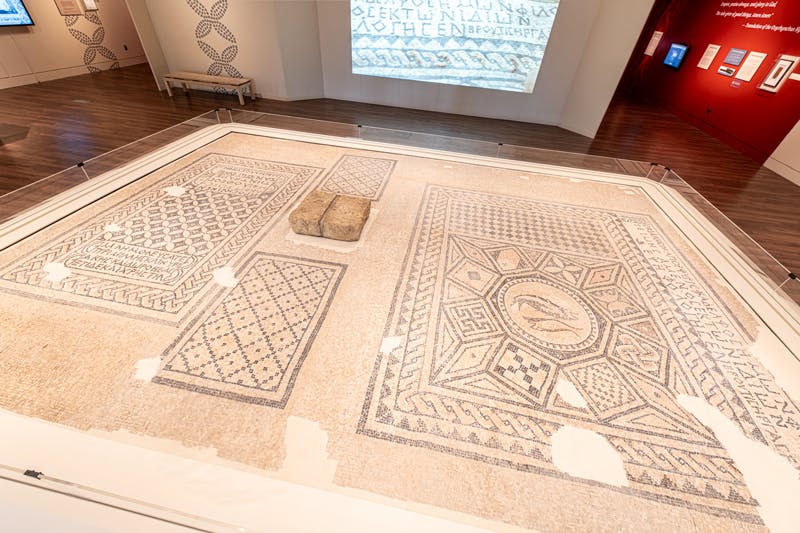
The largest mosaic contains a large design, part of which is centered around a depiction of two fish, and the Gaianus and Brutius inscriptions. The central decoration is the fish medallion (see below) and the surrounding design. The medallion is highlighted by the eight boxes forming an octagon around it, which are further connected by triangles and rhombuses. The entire design is enclosed in a square, again drawing attention to it.
Opposite the mosaic with the fish medallion, on the other side of the table base, is another large mosaic, featuring a guilloche (braided ropes) border and a repeated geometric pattern that separates the two inscriptions on it, the Akeptous and the Women’s inscriptions.
Between the two large mosaics with inscriptions and flanking the other two sides of the table, are two smaller mosaics, each with a repeated diamond pattern.
The four mosaic designs focus all attention on the table at the center, likely used to celebrate the Eucharist, or Lord’s Supper. The inscriptions are also positioned in such a way as to be read by people standing around the table. The geometric shapes and patterns, from the borders to the octagon boxes, convey ideas of eternity, symmetry, and perfection.
The Fish Medallion
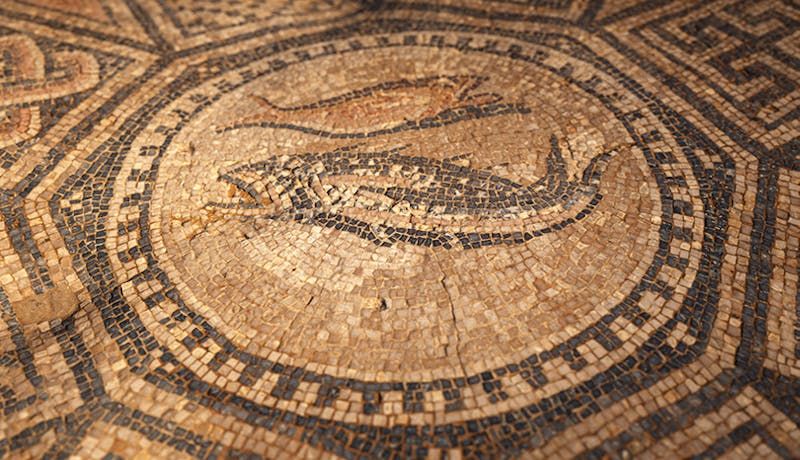
The fish is the earliest symbol of Christianity. It predates the cross, which was not widely used until after the time of Constantine. Why? The Greek word for fish—ΙΧΘΥΣ (ICHTHYS)—is an acronym for “Jesus Christ, God’s Son, Savior.”
• I = Iesous = Jesus
• CH = Christos = Christ
• TH = Theou = God’s
• Y = Yios = Son
• S = Soter = Savior
Often, motifs display two fish, echoing Jesus’s feeding of the 5,000, when two fish were multiplied to feed a crowd as told in Luke 9:16. The two fish here were identified by the archaeologist as a sea bass and a tuna.
Does the Lord know and care about things that matter to me?
Yes! Isn’t that wonderful?
As I viewed that scene and listened to that music after following personal promptings, I rejoiced in more evidence of a relational Lord—who shows up in the details of my life, who rejoices when I rejoice to worship Him, who continually provides evidence of His ancient and modern work…a work that brings about the salvation and exaltation of all who covenantally bind themselves to Him. What a beautiful mosaic of tesserae that is!












 Ad-Free & Subscriber Log-In