


The gospel reading for this Sunday is the “Curing of the Blind Man on the Sabbath.” This Sunday, March 14, 2026, is the Fourth Sunday of Lent. The gospel is from the book of John. Let’s take a look at the readings.
Gospel Text –John 9:1, 6-9, 13-17, 34-38
“As Jesus passed by, he saw a man blind from birth. He spat on the ground and made clay with the saliva, and smeared the clay on his eyes, and said to him, “Go wash in the Pool of Siloam” — which means Sent —. So, he went and washed and came back able to see. His neighbors and those who had seen him earlier as a beggar said, “Isn’t this the one who used to sit and beg?” Some said, “It is, “but others said, “No, he just looks like him.” He said, “I am.”
They brought the one who was once blind to the Pharisees. Now Jesus had made clay and opened his eyes on a sabbath. So, then the Pharisees also asked him how he was able to see. He said to them, “He put clay on my eyes, and I washed, and now I can see.” So, some of the Pharisees said, “This man is not from God, because he does not keep the sabbath.” But others said, “How can a sinful man do such signs?” And there was a division among them. So, they said to the blind man again, “What do you have to say about him, since he opened your eyes?” He said, “He is a prophet.” They answered and said to him, “You were born totally in sin, and are you trying to teach us?” Then they threw him out.
When Jesus heard that they had thrown him out, he found him and said, “Do you believe in the Son of Man?” He answered and said, “Who is he, sir, that I may believe in him?” Jesus said to him, “You have seen him, and the one speaking with you is he.” He said, “I do believe, Lord,” and he worshiped him.”
First Reading –1 Samuel 16:1b, 6-7, 10-13a
God sends Samuel to anoint a new king from Jesse’s sons. Samuel is impressed by the older, stronger sons, but God rejects them. God teaches Samuel with this key line: “Not as man sees does God see; man looks at appearance, but the Lord looks into the heart.” David—the youngest, overlooked shepherd—is chosen and anointed. God’s choices exceed human expectations. He sees potential, faithfulness, and interior truth long before anyone else does.
Responsorial Psalm – Psalm 23: 1-3a, 3b-4, 5, 6
This psalm proclaims God as the Good Shepherd who provides, guides, protects, feeds, and anoints. God pursues us with goodness and mercy. Even when we walk through darkness, God’s presence is the source of confidence and clarity.
Second Reading – Ephesians 5:8-14
Paul reminds believers:
- “You were once darkness, but now you are light in the Lord.”
- Live as children of light—goodness, righteousness, truth.
- “Awake, O sleeper, and arise from the dead, and Christ will give you light.”
Our conversion is illumination. Christ exposes what is hidden and empowers us to live differently.
Gospel Reading – John 9:1, 6-9, 13-17, 34-38
Jesus heals a man who was blind from birth:
- He makes clay, anoints the man’s eyes, and sends him to wash.
- The man gains physical sight—and gradually spiritual sight.
- The Pharisees, though physically seeing, remain spiritually blind.
The healed man ultimately professes faith: “I do believe, Lord,” and he worships Him.
True blindness is not physical but spiritual—refusing to see God’s work. True sight is recognizing Jesus as Lord.
The Catholic View
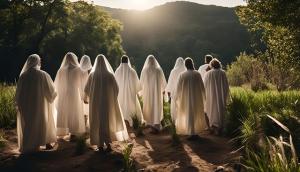
The Word of God invites us to confront a truth we often resist: we do not see as God sees. Our eyes cling to appearances, to what is familiar, to what seems strong or successful. But God looks deeper. God sees the heart. God sees the hidden potential. God sees the person we can become through grace.
We hear this first in the anointing of David. Samuel arrives expecting to find a king among Jesse’s impressive sons—tall, strong, experienced. But God overturns every assumption. “Not as man sees does God see.” The one chosen is the youngest, the overlooked shepherd boy.
Psalm 23 then gives voice to the heart of that divine vision. The Lord is not a distant evaluator but a Shepherd who walks with us.
Saint Paul deepens this truth in Ephesians: “You were once darkness, but now you are light in the Lord.” Notice he does not say we were in darkness—he says we were darkness. And now, through Christ, we are light. This is not a cosmetic change. It is a transformation.
Then the Gospel
Then we come to the Gospel—the healing of the man born blind. Here we see the contrast between human sight and divine sight. The disciples see a theological problem. The neighbors see a curiosity. The Pharisees see a threat. But Jesus sees a person longing for wholeness. He sees a heart ready to receive grace. He sees a story in which God’s works can shine. The man receives physical sight, but, more importantly, spiritual sight. His understanding grows step by step:
- First, “the man called Jesus,”
- Then “a prophet,”
- Then “from God,”
- And finally, “Lord, I believe.”
Meanwhile, those who claim to see remain blind. Their certainty becomes their darkness. Their pride becomes their obstacle. Their refusal to be taught becomes their prison. The God who chose David, the Shepherd who guides us, the Christ who awakens us, and the Lord who heals the blind man is the same God who looks into our hearts today. He sees more in us than we see in ourselves. He sees the goodness He planted, the light He desires to kindle, and the future He is preparing.
Please share your thoughts about this article in the “Comments” section.
Peace
If you like this article, you might enjoy:
The Birthright Citizenship Debate
Operation Epic Fury: A Just War?
SCOTUS Decision on California Parental Notification Law













 Ad-Free & Subscriber Log-In