

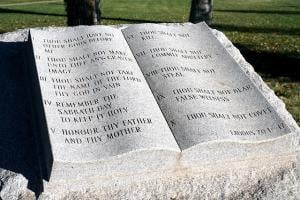
New state laws in Louisiana, Texas, and Georgia require public‑school classrooms to post the Ten Commandments, and federal courts keep blocking those mandates as unconstitutional under the First Amendment. Let’s take a look at the situation.
The Current Situation
States are passing laws mandating Ten Commandments displays:
- Louisiana passed House Bill 71 in 2024, requiring every classroom to display a large, state‑approved version of the Ten Commandments, along with a mandated “History of the Ten Commandments in American Public Education” statement.
- Texas (SB 10) and Georgia pursued similar mandates, requiring schools to display specific wording of the Commandments in every classroom.
- These laws are part of a broader movement in some states to reintroduce explicitly religious content into public schools.
Federal courts are blocking these laws as unconstitutional:
- Courts have consistently ruled that these mandates violate the Establishment Clause because they amount to government endorsement of religion.
- Key rulings:
- Roake v. Brumley (5th Cir., 2025) – A unanimous federal appeals court held Louisiana’s law unconstitutional and upheld an injunction preventing its enforcement.
- Rabbi Nathan v. Alamo Heights ISD (W.D. Tex., 2025) – A federal judge blocked Texas’s law, ruling it “crosses the line from exposure to coercion.”
- Cribbs Ringer v. Comal ISD (2025) – Families filed a new lawsuit to stop additional Texas districts from posting the Commandments.
- Courts repeatedly cite Stone v. Graham (1980), the Supreme Court case that struck down a nearly identical Kentucky law.
The Establishment Clause is central to these arguments.
Why Are Federal Courts Blocking These Laws?
Does requiring classrooms to post the Ten Commandments violate the separation of church and state, or does blocking those displays violate believers’ religious freedom? The First Amendment of the US Constitution states:
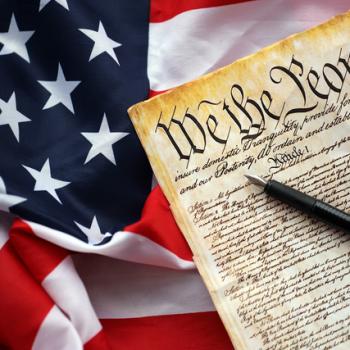
“Congress shall make no law respecting an establishment of religion, or prohibiting the free exercise thereof; or abridging the freedom of speech, or of the press; or the right of the people peaceably to assemble, and to petition the Government for a redress of grievances.”
The Establishment Clause is in the first ten words of the First Amendment:
“Congress shall make no law respecting an establishment of religion…”
This is the entire Establishment Clause. Everything after it is the Free Exercise Clause and the freedoms of speech, press, assembly, and petition. The Constitution does not contain a sentence that literally says:
“The government may not post religious symbols.”
Instead, courts derive that rule from the Establishment Clause. From the very beginning, courts interpreted this to mean:
- The government may not endorse a religion.
- The government may not promote religious doctrine.
- The government may not use its authority to advance faith.
Posting religious symbols — especially sacred texts like the Ten Commandments — is treated as government endorsement of a particular faith. The Supreme Court has repeatedly ruled that government‑sponsored religious displays violate the Establishment Clause when they appear to endorse a faith.
How Do Public Schools Factor In?
Public schools are government institutions because:
- They are created by state law.
- They are funded by taxpayer money.
- Their employees are state employees.
- Their policies are government policies.
- Their classrooms are government‑controlled spaces.
Therefore, when a teacher posts something on the wall, it is legally treated as government speech, not personal speech. The crux of the issue is how the courts (including the Supreme Court) have interpreted the Establishment Clause. The teacher’s wall is not “their space” when it comes to religious symbols — it is government speech.
What About Other Symbols?
The application of this law may feel inconsistent, as many classrooms display flags and symbols that generate contention from parents and other groups:
- LGBTQ+ Flags
- Transgender Flags
- “Everyone Is Welcome Here” / Diversity Posters
- Religious Symbols (Christian, Jewish, Muslim, etc.)
- Black Lives Matter posters
- Thin Blue Line flags
- Pro‑life or pro‑choice messaging
- Political campaign materials
- Cultural or National Flags
The courts have set the precedent for the religious symbols. School policies govern the posting of non-religious symbols. If the school policy allows the posting of various non-religious symbols, they are lawful. Some teachers may allow these symbols when no district policies exist or when they are in violation of the district’s policies. These are local issues for the school district.
The Catholic View

Whenever the Ten Commandments enter the news, the courtroom, or the classroom, something deeper is happening than a legal dispute. We are watching a culture wrestle with the place of God, the meaning of morality, and the formation of our children. And in moments like this, the Lord invites us to look past the headlines and return to His heart. In my view, Jesus cares far less about seeing the Ten Commandments posted on a wall and far more about seeing them written on people’s hearts.
In the Book of Exodus, God gives the Commandments as a covenant of love. They were meant to shape a people who would reflect God’s character in the world—people who would honor life, protect families, speak truth, and worship God alone. The Commandments were never meant to be displayed for display’s sake; they were meant to be lived.
We Need To Focus On Creating Unbiased Environments In Schools
The question then is, why are states continuing to challenge a historical precedent? There are opportunities to educate children about the commandments outside the classroom, including at home. These states may be trying to force their cases to the Supreme Court, but the question of intent remains open. That being said, the posting of many non-religious symbols appears to be an effort to politicize the classroom. Matthew 18:6 tells us:
“Whoever causes one of these little ones who believe in me to sin, it would be better for him to have a great millstone hung around his neck and to be drowned in the depths of the sea.”
Understandably, some parents would object to religious symbols being placed in the schools. Still, it’s also understandable that some parents would object to the non-religious symbols that schools allow by policy. Schools have a “captive” audience of impressionable children. Lately, a growing number of schools are using children to send an anti-ICE political message. Using children in this way is simply adults using children to advance their own causes. The words from Matthew 18:6 are very appropriate for this situation.
Neutrality Policies
Many districts have adopted “neutrality” policies such as:
- “No political or ideological symbols.”
- “Only curriculum‑related displays.”
- “Only U.S., state, and school flags.”
It is unfortunate that adults are using schools as a battleground to push their own agendas. The neutrality policies may be the right solution at this point in time. Let’s pray that we can stop using children as political pawns and focus on providing unbiased environments where children can learn and make their own decisions as adults.
Please share your thoughts about this article in the “Comments” section.
Peace
If you like this article, you might also enjoy:
The Good Shepherd
What Is National Crime Victims’ Rights Week?
Vote: What The National Popular Vote Pact Means For You












 Ad-Free & Subscriber Log-In