


Location of Blue Mosque
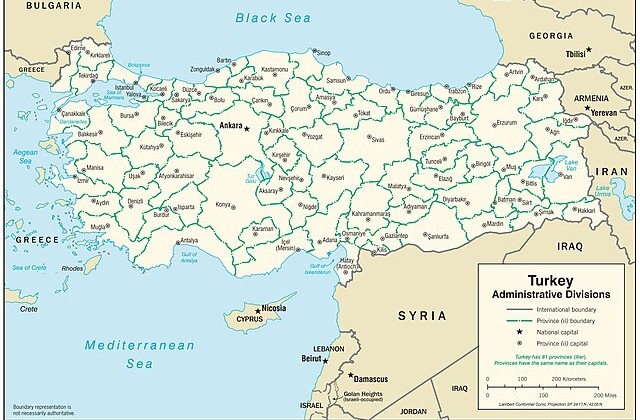
The religous landmark, so named for its impressive azure hue, is located in Istanbul, Turkey in northwest Turkey. This city served as the imperial capital of the Ottoman Empire for nearly 500 years. Ankara became Turkey’s capital in 1923, but Istanbul stands as the country’s largest city and principal seaport. Its population exceeds 15 million with two-thirds in Europe and one-third in Asia. Istanbul straddles the Strait of Bosporous, one of the world’s busiest waterways.
The old walled portion of Istanbul rests on a triangular piece of land between Asia and Europe. This historic part of the city holds the Blue Mosque in its Sultanahmet District, near several other notable tourist sites. The religious site received a UNESCO World Heritage Site designation in 1985 and is one of the most iconic and prominent of Istanbul’s tourist attractions. Although commonly known as the Blue Mosque, the building is officially the Sultan Ahmed Mosque.
The Blue Mosque’s Use
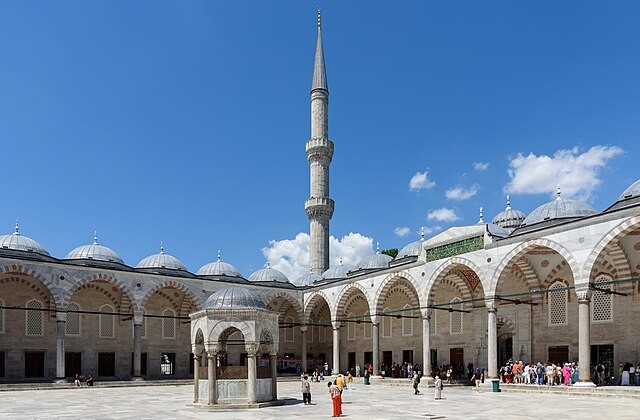
The Blue Mosque functions both as a religious site and a tourist attraction. The structure can hold 10,000 worshippers. Hundreds of Muslims come for daily prayer five times a day. Larger crowds attend during Muslim festivals and on Fridays.
When not being used for worship, the mosque’s doors open to tourists. During prayer times, non-Muslim tourists cannot enter the building during if they do not intend to pray. Entrance to the Blue Mosque is free, but non-Muslims must use the south entrance. All visitors to the mosque must remove their shoes prior to going in the mosque. Even Pope Leo did so, touring the site in his white socks. A dress code requires women to cover their hair with a scarf, and everyone’s knees and shoulders must be covered.
History Of The Blue Mosque
Sultan Ahmed I, the Ottoman Empire’s ruler between 1603 and 1617, ordered the building of the Blue Mosque. This decision stirred controversy from the outset. Typically, war bounty covered the cost of large-scale contruction, but the sultan chose to use treasury funds instead due to lack of any recent war victories.
The mosque’s construction began in 1609 with completion in 1617. Finishing a project of this scale in this relatively short time was an impressive feat then. When constructed, the mosque sat in what was then the center of Istanbul. Over 400 years later, this 17th century building remains standing as one of the most magnificent structures of the Ottoman Empire. It sends the intended message of Ottoman cultural and architectural supremacy.

Architecture Of The Blue Mosque
Besides its religious and cultural significance, the Blue Mosque draws tourists interested in architecture. While four minarets, or towers for making calls to prayer, sit beside most mosques, this one boasts six. The design raised controversy with critics seeing it as trying to rival Mecca’s Grand Mosque. Sedefkar Mehmed Aga, the mosque’s architect, is credited with the structure’s perfect proportions. For example, the marble pnulpit or minbar’s posiiton allows the iman to be heard from anywhere in the mosque.
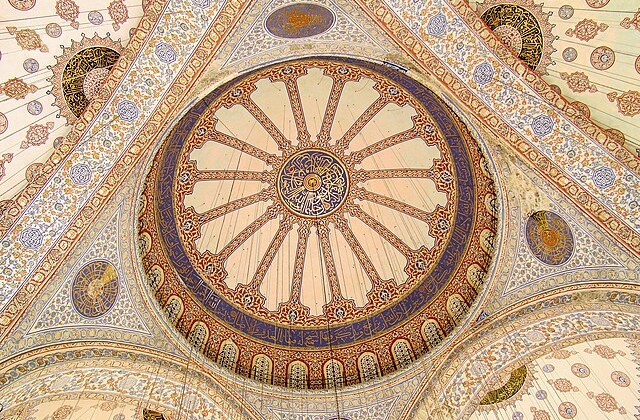
In additon to its more than usual minarets, the Blue Mosque is acclaimed for its many domes and semidomes. From the outside, the structure’s symmetry gives the domes as a whole the appearance of one large dome. The central dome, supported by four pillars, rises 141 feet above the floor. Surrounded by eight cascading domes, it measures 77 feet in diameter. An imam pointed out the tiled domes as well as inscriptions on tbe columns to Pope Leo during his tour. A wall-to wall carpet, essential for Muslim prayer, lines the floor below. A blue and cream-colored flower design adorns this floor covering. Walls bear verses from the Quran written in Arabic calligraphy. Over 250 stained gl ass windows allow colored natural light into the building. Chandeliers, which deter bugs with frequently attached ostrich eggs, supplement that light
The Blue Mosque’s Tiles
Thousands of hand-painted tiles captivate those who enter the Blue Mosque. The site’s nickname, in fact, derives from the handmade blue Iznik tiles which decorate the interior walls. The sunlight streaming in through the structure’s stained glass windows produces a soft blue hue making the area glow. Above the tiles, the walls are painted with variou motifs, generally in blue, adding to the blue glow.
Over 20,000 ceramic tiles line the mosque’s interior. Although blue is the most famous color, the tiles come in a range of colors including white, red, green, and brown.Their patterns depict leaves, flowers, and geometric shapes.
Takeaways From The Blue Mosque
Although deemed Allah’s house by Muslims, Istanbul’s Blue Mosque provides visitors of any religion the opportunity to learn. It offers stunning design for those interested in architecture, physical evidence of life during the Ottoman Empire for history buffs, insight into religious practices for those of faith, and beauty for those who love art or simply the color blue. Pope Leo’s visit certainly added to his knowledge of this sacred site, and others can broaden their knowledge in various areas as well.
Pope Leo’s Visit to the Blue Mosque















 Ad-Free & Subscriber Log-In