

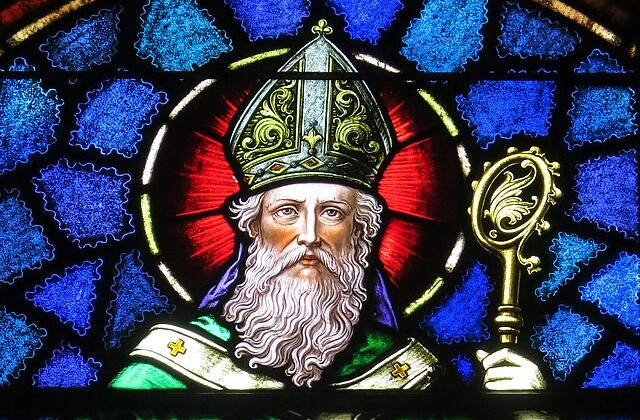
St. Patrick Fun Fact #1 – He’s Not Irish
Despite being the patron saint of Ireland, St. Patrick wasn’t Irish. Britain, an area controlled at that time by the declining Roman Empire, holds the honor of being his birthplace. Patrick’s father Calpurnius served as a deacon and minor local official. Because his family was Romanized, the youth spoke and wrote in Latin.
Patrick, of course, ended up in Ireland, a move initially forced upon him. At the age of 16, Irish raiders kidnapped him from his family’s villa and carried Patrick into slavery in Ireland. After spending six years as a herdsman, he finally escaped enslavement and fled back to Britain. After becoming a priest, Patrick returned to Ireland, where he began converting people to Catholicism.

St. Patrick Fun Fact #2 – His Dates of Birth And Death Are Unknown
While we know where St. Patrick was born, no one can say exactly when that event occurred. However, several indications exist that his missionary service in Ireland took place during the second half of the 5th century. Patrick’s own writing supports this timeframe. One of his letters refers to the Franks in Ireland as still heathen. Accordingly, this period must have been prior to 496 when they were baptized en masse and after 451 when the Franks invaded Gaul.
According to legend, St. Patrick died on March 17th, when St. Patrick’s Day is celebrated. Unfortunately neither his date of birth nor his date of death can be known with certainty. What a fun fact, or perhaps a funny fact, to know that revelers celebrating St. Patrick’s life may be doing so on the wrong day. Some believe Patrick returned to Ireland in 432 and then died there in 461. No matter what the correct date of his death is, everyone can agree that he made a significant impact on the religious landscape of Ireland with his efforts leading to the establishment of numerous schools, churches, and monasteries in that country.
St. Patrick Fun Fact #3 – He Was An Author
Most think of St. Patrick in terms of speaking as a missionary, teacher, and priest. But St. Patrick fun facts reveal this man of faith could write as well. In his lifetime he authored two short books, both written in Latin. His Confessio is a spiritual autobiography. In this work, Patrick is described as baring his inmost soul. A famous passage in the work tells of a dream Patrick had after his return to Britain. He received a letter from “The Voice of the Irish” in which the people urged Patrick to walk among them again. Deeply moved, he did return to Ireland where he is credited with bringing Christianity.
In his Letter to Coroticus, St. Patrick denounced the British treatment of Irish Christians. A British warlord, Coroticus and his soldiers received rebuke for killing and enslaving a number of Patrick’s recent Irish converts. These written words showed courage in standing up against the evils of Patrick’s day.

St. Patrick Fun Fact #4 – He Used Shamrocks As A Teaching Tool
Some teachers use Power Point presentations or videos in the classroom today. St. Patrick fun facts reveal Ireland’s patron saint didn’t need technology. He is believed to have used what was readily available to assist with his gospel presentations. And, unsurprisingly, that tool came from nature, a green plant now clearly associated with Ireland—a shamrock. The plant represents Northern Ireland on the United Kingdom’s coast of arms and appears on the tails of planes belonging to Aer Lingus, the national airline of Ireland.
Shamrocks are three-leaf clovers. Their scientific name, Trifolium, means “three leaves” in Latin. The word “shamrock” comes from the Gaelic word seamrog, which means “little clover,” which differentiates them from four-leaf clovers which are not shamrocks. A shamrock symbolizes faith, hope, and love, but St. Patrick is said to have incorporated the plant into his teaching about the Father, Son, and Holy Spirit in the Trinity.
Facts Make St. Patrick’s Day More Meaningful
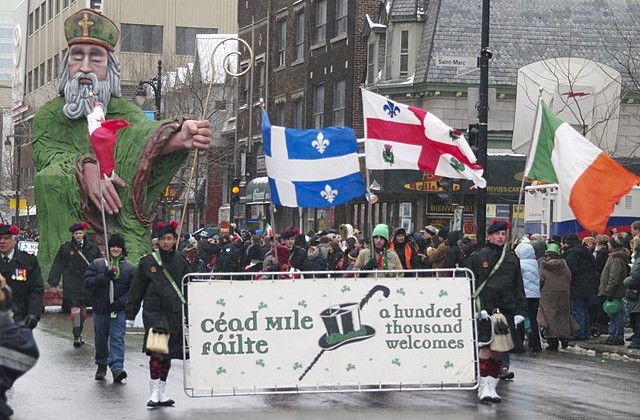
While St. Patrick’s Day and celebrating Irish culture can always be fun, a better understanding of the man being celebrated makes it more meaningful. Although Ireland’s patron saint, St. Patrick wasn’t Irish. Further, his dates of birth and death cannot be ascertained with certainty. March 17th may not be the actual date of his death. A revered missionary and teacher, St. Patrick’s talents extended to writing as well, including two books, a spiritual autobiography and one decrying societal ills. When he did teach, St. Patrick used a beautiful and significant tool to teach about the Holy Trinity, the shamrock, a plant closely associated with Ireland. These facts emphasize that St. Patrick’s Day is more than just about celebrating with parades, wearing green, and eating Irish food. The holiday shines the light on an interesting and caring man who truly deserves a day to honor his life and work in Ireland.












 Ad-Free & Subscriber Log-In