

Once upon a time two explorers came upon a clearing in the jungle. In the clearing were growing many flowers and many weeds. One explorer says, “Some gardener must tend this plot.” The other disagrees, “There is no gardener.” So they pitch their tents and set a watch. No gardener is ever seen. “But perhaps he is an invisible gardener.” So they set up a barbed-wire fence. They electrify it. They patrol with bloodhounds. (For they remember how H. G. Wells’s The Invisible Man could be both smelt and touched though he could not be seen.) But no shrieks ever suggest that some intruder has received a shock. No movements of the wire ever betray an invisible climber. The bloodhounds never give cry.
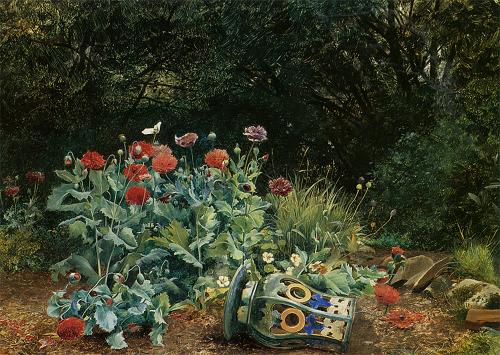
Yet still the believer is not convinced. “But there is a gardener, invisible, intangible, insensitive to electric shocks, a gardener who has no scent and makes no sound, a gardener who comes secretly to look after the garden which he loves.” At last the Skeptic despairs, ‘but what remains of your original assertion? Just how does what you call an invisible, intangible, eternally elusive gardener differ from an imaginary gardener or even from no gardener at all?”
This story, or “parable,” was offered at the beginning of an academic symposium by British philosopher Anthony Flew well over a half century ago as a way to get people to thinking about their beliefs and the evidence that supposedly counts for or against those beliefs. The Believer in the story seems bound and determined to believe that there is a gardener that takes care of the flowers in the clearing, even in the face of no supporting factual evidence.
The Skeptic is only willing to believe in the gardener along with the Believer if shown relevant evidence. “I agree that there are flowers and that there are weeds here, but there are many possible explanations for this in addition to your gardener hypothesis,” the Skeptic might say. “Let’s test your hypothesis.” When it turns out that the Believer doesn’t need evidence to support his belief, the Skeptic knows that the conversation has come to an end. For what can be said to a person who insists on believing something even when there is no supporting evidence or, worse, even when there is strong evidence contrary to the belief?
The symposium at which Anthony Flew provided this parable was entitled “Theology and Falsification”—in short, what is the relationship between belief in God and evidence that might count for or against such belief? The plot with flowers and weeds is an image of the world we live in, a world that contains both beautiful and ugly things. How to account for the beautiful and the ugly, the good and the bad, existing side-by-side in every corner at every level of our reality? The Believer says “God (the gardener) is responsible for the beautiful things,” and the Skeptic challenges “but why would a God interested in creating beautiful and good things allow these ugly and evil things to continue existing?” In other words, “Who is responsible?”
The Psalms in the daily lectionary this week have focused on the “Who is responsible?’ theme. If you ever want to get bummed out, to wonder what on earth God is up to, drop in to any Psalm in the 50 to 60 range and experience the silence and absence of God along with the Psalmist. In virtually every one of these Psalms, something has gone wrong and the Psalmist is looking for answers.
My best friend betrayed me—what are you going to do about it?
Wicked people are prospering—what are you going to do about it?
My life is not working out the way I want it to—what are you going to do about it?
People I know are sick and need healing—what are you going to do about it?
Someone I love has been treated unfairly—what are you going to do about it?
Most of these Psalms end with an “I will worship and praise you anyways” sort of final verse, but they don’t sound particularly sincere. Throughout these Psalms is an energy and anger that reminds me of Ruby Turpin in Flannery O’Connor’s short story “Revelation” who, when her expectations concerning God have been disappointed one too many times, shakes her fist at the sky and shouts “WHO THE HELL DO YOU THINK YOU ARE??
It’s a place that everyone who believes in the goodness of God will eventually arrive. And it’s all a matter of disappointed expectations. If God is God, why is this happening? If I can’t depend on God to be there when expected, to set things right when I don’t approve of them, to punish the wicked and reward the just, what’s the point of believing? As the skeptic asks the believer in frustration, what’s the difference between a God who cannot be detected, understood, explained or relied upon and no God at all.
These questions are the gateway to what one of my students in a colloquium focused on these issues this past semester told me the course had challenged her to develop: a more nuanced and interesting faith. There is abundant evidence that runs counter to the relatively simplistic divine model that many of us were taught to believe in, the model of a problem solving, prayer answering God who can be manipulated into acting by the proper procedures and pious intentions.
A more nuanced and interesting faith, a faith that gets the believer out of the nursery of faith and into the arena of encounter with something far more challenging and disturbing, is a faith that neither ignores contrary evidence nor gives up on belief at the first sign of trouble. The question is, do I want to believe in a God I can’t predict or control, a God who refuses to behave in the manner I would prefer? As Thomas Cahill asks in The Gifts of the Jews,
Can we open ourselves to the God who cannot be understood, who is beyond all our amulets and scheming, the God who rains on picnics, the God who allows human beings to be inhuman, who has sentenced all of us to die?
Opening up to that sort of God requires both guts and a willingness to continually readjust and retool. But it is certainly interesting.














 Ad-Free & Subscriber Log-In