

Readers of this blog know that I have frequently recommended podcasts over the past months and few years. Today my recommendation is “The Ezra Klein Show.” I don’t listen to this podcast every week, since Klein often gets into the political weeds far more than I’m wiling to go. But occasionally the conversation includes matters that are of great interest–this week’s episode is one of thos occasions.
The title of the episode is “Can James Talarico Reclaim Christianity for the Left?” James Talarico is a Texas State Senator who is running for the U.S. Senate seat from Texas currently held by Senator James Cornyn. If you want a clear and eloquent example of a politician from the left who is remarkably willing to speak about his Christian faith and how it has shaped his world vies and his progressive perspective, give the podcast a listen, particularly to the first half where Klein and Talarico have a fascinating conversation about matters such as prayer and incarnation. Jeanne is out of town this week–I texted her that she HAD to listen to this podcast and said “I want this guy to be President!”
James Talarico on “The Ezra Klein Show”
In his introduction to the conversation, Ezra Klein identifies James Talarico as a striking and unusual public voice at a time when “the radicalism of faith seems to have been perverted by the corruption of politics.” Only a few minutes into the interview, Talarico said any number of things concerning his faith that we, to say the least, unusual and refreshing coming from an up-an-comer in the political arena.
We discover, for instance, that Talarico, whose grandfather was a Baptist minister and who was raised in the Presbyterian church, is a seminary student hoping “to be a minister one day.” His study of Hebrew and Greek revealed something that turned out to be “mind-blowing.”
I was studying this word “faith [pistis].” In many translations, it is “belief” — the idea of believing in a concept or an idea — which makes sense in English, Western, translations. But it can also be translated as “trust,” which to me is much more experiential: Trusting that love is going to get you through the hour, through the day, through your life. That love is going to carry all of us forward. That love will ultimately prevail, even when it’s temporarily defeated. To me, that’s what my faith feels like. It feels like trust. Almost like when I learned how to swim at our neighborhood pool, and I remember my swim teacher telling me: Don’t fight the water. Let the water carry you.
I love that. I was raised in a tradition where faith was entirely about believing various propositions–various doctrines–as true with certainty. Understanding faith as “trust” changes things entirely in a way that resonates strongly with my own esperience over the past several years. Understanding faith as something that one immerses oneself in as a fish swims in water or as the atmosphere that one breathes makes a huge difference. Faith becomes less of a struggle and more of a life-giving trust that I am surrounded by faith wherever I go, whatever I am doing.
The genius of Christianity — the miracle of Christianity — is not the claim that Jesus is God. It’s that God is Jesus, meaning that Jesus helps us understand the mystery. A mystery can’t help us understand Jesus. So this idea that ultimate reality, the ground of our being, the cosmos, however you want to define God, somehow looks like this humble, compassionate, barefoot rabbi in the first century, someone who broke cultural norms, someone who stood up for the vulnerable and the marginalized, someone who challenged religious authority — that, to me, is such a revolutionary idea, and it leads you to challenge organized religion. The Gospel just inherently tries to break out of some of these religious dogmas and orthodoxies and challenges religion itself.
The genius of Christianity is not that Jesus is divine, but rather than the divine became human in the form of Jesus. That’s a compelling way to express both the miracle and the fragile intimacy of of the incarnation. As Talarico continues through the interview, it is clear that this business of God becoming human is still happening today. No wonder I loved this conversation–I’ve been exploring this truth for more than a dozen years on this blog.
As you listen to the conversation, pay attention to what Klein and Talarico have to say about prayer. Klein is a committed person of Jewish faith–their comparison of notes about what prayer amounts to is illuminating. But in the interest of keeping this post within my usual parameters, for me the most mind-blowing part of the discussion is when Klein notes that Talarico’s publicly presented faith is “very, very progressive form of Christianity,” playing a clip from Talarico’s appearance on Joe Rogan’s podcast to illustrate.
Rogan: What do you think is the biblical evidence to support the opinion of being pro-abortion?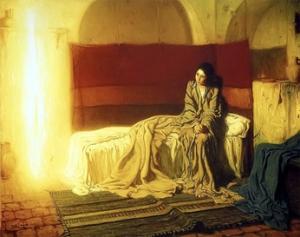
Talarico: So before God comes over Mary and we have the incarnation, God asks for Mary’s consent, which is remarkable. Go back and read this in Luke. The angel comes down and asks Mary if this is something she wants to do, and she says: If it is God’s will, let it be done. Let it be. Let it happen. So to me, that is an affirmation in one of our most central stories that creation has to be done with consent. You cannot force someone to create. Creation is one of the most sacred acts that we engage in as human beings, but that has to be done with consent. It has to be done with freedom. And to me, that is absolutely consistent with the ministry and life and death of Jesus.
When I heard this, I had to pause my walk with Bovina and rewind the episode on my phone to listen again. I have been an evolving Christian my whole life; I have been largely progressive–and certainly committed to a pro-choice position on the abortion issue–for my entire adult life. But I’ve never placed my pro-choice commitment within the context of my faith in the way that Talarico does in the above clip.
In my new book A Year of Faith and Philosophy I have a section during Advent on Mary, the annunciation, and the Magnificat (one of my favorite stories from scripture). I also have a section on why Jesus asks the lame man who has been at the pool of Bethesda for thirty-eight years “Do you want to be healed?”, empowering the man to choose healing freely rather than having it imposed on him by Jesus. But I had never thought of putting those two stories–annunciation and choice–together in the way that Talarico does in his response to Rogan’s question. It is both beautiful and radical.
For reasons that are a complete mystery, God chose a young, unimportant teenager from a nowhere town in the eastern backwater of the Roman empire to be the mother of God in flesh. The divine angelic messenger tells Mary in the Luke narrative everything that is going to happen but, after Mary asks a skeptical question or two, as Talarico points out, the conversation with the angel ends with Mary saying “Here am I, the servant of the Lord, let it be with me according to your word.” Mary chose to consent to the angel’s message in other words. The God of the Christian faith is a God of love, and love is incompatible with power. Mary got to choose, in other words. Mary could have said no. And if she had, the story would have developed very differently.
Why does God honor the free choice of human beings rather than forcing the divine will and plan on humans whether we like it or not? Because God chooses to offer the loving possibility of loving relationship to which each of us has the opportunity to respond “yes” or “no,” rather forcing it on anyone. Nothing is more holy than choice. Food for thought, to say the least.














 Ad-Free & Subscriber Log-In