

Sunday was Trinity Sunday, which I jokingly warn my clergy friends each year is a trap designed to lure them into preaching something that can be condemned as heretical. Preaching on the doctrine of the Trinity is like walking a tightrope — a narrow, invariable path with the threat of danger on every side. This doctrine seems like a machine designed to generate heresies and accusations of heresies. Trying to explain or explore the meaning of the Trinity is to invite accusations and attacks — an easy way to get in trouble.
The way I tend to get in trouble is by reminding my fellow humans that our constructs and formulations for understanding God are all going to be inadequate because, well, God is God and we are not and we’re trying to grasp something and someone far beyond our ability to grasp. So I’ll point out that the Trinity is, like all of our God talk, a metaphor, and the kinds of people who get upset whenever you point out that anything is a metaphor will, of course, get upset with me, but their being upset with me doesn’t change the fact that we’re all still finite, imperfect creatures speculatively trying to understand an infinite creator and thus finite, imperfect metaphors are the best we’re going to manage.
Every year around Trinity Sunday I wind up rewatching this classic, hilarious video from Lutheran Satire, in which a pair of inquisitorial cartoon twins bully St. Patrick as he tries to suggest analogies for understanding the Trinity:
After rebuking Patrick’s various attempts for lapsing into “modalism” and “Arianism” and “partialism,” the flustered and frustrated saint sighs deeply and retreats to the safety of an Athanasian recitation: “Fine! The Trinity is a mystery which cannot be comprehended by human reason, but is understood only through faith, and is best confessed in the words of the Athanasian Creed, which states that we worship one God in Trinity, and Trinity in unity, neither confusing the persons nor dividing the substance, and we are compelled by the Christian truth to confess that each distinct person is God and Lord and that the deity of the Father, the Son, and the Holy Spirit is one, equal in glory, co-equal in majesty.”
You’ll notice that even that brief restatement of the official, permissible doctrine spends as much time saying what it’s not saying as what it is — as much time warning against the pitfalls and perils of getting this wrong as it spends explaining what it is we’re actually trying to say or believe here. That approach and tone and wary substance hardly seems like the stuff of a great annual sermon. It’s less like preaching than like being a junior official at the State Department being forced to answer a question about the status of Taiwan.
I appreciate that the lawyerly theological objections of those cartoon twins can actually be important. How we imagine or understand or talk about what God is like shapes how we imagine/understand/talk about what God desires, which can in turn influence how we think about and how we behave toward other people. That matters. That is what matters and, ultimately, that is all that matters.
Putting that so bluntly causes some of my brethren to recoil in horror. You’re flattening the vertical into the horizontal! You’re collapsing the transcendent into the immanent! Danger Will Robinson!
And that’s where I sometimes get as flustered and frustrated as Patrick in that cartoon and will just lean into their confusion and respond, “Yes! Fine! Flatten and collapse the snot out of that ethereal, otherworldly nonsense!” And then I’ll get as angrily insistent and repetitive on that subject as 1 John 4 and wind up being just as ignored and unpersuasive as that passage seems to be.
When I’m less frustrated, I’ll try to point out that these constructs of vertical versus horizontal or transcendent versus immanent are bogus and misleading — confusions of person and divisions of substance. These are not opposites or oppositions or parts or fragments or modes or divisions. The second is like unto it. The second is the same exact thing in different words.
Yes, I will tend to emphasize the temporal, horizontal, immanent and tangible because I am a temporal, finite creature who is far more capable of understanding that as something I can observe, measure, and comprehend. Unlike the abstractions and infinities and mysteries of the transcendent and the vertical, it is possible for me — for us — to look at and to touch the concrete realities of the here and now and thus to discern, with far greater possibility of accuracy and reliability, whether or not we’re getting it right.
The so-called “horizontal” is thus the test and the proof and the standard by which we can judge our otherwise immeasurable and incomprehensible suppositions and speculations about the so-called “vertical.” This is, again, the epistemology of 1 Corinthians 13 — love is the only thing we can be certain of. However elegant and refined and meticulous one’s systematic theology may appear to be, if it does not bear good fruit it must therefore be wrong. If our “vertical” theology or our elaborate speculations about the transcendent do not result in our learning to do justice and love mercy — to bring good news to widows, orphans, strangers, and the poor, to feed the hungry and to welcome strangers and to clothe the naked — then it’s all error and heresy and bunk.
When theologians start to sound like the twins in that video, it’s often from a genuine concern that theological error will lead to sin. Sure, there are some who are just playing Gotcha! games because they enjoy that sort of thing, but usually if someone is going on about the dangers of “modalism,” it’s because they perceive such misperceptions as actually dangerous. They worry that this erroneous way of thinking about God will ultimately lead us to mistreat our neighbors. I think that’s why St. Nicolas wound up throwing hands at the Council of Nicea — not because he was defending an abstraction, but because he feared that the error he was condemning would lead to bad behavior and wind up being bad news for the poor.
I respect that worry, but I think it misreads the way that most of us humans actually work most of the time. I think we tend to work the other way around. We form our abstract theologies and ideologies as a justification for our actions more than we tend to act on the basis of those supposedly pre-existing theologies and ideologies. We are capable of reason, but we’re better at rationalizing than rationally deciding.
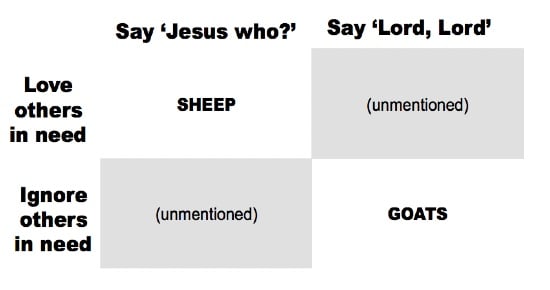
Think again of Jesus’s parable of the Sheep and the Goats in Matthew 25. We’re always tempted to misread this story by filling in the blanks. The story gives us two — and only two — categories: Sheep and Goats. The Goats all recognize Jesus and call him Lord, but they all also failed to feed or to clothe him in his need. None of the Sheep have any idea at all about who this guy is, but they all passed the test when it came to “I was hungry and you fed me.” The Goats, in other words, all had correct “vertical” theology, but failed the “horizontal” test, while the Sheep all passed the horizontal test while having no “vertical” theology at all.
We Christians read this story as people who like to think that we have good and proper and correct “vertical” theology. So we take those two variables and chart them out to supply the “missing” quadrants I’ve illustrated above. Surely those unmentioned quadrants must also exist, right? We want them to exist and we need them to exist, so we mentally add these options to the story, supplying the safe place for us to stand which it had otherwise refused to provide.
That move is not entirely wrong. It would be a mistake, I think, to read Jesus’s parable and take as its message the idea that anyone who calls him “Lord” must, therefore, be a damnable “Goat” consigned to “the eternal fire prepared for the devil and his angels.”* That would be missing — or evading — the point of this story in the same convenient direction of elevating one proper, correct “vertical” formula above the “horizontal” matters it presents as paramount.
Supply all the missing categories and quadrants you like and the meaning of the story remains unchanged. “Love your neighbor” is both necessary and sufficient. That is not a collapsing or a flattening. It is a recognition that the supposed fragments or modes or parts we relegate to the “horizontal” or the “immanent” are, in fact, the essence of the supposed fragments or modes or parts we relegate to the “vertical” and the “transcendent.” This is not a mystery and it is not beyond the reach of human comprehension.
* The parable of the Sheep and the Goats is one of the very few places in the Bible where one can find imagery like this that seems to fit with the much later, extra-biblical folklore of “Hell.” Nearly all such passages regarding fiery torment are in red letters, in the parables of Jesus in the Gospels. Every such passage insists, emphatically, on a soteriology that every single proponent of the folklore of Hell rejects and denies and condemns. “Hell” is not in the Bible, but if you already have the idea of Hell and you go looking for places where you can squeeze it back onto the page, the only places you’ll find that allow you to do that will be passages that very clearly and explicitly state that “Hell” is for Dives.










 Ad-Free & Subscriber Log-In