

There’s a strange moment that happens to a lot of people leaving Evangelicalism.
You expect some grand rebellion. Maybe fireworks. Maybe liberation. Maybe the sky to crack open while DC Talk plays faintly in the distance.
Instead, you buy groceries on a Sunday morning and feel guilty for no reason.
You question a pastor’s political rant and immediately feel anxious, like God just opened a file on you somewhere.
You hear someone say “trust yourself,” and your nervous system reacts like they suggested snorting cocaine off a Ouija board.
That’s because many people don’t leave Evangelicalism with just bad theology. They leave with installed phobias.
Not ordinary fears. Conditioned fears. Reflexive fears. Emotional tripwires carefully planted over years of sermons, altar calls, purity culture talks, end-times conferences, and youth pastors treating secular music like a gateway drug to demon possession.
Modern Evangelicalism often survives by training people to fear reality itself. Not all reality. Just the parts it can’t control.
This Has a Name
Steven Hassan, who studies cult indoctrination, describes a process called “phobia indoctrination” — embedding irrational fears into members to keep them psychologically dependent on the group. Leave and your life will collapse. Question authority and disaster follows. Step outside the approved worldview and destruction awaits.
Evangelicalism perfected this model and wrapped it in worship music. It didn’t invent it — institutional Christianity has been running versions of this program for centuries. But American Evangelicalism industrialized it.
From childhood, many Christians are taught that the world outside the church isn’t merely different — it’s dangerous. Secular people aren’t just wrong, they’re blind. Universities aren’t educational spaces, they’re faith-killing factories. Doubt isn’t part of spiritual growth, it’s a satanic attack. Therapists might pull you away from God. Scientists are suspicious unless they already agree with Genesis.
And hovering over all of it: the constant threat of cosmic punishment. Hell. Judgment. God removing His hand of protection.
For a movement constantly talking about freedom in Christ, Evangelicalism spends a remarkable amount of energy making people terrified of freedom.
Because fear creates dependence. If you can convince people that reality itself is hostile, they’ll keep running back to the institution that claims to protect them from it.
The System Is Working Exactly as Designed
This is why so many Evangelical churches subtly discourage independent thinking — not because every pastor is a cartoon villain twirling a mustache in his church office, but because the system itself depends on certainty and control.
Questions destabilize certainty. Curiosity destabilizes authority. Experience destabilizes doctrine.
So instead of teaching people to engage the world thoughtfully, many churches train people to retreat from it emotionally. The result is adults carrying invisible panic buttons nobody told them were installed.
You can see it everywhere: people terrified of disappointing God for sleeping in on Sunday, people panicking after reading outside the approved theological bubble, people convinced every hardship is divine punishment, people unable to trust themselves after decades of outsourcing conscience to authority figures.
And the cruelest part — the fear lingers long after belief fades.
Many former Evangelicals intellectually stop believing years before their nervous systems catch up. Because these fears were planted before critical thinking fully developed. Tell a child often enough that demons are watching, that hell awaits unbelievers, that questioning authority invites destruction — and eventually those ideas stop functioning as doctrines. They become survival instincts.
That’s why deconstruction can feel less like changing your mind and more like recovering from psychological whiplash. You’re not just untangling theology. You’re retraining your body to stop interpreting reality as a threat.
Meanwhile, the Actual Teachings
Here’s the part that somehow gets missed in all of this.
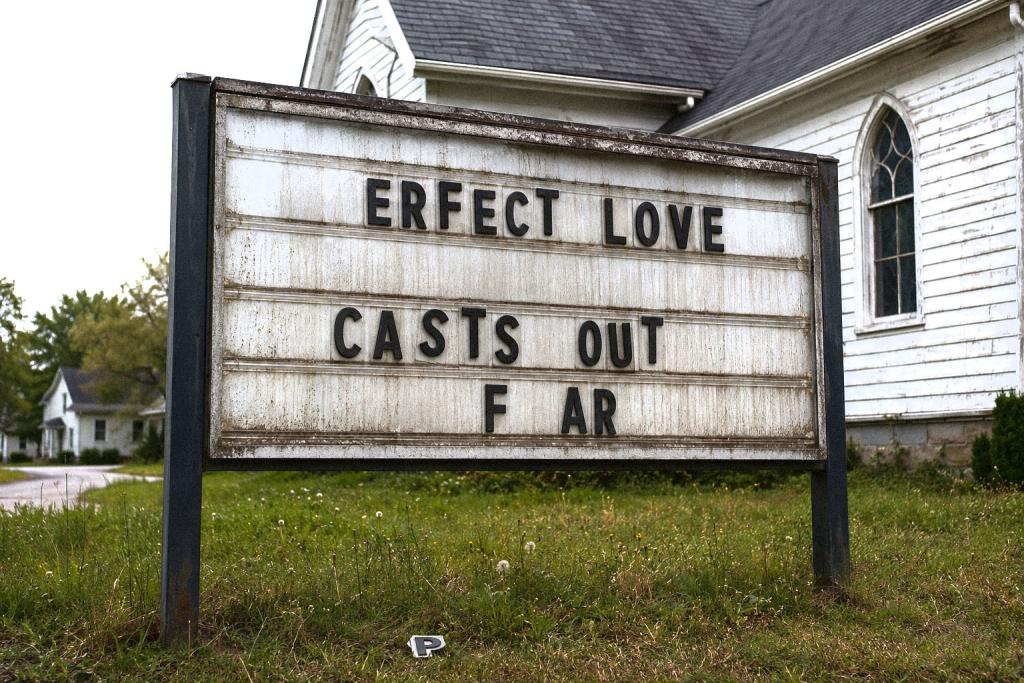
Jesus said “fear not” approximately one million times. The actual number is lower but the point stands — the throughline of the teaching was consistent liberation from anxiety as a way of life. Love your enemies. Do not worry about tomorrow. The kingdom is within you. Perfect love casts out fear.
That last one is doing a lot of work that nobody wants to talk about.
A system that requires fear to function has quietly replaced its foundation. What presents as faith is often managed terror. What looks like devotion is frequently just the psychological inability to imagine surviving without the group’s approval. The institution took “perfect love casts out fear” and built a fear factory on top of it — which is either the greatest irony in American religious history or a long-running deliberate con. At this point the distinction barely matters.
When Fear Is the Product, Not the Side Effect
Every power structure understands that fear is sticky. Politics uses it. Media uses it. Corporations use it. But American Evangelicalism weaponized existential fear with unusual efficiency — entire ministries built around Satanic Panic, purity culture, hell houses, rapture films, and rolling moral panics about whatever threatened the in-group that decade. At some point it stopped sounding like “fear not” and started sounding like a nervous parent forwarding chain emails at 11pm.
The economics were never complicated. Anxious people tithe consistently. Fearful people obey quickly. Terrified people don’t ask hard questions. This isn’t a conspiracy — it’s just incentive structure doing what incentive structure does. You don’t need cartoon villains when the system rewards fear and punishes curiosity automatically.
And systems built on fear cannot survive people becoming emotionally free.
Because emotionally free people start noticing manipulation. They start trusting their instincts. They stop confusing certainty with wisdom. They realize that “I don’t know” is often more honest than manufactured confidence dressed up as faith.
And that’s the quiet scandal underneath all of this.
A faith built entirely on fear eventually reveals what it actually worships. Not truth. Not love. Not God.
Control.
If your belief system collapses the moment people stop being afraid, then fear was never the side effect.
It was the product.
If this felt a little too accurate, there’s more where that came from.
The Tribulation Survival Guide
— same world, fewer guardrails.

Or skip the algorithm →
Want to know how you’d actually survive the end times?
You Missed the Rapture — find out how you die
Podcast, socials, and the rest →














 Ad-Free & Subscriber Log-In