

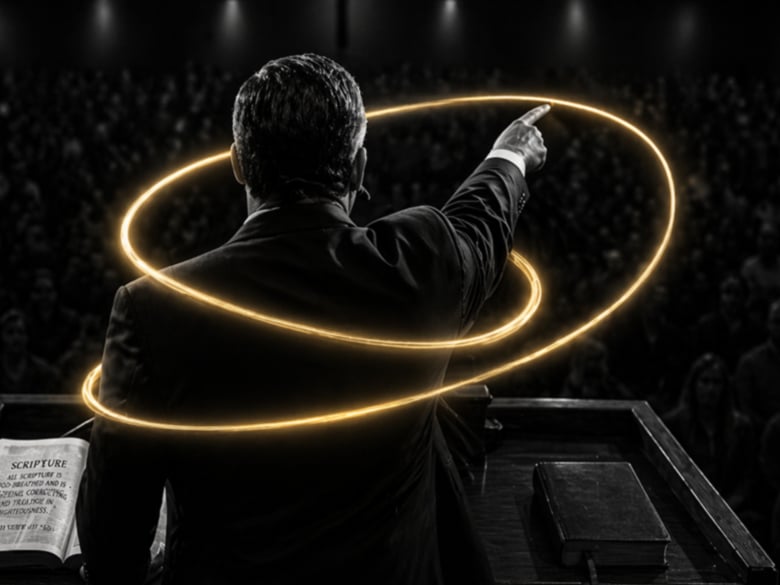
There is a moment in Interstellar that has tied people into knots for years. Cooper gets the coordinates to NASA because future Cooper gives them to him — transmitted through a bookshelf, inside a black hole, across time. The mission only happens because the mission already happened. The coordinates exist because the coordinates already existed.
Nobody knows where the coordinates came from.
That is the bootstrap paradox: when something has no real point of origin because it is trapped inside its own loop. Information that causes itself. An effect that produces its own cause. A closed circle with no beginning and no exit. Physicists find it maddening. Screenwriters find it useful. And it turns out theologians have been living inside one for centuries without mentioning it.
The Bible Is True Because the Bible Says So
Spend enough time in church and eventually you hit the same closed loop.
The Bible is true because it is the Word of God. How do we know it is the Word of God? Because the Bible says so. How do we know we can trust what the Bible says? Because it is the Word of God. We trust the church because the church teaches the Bible correctly. How do we know the church teaches it correctly? Because the church says it does.
Round and round. Nobody knows where the coordinates came from.
Now — to be fair — not every religious thinker relies on naked circularity. Theologians from Aquinas to C.S. Lewis have spent considerable effort building foundations that don’t simply point back to the text: cosmological arguments, fine-tuning arguments, presuppositionalism. Smart people, serious arguments, worth engaging on their own terms.
But here is the honest problem: most people sitting in most pews on most Sunday mornings are operating on the loop. And however much philosophical scaffolding gets erected around it, every argument for scriptural authority eventually arrives at the same destination — because this is what we were told, and what we were told is that this is trustworthy. The scaffolding just makes the loop harder to see.
Nobody would accept this logic anywhere else. This politician is honest because his campaign says so. This investment is safe because the salesman promised. This televangelist needs a third private jet because God told him — and how do we know God told him? Because the televangelist said so.
Case closed, apparently.
Religion Has More Cheat Codes Than an Old Nintendo Game
Closed loops only hold together if nobody questions them for too long. So the loop requires protection — and over centuries, religious institutions have developed a remarkably comprehensive library of what the philosopher Karl Popper would call unfalsifiable responses. Which is a fancy way of saying: answers that are specifically designed to be immune to evidence. Any evidence. All of it.
Prayer didn’t work? You lacked sufficient faith. Prophecy failed? You misunderstood the timing. The pastor got caught cheating? Spiritual warfare. The church is abusive? Nobody’s perfect. God feels absent? He is testing you. You are asking too many questions? Stop leaning on your own understanding.
Notice what these have in common: every single one of them protects the system from scrutiny. No outcome can falsify the belief, because every outcome has a preloaded explanation that loops back to confirming it. Heads I win, tails your faith was insufficient. It is an epistemological vending machine that only dispenses one product regardless of which button you press.
Popper’s point — and it is a good one, even if he had the decency to phrase it less sarcastically than this — is that a claim which cannot even in principle be proven wrong is not a confident claim. It is a hiding claim. It is not describing reality. It is defending a territory.
The church doesn’t just give people beliefs. It gives them preloaded responses to protect those beliefs from examination. It is a little like those customer service bots that keep routing you in circles until you give up and die quietly in the chat window. You are not supposed to ask where the coordinates came from. You are supposed to feel guilty for asking.
Why People Stay in the Loop
Here is where honesty requires slowing down — because writing off everyone inside closed systems as naive is itself a kind of lazy thinking, and lazy thinking is supposed to be the other guy’s problem.
People don’t stay in loops because they’re stupid. They stay because loops are genuinely useful. They offer certainty in a universe that provides very little of it. They hand you a community when loneliness is epidemic. They give you a language for grief, a framework for meaning, a reason to get out of bed after catastrophic loss. They tell you that your suffering is not random noise — that it fits somewhere inside a larger story.
That is not nothing. That is, for many people, everything.
Closed systems survive not because they fool people, but because they fulfill people. The question is not whether the loop feels good — of course it does, that is rather the point — but whether feeling good is sufficient justification for treating the loop as true.
Comfort and accuracy are not the same thing. A beautiful map of a country that doesn’t exist is still a map of a country that doesn’t exist.
If Faith Can’t Survive Questions, It Probably Isn’t Faith
Here is the thing about Cooper in the black hole: he doesn’t stop there. He doesn’t accept the loop as the final answer and go home. He pushes through — into a higher-dimensional space where causality opens up, where the coordinates finally have a real origin, where the paradox resolves into something larger than itself.
That is a more interesting model of faith than what most institutions are currently offering.
The honest truth is that genuine faith — the kind that serious theologians and actual mystics across traditions have described, as opposed to the kind that fills stadium churches on Sunday mornings — has always been comfortable with not knowing. It sits with mystery. It survives doubt. It says I don’t know without the floor caving in. The Desert Fathers had a name for this: apophatic theology, the discipline of confessing what cannot be said rather than papering over the silence with laminated certainty. It is, in its own way, the opposite of the loop — an acknowledgment that the coordinates might not be fully available to us, and that this is okay.
The trouble is that institutions need certainty to function. Certainty fills seats. Certainty generates tithes. Certainty is enormously scalable in a way that honest mystery is not. So the loop gets defended, the cheat codes get deployed, and the questions get quietly discouraged before they become contagious.
If your belief system collapses the moment someone points out that its foundations are circular, the problem is probably not the question. A Jenga tower built of prophecy charts, purity rings, and certified answers to questions nobody was supposed to ask is not a theology. It is a defense mechanism wearing a theology’s clothes.
Real faith should be able to say I don’t know. It should survive doubt and mystery and the occasional person who watched too much Interstellar and started asking uncomfortable questions at small group. Because if the only thing holding your belief system together is telling people not to ask where the coordinates came from — if the whole structure depends on that question never getting a real answer — then you don’t have truth.
You have a really well-defended loop.
And somewhere, future Cooper is still trying to find his way out of it.
If this felt a little too accurate, there’s more where that came from.
The Tribulation Survival Guide
— same world, fewer guardrails.

Or skip the algorithm →
Want to know how you’d actually survive the end times?
You Missed the Rapture — find out how you die
Podcast, socials, and the rest →










 Ad-Free & Subscriber Log-In