FOR TRUMP, REDEDICATING THE COUNTRY TO GOD IS IMPORTANT, BUT NOT THAT IMPORTANT
This past May 17, thousands of MAGA-supporting evangelicals and other Christians swarmed the National Mall in Washington, DC, with the intention to “rededicate the country to God.”
Meanwhile, President Donald Trump, who issued the call for the “sacred jubilee,” not only didn’t show up but also didn’t deliver the promised live video-streamed remarks to the crowd. Instead, the White House sent a recorded video clip used at a previous event weeks earlier.
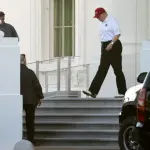
In fact, not only did Mr. Trump bow out of the affair on the Mall, but he also left his residence at the White House, which is only 10 minutes from the event, and was driven to his private club in nearby Sterling, Virginia. There, he took in several rounds of golf, likely ate a sumptuous meal, and returned home two hours before the prayer event ended. That meant he could have dropped by for at least a cameo appearance, or to simply wave from his limousine, as he has done at other similar outdoor events. He did neither.
In other words, Mr. Trump ignored the Rededicate 250: A National Jubilee of Prayer, Praise & Thanksgiving.
Of course, all this begs the question, What could be more important than rededicating our nation to God?
According to Mr. Trump’s behavior on May 17, 2026, a few rounds of golf are more important than rededicating the country to God.
TRUMP’S DYSFUNCTIONAL RELATIONSHIP WITH EVANGELICALS
My first close encounter with Donald Trump was in an unlikely setting: the 80th birthday party for the late Christian Broadcasting Network founder, Pat Robertson. It was held at a swanky Washington, DC, hotel in 2011.
When I walked into the ballroom, I saw 500 of the top evangelical celebrities from around the country—a veritable who’s who of the religious right. I had worked alongside many of them for decades, but by now, I was on my way out of the movement they represented and I had helped lead. Still, I was at home with my religiopolitical tribe.
Looking up at the dais, I was shocked to see something I never expected. Sitting next to Pat Robertson was his “guest of honor” for the evening—none other than Donald Trump.
Here’s why I was shocked:
First, I grew up in New York State, where Donald Trump, Manhattan’s wealthy playboy real estate mogul, was constantly in the headlines for one scandal or another. It was his womanizing, shady business dealings, the latest lawsuit, rumors of organized crime connections, and on and on.
Second, when I was a young minister in training, my Bible college preaching instructor directed his students to always use a real-life illustration for every point they made in a sermon. One example he gave us was, “If you’re preaching on the rich young ruler, who loved his money more than God, and walked away from Christ, a good real-life example of this would be Donald Trump.”
Third, I was sure when I saw Donald Trump in that Washington ballroom, that he was NOT any kind of believer. What came to mind was a passage from the Gospel of Matthew that I had studied, read devotionally, and preached from innumerable times:
“Beware of false prophets. They come to you in sheep’s clothing, but inwardly they are ravenous wolves. By their fruit you will recognize them. Are grapes gathered from thornbushes, or figs from thistles? Likewise, every good tree bears good fruit, but a bad tree bears bad fruit. A good tree cannot bear bad fruit, and a bad tree cannot bear good fruit. Every tree that does not bear good fruit is cut down and thrown into the fire. So then, by their fruit you will recognize them.
Not everyone who says to Me, ‘Lord, Lord,’ will enter the kingdom of heaven, but only he who does the will of My Father in heaven. Many will say to Me on that day, ‘Lord, Lord, did we not prophesy in Your name, and in Your name drive out demons and perform many miracles?’
Then I will tell them plainly, ‘I never knew you; depart from Me, you workers of lawlessness!’”
So, why was Donald Trump Pat Robertson’s “guest of honor” at a party to which the most influential evangelical leaders were in attendance?
I would soon get the answer.
As I took my seat, I leaned over to a colleague who knew Pat very well.
“What is Donald Trump doing here?” I asked in exasperation.
“They’re members of the same club,” he answered rather glibly. “They’re billionaires.”
PAT ROBERSTION, DONALD TRUMP, AND BIG-MONEY FELLOWSHIP
Pat had recently sold the cable TV Family Channel, a platform that featured mostly old reruns of 1950s, 60s, and more recent Hallmark-style programming. Pat thought vintage shows like Gunsmoke, The Rifleman, The Jack Benny Show, and, of course, The Waltons, would help defeat the destructive libertine culture that the 60’s sexual revolution had ushered in. (What went unexamined in those days was Pat’s own
history of having fathered a child out of wedlock in the early 1950s, something that went undiscovered until he ran for president in 1988.)
While the Family Channel was technically started as part of the non-profit Christian Broadcasting Network, it was later spun off into a for-profit entity in which Pat and his sons bought an interest. When they soon sold it, they became very wealthy. It seemed Pat was now an admirer of the man who made such dubious deals all the time.
My table was close to the head table, so I could hear Pat chatting with Trump throughout the evening. At one point, after Pat had given Trump the podium, he coached his special guest to “lift up the Bible.” At that, Trump held up a light green leather-bound volume, announcing that it was “the Bible my mother gave me at confirmation.”
The audience of low-church, non-liturgical, anti-ritualistic, free-form “Bible Christians” was mute. They were clearly unimpressed by the reference. After all, evangelicals don’t practice “confirmation,” when a child reaffirms vows spoken over them during their infant baptism, usually at ages 8-13. Trump noticed the dud. Pat prodded him again and said, “What your mother told you!”
Trump then spouted, “My mother told me this is the most important book of all time.”
The place roared. Trump noticed again. His eyes darted around the room, went to Pat, who beamed with delight, then went to the Bible, and back to the room. He was clearly learning what pleased this audience.
Pat’s platform was Trump’s evangelical Ed Sullivan Show debut. He was a hit and, like Elvis, would go on to wow the—in this case, evangelical—world.
TRUMP LEARNS THE EVANGELICAL ROPES
I recount all this because Trump’s cynical exploitation of evangelical gullibility, sycophancy, and magical thinking was on full display—in flagrante—as he skipped rededicating to God the country Trump believes he rules with the assistance of a Pat Robertson-like “god” who eagerly gives him a platform to do so.
I’ve worked with plenty of narcissistic sociopaths like Trump. American evangelical culture is rife with them. Some are detected and bounced out, especially on the local church level, but once you become a superstar celebrity, it rarely happens. This is due to two gigantic and enormously consequential traits of evangelical culture, especially on the Pentecostal-Charismatic end of the evangelical spectrum.
Pentecostals and Charismatics are subsets within evangelical Christianity. I know a lot about them because I was formed within both. My first exposure to Christianity came in my late teens through a church associated with the “Charismatic renewal,” a late-1960s phenomenon in which spectacular spiritual manifestations began to occur within conventional churches like Episcopal, Methodist, and Lutheran congregations.
After I made my initial profession of Christian faith in a Methodist church (my “born again” experience), I started attending a weekly “Charismatic prayer group,” during which I first heard people speak in tongues, saw them “slain in the spirit” (or kind of fainting or swooning during ecstatic worship), and declare miraculous healings over the sick and disabled.
These “supernatural” elements of religious experience had been markers of an earlier religious phenomenon, at the turn of the last century, that gave birth to “Pentecostalism,” with those same sensational attributes of
speaking in tongues, miraculous healings, prophetic utterances, in which God speaks directly through human agents, and so on. But Pentecostals also carry with them the vestiges of the even earlier 19th-century temperance movement, a social and religious campaign against alcohol and tobacco consumption, which caused enormous personal and familial suffering. As time went on, gambling, dancing, and even card games were added to the list of prohibited activities for these “holiness Christians.”
Speaking of prohibitions, it was temperance activists and holiness Pentecostals who helped pass the 19th Amendment to the US Constitution in 1919, prohibiting “the manufacture, sale, and transportation of intoxicating liquors.” While the 21st Amendment repealed the 19th in 1933, a large and vibrant slice of American evangelicals remain teetotalers to this day, and won’t even go to most “moving pictures” because they’re too racy. Nevertheless, from those days until now, flamboyant evangelists and self-proclaimed apostles are notorious for their scandalous behavior.
As I’ve explained in a Mother Jones piece about why evangelicals aren’t bothered by Trump’s Jeffrey Epstein drama, this tolerance for moral turpitude dates to the beginnings of this evangelical subculture that now dominates Trump’s religious base. Even his official White House religious liaison, the evangelist Paula White, is quintessentially of this ilk.
All of this is to say that Trump’s religious core, who flocked to the National Mall on May 17, to see their favorite religious celebrities shore up Trump by more or less endorsing everything he says and does as expressions of God’s will for the United States and the world, are not used to questioning anything related to their faith. They most certainly don’t question the big names who are seen as divine oracles. (Read my Mother Jones piece to find out why.)
Donald Trump called for a rededication of America to God, then decided to skip out of it to engage in his favorite Sunday ritual—oh, not going to church—but rather golfing with buddies that constitute a circle jerk, or unquestioning self-validation for him. While you might think this would be a problem for him, it’s of no concern to hardcore believers who see him as infallible.
UNQUESTIONING EVANGELICAL SYCOPHANCY
For too long, evangelicals, especially Charismatics and Pentecostals, have been taught that questioning anything to do with faith—and supporting Donald Trump is now a tenet of religiopolitical faith—is an offense to God. That same Paula White discussed earlier has said that for her to say no to Trump is the same as
saying no to God.
There is a long history of the exploitation and cooptation of religion by autocrats, fascist dictators, emperors, absolute monarchs, warlords, and mafioso. Christianity has been a particular target from the time of ancient Rome, to the Europe of the Middle Ages, to Czarist Russia, Mussolini’s Italy, Franco’s Spain, and Hitler’s German Third Reich. They all leveraged the dominant religious cultures of their countries.
The United States is no different. While our founding generation of federal leaders had a cautious engagement with religion, states initially declared favored religions and used language and ritual to justify their own authority into the early 19th century. After that, politicians learned to use church membership, religious jargon, and appeals to religious biases, prejudices, aspirations, fears, and resentments to win votes, gain advantage, and achieve political ends.
Federal candidates, elected and appointed officials, and especially judges and justices, mostly avoided starkly religious references until about 50 years ago, when American evangelicals made a compact with the Reagan presidential campaign, the Republican congressional majority ten years later, and eventually several dominant conservatives on the Supreme Court. (Lower federal court jurists would follow suit.) But Donald Trump’s flagrantly cynical use of the Christian religion and of evangelicalism in particular is without comparison.
Evangelical faith begins with asking forgiveness. For a born-again, Bible-believing disciple of Jesus, it is the sine qua non for salvation and living a holy life. Yet, the closest Trump has ever gotten to even alluding to this humility of the soul is when he
reflected on taking communion, “When I drink my little wine—which is about the only wine I drink—and have my little cracker, I guess that is a form of asking for forgiveness, and I do that as often as possible because I feel cleansed.”
Evangelicals are non-sacramental when it comes to rituals like communion. “Drinking my little wine,” to “have my little cracker” does not convey grace in and of itself. The Apostle Paul commands, “Let a person examine himself, then, and so eat of the bread and drink of the cup” (
1 Corinthians 11:28). Believers must test their motives, confess known sins, and ensure they are relying on Christ’s merits rather than their own worthiness. Trump has never borne visible or verbal testimony to anything approaching this sort of humble reliance on God.
In fact, Trump’s references to God generally frame any divine help as either obligatory of the incumbent force in the universe, who knows how good this guy is for humanity, or a volunteer act of holy fandom for a really fantastic guy. God helps Donald Trump because He wants to, and He must, if the Creator wants what’s best for the people He created. God also rescues Trump because He’s so good for America—and, by extension, for the whole world.
FOR TRUMP, JESUS IS A LOSER
In Trumpian religion, Donald Trump is the savior that Jesus is not. Jesus died on the cross—so, like the late Senator John McCain, whom Trump
denounced for having been captured during the Vietnam War, Jesus failed. He wasn’t any kind of hero. On the other hand, Trump triumphs over his enemies. When Trump posted his Fulton County jail mugshot on X (formerly Twitter) in August 2023, he explicitly captioned the photo with the words: “NEVER SURRENDER!” He heavily leaned into the phrase for fundraising. In February 2024, he even launched an official line of gold high-top
sneakers explicitly named the “Never Surrender High-Tops.”
In contrast, evangelicals often speak of “surrendering to Jesus.”
A very popular old hymn still sung in many evangelical churches is “All to Jesus I surrender.” When evangelical Christians confess this, they mean they have surrendered their own will, preferences, and even self-control to the “Lordship” of Jesus Christ. They are no longer in control of themselves, but rather yield to God’s will in everything; very different from Trump’s disposition at communion. Before making his specific comment about communion, in that same interview, when Republican and Christian pollster Frank Lutz asked if he ever sought
forgiveness from God, Trump said, “I’m not sure I have. I just go on and try to do a better job from there. I don’t think so. I think if I do something wrong, I think I just try and make it right. I don’t bring God into that picture.” He has never said anything since to contradict that statement.
Trump’s disposition towards seeking God’s forgiveness and his lack of surrender to anyone or anything spiritual, let alone to Jesus, is enough evidence of his religious insincerity. But add to it the fact that after using the platform of the National Religious Broadcasters’ convention to invite “Americans from all across the country to come together on the National Mall to . . . rededicate America as one nation under God,” he did what he mostly does on Sundays—he played golf. When I was a young minister, there was a corny joke that circulated among clergy about an unnamed friend who surreptitiously took a Sunday morning off from preaching to play golf. Out on the course, he asked God for a win with a hole-in-one. When he got it, he said, “I don’t know why you’d give me that, Lord, but I thank you for it!” A voice then came from heaven and said, “Yea, but who ya goin’ to tell about it?”
My point is, if there’s one basic thing a Christian is expected to do on Sunday morning, it’s to go to church, or at least something akin to it. The writer of the New Testament Book of Hebrews
warns believers against “neglecting to meet together, as is the habit of some, but encouraging one another even more as you see the day of the Lord coming nearer.” Look, everyone misses church at some time for any number of reasons, but President Trump called for the sacred meeting, was just minutes away from it, had all kinds of options for appearing there safely, but chose to drive in a motorcade just a half-hour west to relax while “Americans from acorss the country” gathered in insufferable heat for 12 hours right where he invited them to be, on the National Mall—to “rededicate America to one nation under God.”
THE DEAD GERMAN PASTOR WHO FACED THIS 93 YEARS AGO
My posthumous mentor, the young, brave, brilliant World War II-era German evangelical pastor, moral theologian, and Nazi resister,
Dietrich Bonhoeffer, warned Christians against what he called the
escape into “individualistic interiority or otherworldliness.”
1 His critique centered on a particular spiritual danger: when life becomes difficult, people “leap boldly into the air and soar” into what they imagine as an eternal realm, thereby “leapfrogging over the present” and scorning the earth.
1This otherworldly escapism, in Bonhoeffer’s view, represents a fundamental distortion of Christian faith. He observed that Christians had “discovered the devious trick of being religious” at the earth’s expense, and that “otherworldliness affords a splendid environment in which to live.”
1 The problem wasn’t merely psychological comfort—it was theological. Bonhoeffer insisted that “all concepts of reality that ignore Jesus Christ are abstractions,”
2 and otherworldly religion precisely does this by divorcing faith from concrete earthly existence.
Instead, Bonhoeffer argued that “the disciple must live with Christ in the stark reality of world affairs,”
3 and to flee from this reality would be to fall into “the danger of an idealized docetism.”
3 His alternative vision demanded that Christians engage the world as it actually is—not as they wish it to be. Rather than leading people into “otherworldliness of religious escapism,” Christ “makes the human being strong” and “returns him to the Earth as its true son.”
1 For Bonhoeffer, living in reality meant accepting that Christian discipleship unfolds concretely within history and politics, not in imagined spiritual realms detached from suffering, injustice, and earthly struggle.
Let me summarize my mentor’s deep and dense thought: Christians need to dump their magical thinking and get real.
While I believe the most ardent Trumpian religious adherents are a minority, even within the minority that is American evangelicalism, they are still of enormous consequence. What makes them dangerous to themselves, their fellow believers, and to all Americans—and arguably the people of the world—is their divorce from reality. Ardent MAGA religious Trump loyalists wish the object of their devotion to be an instrument of God, so they make him one. He is a modern-day golden calf, like the one the Israelites created in the desert to justify themselves. Idols don’t demand we change because we make them in our image.
They also wish that America were heaven on earth, a new, idealized Christendom where everything works as Christians dream it would, but it just ain’t so. I remain an evangelical believer, as we often remind ourselves that we live in a “fallen world.” As so many stories in the Bible demonstrate, things aren’t as we wish them to be; they are as they are, and we need to deal with them as such.
Some years ago, in a moment of apercu, I realized that as a minister of the gospel, my task was not to demand that others leave their reality to enter my fantasy. Rather, it was my task to leave my fantasy to enter their reality.
IN SUMMARY: MAGA’S NOT CHRISTIAN, AND DOESN’T APPEAR CHRISTIAN
Trumpian MAGA religion is not Christianity; it’s a form of sacralized nationalism. The question is, when will my fellow evangelicals who are Trump devotees wake up to that reality and face its consequences?
POST SCRIPT
PS: If you are interested in this content, I highly recommend reading a short and comprehensive book by my friend and colleague,
Dr. Mike Austin, of Eastern Kentucky University. Entitled “
American Christian Nationalism: Neither American Nor Christian,” Mike, a scholar of moral philosophy and ethics, and a past president of the
Evangelical Philosophical Society, argues that Christian nationalism conflicts with both democratic principles and true Christian virtues, proposing a “Beloved Community” model of civic engagement. The book argues that this ideology prioritizes power over sacrificial love, constituting a form of political idolatry.














 Ad-Free & Subscriber Log-In