

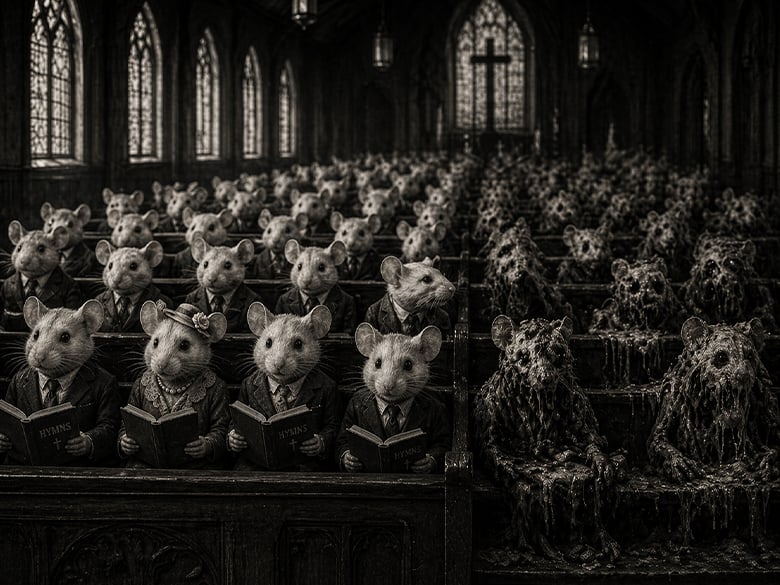
Scientists recently discovered that repeatedly cloned mice eventually started falling apart.
At first, the clones seemed fine. They survived. They reproduced. They looked more or less normal.
But as the generations continued, the copies became unstable. Genetic mutations stacked up. The further they got from the original, the more fragile and distorted the clones became until eventually they could no longer survive.
It turns out that making copies of copies of copies has consequences.
Which brings us to American Christianity.
A lot of modern faith feels less like something alive and more like a spiritual Xerox machine. Churches are full of people who inherited a copy of a copy of a copy and never stopped to ask whether the thing they were handed still resembles the original.
The words are still there. The slogans are still there. The Bible verses are still there.
But something underneath has started mutating.
Christianity Was Never Supposed to Be Copy-and-Paste
The strange thing is that the Bible itself is full of people struggling, doubting, arguing, failing, grieving, and wrestling with God.
Job spends most of the book demanding answers. Ecclesiastes doesn’t read like scripture. It reads like the private journal of a man who is one inconvenience away from walking into the ocean. That book is in the Bible. Canonized. Considered sacred. Which suggests that someone, somewhere, decided that kind of honesty belongs inside faith — not outside it.
Thomas doubts. Jacob literally wrestles with God. Peter screws up constantly. Even Paul tells people to stop acting like children and grow up.
Faith was never meant to be inherited like grandma’s china cabinet or your uncle’s old fishing hat.
It was supposed to be tested.
Not destroyed. Not abandoned. Tested.
Because faith that has never been questioned is not faith. It is brand loyalty.
The Church Prefers Dependence
A lot of churches do not actually want mature people. Mature people ask hard questions. Mature people notice contradictions. Mature people do not panic every time a pastor says something dumb from the pulpit.
What many churches actually want is dependence.
They want people who need the pastor to explain every verse, define every enemy, decide every political issue, and tell them what kind of coffee shop is secretly demonic this week.
Instead of helping people grow, many churches keep people permanently trapped in spiritual infancy.
Milk forever. Never meat.
Like some kind of giant religious mama bird endlessly chewing up half-digested theology and spitting it back into the mouths of adults who have been trained to mistake certainty for wisdom.
That is not discipleship.
That is dependence with a worship band.
Copies Lose Something Every Generation
Jesus talks about loving enemies, forgiving people, caring for the poor, refusing violence, and giving up power.
Then the copying process begins.
Jesus becomes church tradition. Church tradition becomes denominational culture. Denominational culture becomes political identity. Political identity becomes culture war panic. Culture war panic becomes a guy with a podcast microphone and a thumbnail face screaming about pronouns.
This happens across the entire spectrum. On one end, Jesus becomes a culture war general — nationalist, outraged, mostly concerned with enemies. On the other end, Jesus becomes a therapist who never challenges anyone, a cosmic affirmation machine who exists primarily to validate whatever you already believe. Both are copies. Both have drifted. The megachurch and the progressive faith community can both produce adults who have never once let their beliefs cost them anything.
By the end, the thing barely resembles the original.
The cross necklace is still there. The Bible verse in the Instagram bio is still there. The “God first” t-shirt is still there.
But the actual teachings have been replaced by fear, outrage, nationalism, conspiracy theories, and the sort of consumer Christianity where Jesus mostly exists to help people win elections and feel superior to strangers.
Eventually you are not looking at Christianity anymore.
You are looking at a clone that has been copied so many times it can barely stand on its own legs.
Borrowed Faith Collapses Under Real Life
Borrowed faith works fine until something hard happens.
It works until someone loses a child. Or gets divorced. Or has a panic attack. Or comes out. Or gets sick. Or watches their prayers bounce off the ceiling like a racquetball.
That is usually when the copy starts breaking down.
Because what many people were handed was never a living faith. It was a script. And scripts only work as long as life stays on script.
The moment life becomes painful, unfair, confusing, or morally complicated, borrowed certainty starts to crack.
People suddenly realize they were given answers for a world that does not exist.
They were taught that good people are rewarded, prayer fixes everything, suffering always has a purpose, doubt is dangerous, and God always has a neat little lesson hiding inside every tragedy.
Then real life shows up and beats the hell out of all of it.
What Gets Forged Doesn’t Fall Apart
This does not mean people should believe whatever they want.
It does not mean truth is fake or that every idea is equally valid.
The obvious objection is that this argument is just intellectual cover for giving up. That every generation of drifters and doubters has dressed up their departure in the language of authenticity. That “forging your own faith” is often just a polite way of saying you stopped showing up.
That objection deserves respect. Because sometimes it’s true.
Some people don’t forge anything. They just leave. They trade inherited certainty for inherited skepticism, swap one borrowed script for another, and call it growth. The coffee shop replaces the sanctuary but the dependence stays exactly the same.
The difference between forged faith and abandoned faith isn’t comfort. It’s that forged faith still costs you something.
It means faith has to be lived long enough to become your own. It has to survive grief. Failure. Doubt. Anger. Therapy. Questions. Disappointment. Silence.
Faith has to be metabolized. It has to pass through your own body, your own mistakes, your own relationships, your own losses, your own hopes.
You can usually tell the difference in a person. Someone with forged faith can sit with a grieving friend without reaching immediately for explanations. They don’t need the tragedy to have a lesson. They’ve already made peace with the silence. They’ve already been in it long enough to know that God doesn’t always show up on cue, and they stayed anyway — not because it was easy, but because somewhere in the wrestling they found something they couldn’t unfind.
That is a different thing entirely from someone who has simply never been tested.
The scientists who studied those cloned mice noted something worth remembering: it wasn’t that the copies were bad at the start. Most of them looked fine. The instability accumulated quietly, generation by generation, until the genetic weight of all that borrowed material became too much to carry.
Faith works the same way. A copy can sustain itself for a while. It can look healthy. It can reproduce. But copies don’t have the resilience of something that fought its way into existence — something tested, questioned, and still standing on the other side.
The question worth asking isn’t whether your faith is orthodox enough or progressive enough or culturally acceptable enough.
The question is whether it’s actually yours.
Whether it has survived anything. Whether it has cost you anything. Whether you have ever genuinely risked being wrong about it.
Because a faith you’ve never honestly questioned isn’t protecting you from anything.
It’s just a very old security blanket.
If this felt a little too accurate, there’s more where that came from.
The Tribulation Survival Guide
— same world, fewer guardrails.

Or skip the algorithm →
Want to know how you’d actually survive the end times?
You Missed the Rapture — find out how you die
Podcast, socials, and the rest →












 Ad-Free & Subscriber Log-In