

I’m feeling encouraged today thinking about the disastrous ending of Game of Thrones.
I sometimes joke that I actually love the ending of that story. Arya kills the Night King and saves the day. The End. Nothing happens after that. But, alas, the story did not end there. Instead, the show kept going, and where it kept going to changed the way we understood everything that came before that ending.
I was prepared for something like that, though, because before I started watching Game of Thrones, I had watched Lost. And years before that, I had watched The X-Files.
So even though I got hooked on Game of Thrones, I was cautious about it. I couldn’t wait to see what happened next and I couldn’t be sure what might happen next — especially after poor Ned Stark lost his head — and every new episode was an event I eagerly anticipated.
But I also remembered the Smoke Monster and the Smoking Man, so I reserved my judgment. I remembered how Lost got lost, and how the threads of the X-Files conspiracy mythology got so tangled that they became meaningless. I had learned that you can’t be sure what to make of a story until you know how the story ends.
So I kept watching Game of Thrones, through all the murder and muck. “As long as they don’t kill the little man or the little girl, I’ll keep watching,” I said. And I did. But I was reserving judgment — reserving trust — until we learned how the story ended, because the end of the story tells us what the story means.
The meaning — or lack of meaning — of the ending shapes how we understand the whole story that came before. A meaningless ending can make the whole thing meaningless. A good ending can redeem what might have otherwise only seemed meaningless.
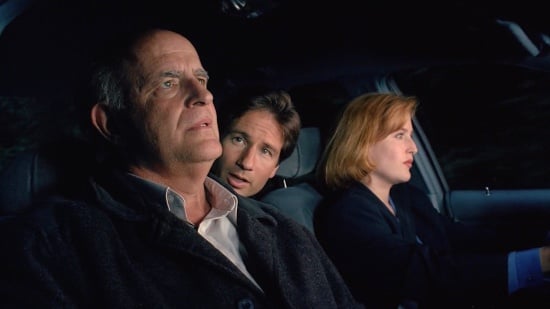
Or, at least, that’s what Clyde Bruckman* came to think.
All of this is a problem for historians, because in a sense they’re trying to tell a story that hasn’t ended yet. They’re trying to tell a story that doesn’t end. And because we cannot know the ending, none of us can ever be sure what to make of it.
Historians can try to get around this problem by taking on smaller, seemingly self-contained little slices of history — smaller chunks that can be addressed as a story with a beginning, a middle, and an end. But “self-contained” turns out to be a frustratingly hard-to-find aspect to most of history.
Think of Taylor Branch’s monumental three-book history of the Civil Rights Movement, America in the King Years. Each thick volume in that Pulitzer Prize-winning trilogy covers a set time — “1954-1963,” “1963-1965,” “1965-1968.” This is a story told from beginning to end. It’s a remarkable, awe-inspiring story, full of heroes and giants and living legends. It is the uplifting story of a nation waking from its slumber to finally grasp the full scope of its creed and its highest ideals, to finally — centuries after its founding — begin to enact laws that would make its Constitution meaningful and its claim to be a democracy something tangible and real.
Branch finished writing his history in 2006. He published an abridged, one-volume edition of his great work in 2013. That came out just before the Roberts Court revised and revoked the meaning of the Constitution with its decision in Shelby County, beginning the dismantling of the Voting Rights Act of 1965 that the corrupt and corrupting court completed this year. The abridged version of the story was upended as soon as it was published.
It turns out the story Branch wrote hadn’t ended yet. And it wouldn’t end the way he thought it did. From where we sit now, we can see that the story did not end in triumph for the movement and for civil rights and for the nation. The story would end later, with a whimper, due to the scrawlings of lawless, unprincipled little men — characterless characters who seem less than the shadows of the great champions of the story Branch thought he was telling.
I’m thinking about all of this today — about the disappointing ending of Game of Thrones, and about “Clyde Bruckman’s Final Repose,” and about America in the King Years — because I just read this article on Matthew Avery Sutton’s new book, Chosen Land: How Christianity Made America and Americans Remade Christianity, a “a 500-year historic survey of Christianity in America.”
Beginning with Native Americans and how they viewed religion as part of their culture, Sutton exposes the “vibrant and diverse” place 15th-century America was before “the Christian invasion began.”
From there, he moves on through early Spanish conquests and missions work and writes about how Christopher Columbus believed God had chosen him as part of fulfilling the Bible’s prophecies of the last days. Sutton explains how Spanish soldiers often justified beating and killing Indigenous men and raping Indigenous women, while at the same time some Franciscan monks complained these acts “‘brought discredit on our teaching.’”
The book concludes with President Donald Trump’s second presidency and how he began “not just as a politician, but a self-anointed messiah.”
… In between these two historical worlds of past and present, Sutton shows how Christians in America rebranded and redefined Christianity to gain followers and influence over the centuries, since America’s founding documents prohibited federally sponsored churches. Each Protestant denomination competed for followers like companies would compete for buyers in the free market.
The book sounds interesting. I haven’t read it — not sure if it’s even out yet — but the discussion of Sutton’s general ideas here is intriguing. Some points in this article I agree with, some less so.
But I also see a very big problem here, an obstacle that every such history ending with “the present” faces.
The present is not the end of the story. The present is the middle of a story that has not yet ended — a story that does not end here.
Go back a hundred years to 1926 and think of a historian writing what would then only be a 400-year “historic survey of Christianity in America.” That book might start just the same as Sutton’s, but it would end with … Calvin Coolidge. It’s easy to see now, in 2026, that the Epoch of Coolidge was not the end of the story. We’re not tempted or misled into viewing 1926 as the apotheosis or culmination or conclusion of all that came before.
But we are tempted and misled into viewing 2026 like that. I just fell into that trap myself, right here, up there where I talked about how the story of the Civil Rights Movement didn’t end in 1968 because it actually ended, again, in 2013, and yet again in 2026.
But now is not the end of that story. Now is just now. That story is still happening. The Second Reconstruction of the King Years may have ended, but we do not and cannot yet know the rest of the story or how what new “endings” and new beginnings are yet to come.
It’s tempting, and depressing, to assume that the story of the Second Reconstruction will parallel the story of the first for another generation. The parallels, so far, are dismayingly close, with the federal government and the Supreme Court playing the same role they played the first time around, abandoning and betraying the promise of full democracy. But that doesn’t mean we’re doomed to generations of the new Plessy regime that John Roberts and Sam Alito dream of imposing.
We are here, and here is Not Good. But here is not the end of the story.
The Age of Trump is not the end of the story of “Christianity in America” any more than the Age of Coolidge was. History always gets renewed for another season. The story keeps going. We can’t wait for the ending to find out what it all means because it doesn’t have an ending that any of us will live to see. (Unless it does, in which case we still won’t.)
“I do not pretend to understand the moral universe,” Theodore Parker said. “The arc is a long one. My eye reaches but little ways. I cannot calculate the curve and complete the figure by experience of sight.”
We cannot see the end of the story, but we can see enough to know that it does not end here. The arc of the moral universe is long, and it does not bend toward Trump.
Again, I appreciate the dilemma for historians like Sutton. Grand sweeping histories have to stop at the present because they can’t go beyond the present. The best they can do is something like Giovanni Villani’s unfinished sentence. “And this plague lasted until _____” Villani wrote in 1348 in his unfinished history of Florence. He left the end date blank so he could fill it in later. He didn’t get a chance to do that because he died from the plague in 1348.
If you’re writing a Nuova Cronica of American Christianity now, it has to end in the middle of the current plague because this is where we are, right now. But the story itself doesn’t end here. This is the present, not the conclusion.
Imagine a grand, sweeping history of music published in 2004. It’s called “From Bach to Bedingfield.” The ending of this story would shape how we understand everything it tells us about the beginning and the middle of that story. Bach, Mozart, Louis Armstrong, Robert Johnson … all would be seen as a path leading inevitably and inexorably toward the 2004 release of Natasha Bedingfield’s breakthrough 2004 album Unwritten.
But as that great poet and chanteuse herself reminds us, that would be a foolish distortion of the story, mistaking one small part of the ongoing story for the ending that gives it meaning. Any one given album or composition or artist is only ever a part of the story, not the ending of it. “Today is where your book begins / The rest is still unwritten.”
Fifty years from now, some historian will write a history of Christianity in America, from Columbus to the present. The Trump years will be a part of that story, but only a part. And that part of the story will appear very different from the way it appears now — different in ways we cannot foresee or imagine. Fifty years from now, another historian will write a new massive history of the Civil Rights Movement. This new branch of history won’t be the end of that story either.
If we trick ourselves into thinking that the present is the end of the story, we’ll never do what we should be doing, which is making sure that those future historians have something really good to write about.
* OK, let’s ruin that allusion by examining its layers. “Clyde Bruckman” is a fictional character played by Peter Boyle in a memorable monster-of-the-week episode of The X-Files. Bruckman is a sad-sack Willy Loman-esque insurance salesman who also happens to be psychic. He knows exactly how everyone he meets is going to die. He knows exactly how he is going to die. This makes him cynical and fatalistic and not very good at selling insurance. Death, as he sees it, is a meaningless ending that makes everyone’s story meaningless. But in the end, he changes his understanding of that. And the end of his story changes how we see the whole story he’s in, reshaping a light comic diversion into something more moving and thoughtful than expected.
Boyle’s character in that story is named after the writer and director of many of the greatest comedies from the silent film era. Clyde Bruckman wrote classic material for W.C. Fields, Buster Keaton, Harold Lloyd, the Three Stooges, and Laurel and Hardy. That epic pie fight in Laurel and Hardy’s Battle of the Century? That was Clyde Bruckman’s handiwork. The real Clyde Bruckman was a funny man. He was also a troubled and traumatized man. He shot himself in the head in the restroom of a restaurant in Santa Monica in 1955, apologizing in his suicide note that “I have no money to pay for a funeral.”
I don’t think Darin Morgan named Boyle’s character “Clyde Bruckman” because he wanted the sad ending of the real Clyde Bruckman’s life to shape how we understand this story he wrote for The X-Files. I think Morgan gave this character that name to challenge the idea that the real Clyde Bruckman’s sad ending defines the full meaning of his life, and to suggest that his story was more beautiful and meaningful than the poor, haunted comedian himself was able to see.
If you or someone you know is in crisis, call or text the 988 Suicide & Crisis Lifeline at 988 for help.
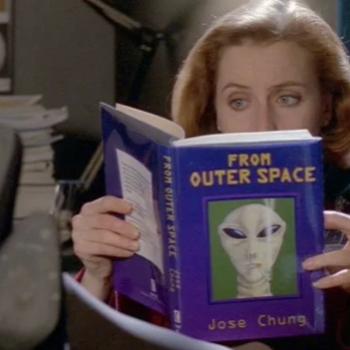
If you or someone you know has never seen “Clyde Bruckman’s Final Repose,” it can be viewed for free (with commercials) on Pluto TV. And then, while you’re there, watch (or re-watch) “Jose Chung’s From Outer Space.” Historians could learn a thing or two from that one too.






 Ad-Free & Subscriber Log-In