

NPR’s Neda Ulaby looks at David Barton’s favorite painting: “Conservative Christians love this painting of George Washington. The event it depicts may not have happened.”
This is about the image of Washington praying at Valley Forge, which some regard, as Ulaby says, as “a powerful statement about how the United States was founded as a Christian nation.” Specifically, this is about Arnold Friberg’s giant painting of this apocryphal scene, his 1975 “The Prayer at Valley Forge,” which was commissioned for the celebration of the Bicentennial.
According to the museum’s wall text: “‘The Prayer at Valley Forge’ is a poignant portrayal of George Washington during one of the most critical moments in the American Revolution. In the harsh winter of 1777-78, amidst the immense hardships faced by the Continental Army at Valley Forge, many believe Washington knelt in a moment of solitary prayer, seeking guidance and strength from God.”
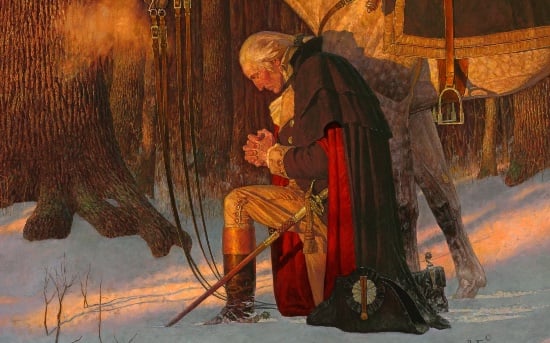
I would suggest that everything you need to know about the “conservative [white] Christians” who revere this painting and the “founded as a [white] Christian nation” ideology they use it to promote is revealed by the fact that it is a painting of George Washington praying at Valley Forge and not a painting of Joshua Chamberlain praying at Gettysburg. Once you understand why these folks love the former and would despise the latter, and why, you’re 99% of the way to understanding just about everything about America in 2026.
Ulaby’s report focuses on whether or not the prayer depicted in Friberg’s painting “really happened.” And the answer is that it almost certainly did not. This was a legend concocted by Parson Weems, who cashed in with a notoriously mythologizing “biography” of Washington published shortly after the first president’s death:
Historians do not believe there is much evidence for this story. Thomas Tweed, professor emeritus at the University of Notre Dame, has written about its origins, which came from a popular biography written shortly after Washington’s death entitled The Life of George Washington: With Curious Anecdotes, Equally Honourable to Himself and Exemplary to His Young Countrymen.
“Parson Weems, Washington’s early biographer, concocted that story — as well as the yarn about George and the cherry tree — to establish the moral character and personal piety of the first president and, thereby, advance a particular view of national belonging and church-state relations,” Tweed wrote in an essay for Yale University Press.
After the publication of Weems’ book in 1800, images of the first president praying became a meme — long before there were memes. Paintings and engravings were reproduced on china plates and on postage stamps in the 1920s. It appeared on the cover of the popular magazine The Saturday Evening Post in 1935, and reproduced in stained glass in a special prayer room built in the U.S. Capitol for members of Congress in the 1950s.
Tweed’s article, like Ulaby’s, capably covers the dubious history depicted in the painting, so let us consider instead something that Friberg and all of those earlier painters and illustrators got right in this image: Washington’s outfit — his uniform and his clothing.
The clothing Washington wore at Valley Forge was made by his personal tailor at Mount Vernon, an Englishman named Andrew Judge. Judge came to Virginia as an indentured servant and worked for the Washingtons in the 1770s until the term of his indenture was completed, after which he moved to Alexandria, Virginia. So Andrew Judge was never President Washington’s tailor, but he was General Washington’s tailor.
Every painting and image we have of George Washington during the Revolution shows him wearing the clothes that Andrew Judge made for him. All of those snazzy uniforms and martial regalia and coats and capes were Judge’s handiwork.
But that is not why we remember Andrew Judge. We remember him because of his daughter. Andrew Judge was a good tailor, but he was a lousy father.
While indentured at Mount Vernon, Judge fathered a child with Betty, an enslaved woman that the Washingtons did not permit to marry or to have a surname. Martha Washington had inherited Betty as her property after the death of her first husband. When Betty’s daughter was born at Mount Vernon in 1773, the white laws of the white colony of Virginia stated that because she was the property of Martha Washington, her child was also Washington’s property. And so Oney Judge was born a slave, not a person but a thing. A thing “owned” by Martha Washington. (“People as things, that’s where it starts.”)
Oney Judge grew up enslaved and worked for Martha Washington at Mount Vernon all through the Revolution and early years of the new country under the Articles of Confederation. After the Constitution was adopted and George Washington was elected as the first president, she was moved with the family to the president’s house in Philadelphia, which served as the capital during Washington’s years in office. (Washington was not president in “Washington,” it was still being built and would not be named that until after his death.)
Living in Philadelphia created a problem for the Washington household. Pennsylvania law held that anyone who lived here uninterrupted for six months had established legal residency, and residents of Pennsylvania were, according to state law, not permitted to own slaves. So George and Martha Washington made regular visits to Mount Vernon and regular “tours of the South” to ensure they never accidentally established legal residency here.
This residency law also applied to all of the slaves in Washington’s household, which meant the Washingtons also had to ensure that the half-dozen enslaved people who lived with them at the president’s home in Philly got cycled out of town and back to Mount Vernon every five and a half months or so.
That’s why the president’s entire household was preparing a brief visit back to Virginia in May of 1796. This is also when Oney Judge learned that Martha Washington intended to “gift” her to Washington’s granddaughter as a wedding present. And so, as Oney Judge put it in an 1845 interview:
Whilst they were packing up to go to Virginia, I was packing to go, I didn’t know where; for I knew that if I went back to Virginia, I should never get my liberty. I had friends among the colored people of Philadelphia, had my things carried there beforehand, and left Washington’s house while they were eating dinner.
She boarded a ship to New Hampshire and never looked back. George Washington sent slavecatchers and government officials after her to recapture his “stolen property,” but her neighbors in the free state of New Hampshire helped her elude those kidnappers. Bounties and rewards were offered for her capture and re-enslavement for years afterwards.
Oney Judge married — becoming Oney Judge Staines — and had free children of her own. This apparently enraged Washington, who regarded those children as his rightful property — property she was obstinately and insubordinately stealing from him. So she wrote a letter to the president, offering a deal. She would voluntarily return to enslavement in his household if he would promise not to pursue the enslavement of her children. Parson Weems does not tell us whether or not Washington knelt in prayer to consider this offer, but we know that he rejected it, angrily, unable to abide the suggestion that he would deign to negotiate with a woman who was only three-quarters white.
Oney Judge Staines joined a church in New Hampshire and became known and respected for her devotion and piety. She was, her neighbors all said, a good Christian woman. A painting of Oney Judge kneeling in prayer would be a depiction of a real and frequent actual historical event.
She lived a free woman in New Hampshire until her death in 1848. The year before that she was interviewed by the Rev. Benjamin Chase, writing for an abolitionist newspaper. Chase asked her about the pious, “Prayer at Valley Forge” myth of George Washington as portrayed by Parson Weems and the like. She said “the stories told of Washington’s piety and prayers, so far as she ever saw or heard while she was his slave, have no foundation. Card-playing and wine-drinking were the business at his parties, and he had more of such company Sundays than on any other day.”
Regarding her eyewitness account of life as a slave in the president’s house, Chase wrote:
Card-playing and wine-drinking were the business at his parties, and he had more of such company Sundays than on any other day. I do not mention this as showing, in my estimation, his anti-Christian character, so much as the bare fact of being a slaveholder, and not a hundredth part so much as trying to kidnap this woman; but, in the minds of the community, it will weigh infinitely more.
Chase is, appropriately, gobsmacked by the hypocrisy of the white Christians who gave greater weight to “card-playing and wine-drinking” than to “the bare fact of being a slaveholder” and “trying to kidnap this woman” (and her children!). But this isn’t so much hypocrisy as a coping mechanism and a permission structure. It is the psychological mechanism by which these white Christians are able to wake up every day and continue to think of themselves as white Christians.
How can they regard themselves as disciples of Jesus when they enslave others? How can they tell themselves, every day, “I am a good person,” when they are, every day, complicit in staggering injustice and cruel harm to their neighbors?
“Whoever claims to love God yet hates a brother or sister is a liar,” 1 John 4 says. And at some level they know this to be true. They know that their actions prove them to be liars — to be Bad People. They know. And yet such knowledge is intolerable, unbearable. It is undeniable, yet it must be denied because their whole identity — whole self-image and sense of meaning — depends on them telling themselves, every day, “I am a Good Christian and a Good Person.”
They managed to semi-maintain this illusion and this self-deception by pretending that some token claim of moral superiority “weighed infinitely more” than the glaring, massive sin at the true heart of their lives and identities. They kept the self-deception going by telling themselves “I abstain from card-playing and wine-drinking and this makes me a Good Christian and a Good Person, never mind my enslavement and oppression of God’s children.”
Did this work for them? Well, sort of.
It worked the same way that it worked for later generations of their descendants, who told themselves “I support anti-Communism and this makes me a Good Christian and a Good Person, never mind my support for segregation and tacit support for lynching.” And it worked the same way it worked for those people’s children and grandchildren, who tell themselves “I want to criminalize abortion, and this makes me a Good Christian and a Good Person, never mind my devoted support for repealing every achievement of the Civil Rights Movement and my steadfast opposition to pluralist democracy.”
It can kind of sort of work for you if you really devote yourself to the denial of the undeniable and just work really hard at reassuring yourself that, whatever nagging doubts may flicker at the edge of your thoughts, surely you must be a better person than those card-playing, wine-drinking, Commie baby-killers.
And but so anyway, no, George Washington never knelt in prayer before chopping down a cherry tree at Valley Forge.








 Ad-Free & Subscriber Log-In