

It is a scene so familiar in our imaginations that it has become iconic. On the top of a hill in the middle of the impromptu gathering is the man everybody has been talking about and has gathered to check out. He doesn’t look any different from any number of other guys in the crowd. In spite of the stories that seem to pop up everywhere this man goes, you would not be able to pick him out of a lineup. Then he opens his mouth, and the world is forever changed. Here is Matthew’s full version of the Beatitudes, today’s lectionary gospel reading: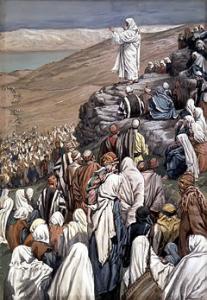
Blessed are the poor in spirit, for theirs is the kingdom of heaven.
Blessed are those who mourn, for they will be comforted.
Blessed are the meek, for they will inherit the earth.
Blessed are those who hunger and thirst for righteousness, for they will be filled.
Blessed are the merciful, for they will receive mercy.
Blessed are the pure in heart, for they will see God.
Blessed are the peacemakers, for they will be called children of God.
Blessed are those who are persecuted for righteousness’ sake, for theirs is the kingdom of heaven.
Blessed are you when people revile you and persecute you and utter all kinds of evil against you falsely on my account.
Rejoice and be glad, for your reward is great in heaven.
We don’t know the details of the setting, of course—the traditional images are evocations of centuries of imagination. Maybe it was a cloudy and windy day. Maybe these words were spoken inside someone’s home or a synagogue. Maybe they were shared in private only with a few intimate friends and confidants. Maybe the man never spoke these words at all and they are intended as a brief summary, written decades after the fact, of how he lived and called others to live.
But the Beatitudes are so beautifully poetic, so rich yet sparse, so gentle yet powerful, so all-encompassing and embracing that over the centuries they have seeped into the Christian ethos as the summary expression, as the “mission statement” of a religion and all it professes to stand for. The beauty and familiarity of the language can easily disguise what is most remarkable about the Beatitudes—they are a crystal clear call to radically uproot everything we think we know about value, about what is important, about prestige, about power, and even about God. They are a challenge to fundamentally change the world.
The Roman-dominated world into which these words came like a lightning bolt was not that different from our own. One’s status or rank in the social hierarchy depended on factors such as power, birth, economic status, education, gender, race—usually some combination of these. Those who lacked these qualities, whether through their own fault or because of matters entirely outside their control, had little opportunity to rise above their lowly state.
Throughout season two of “The Chosen,” Jesus’ notoriety continues to grow; about halfway through the season Jesus asks the disciples to help him plan for a “big sermon” that he intends to give soon. Some of the disciples are assigned crowd control (they are expecting thousands of people), while others are tasked with finding the perfect location for the event. Flyers are written and distributed throughout the towns around the Sea of Galilee. And Jesus asks Matthew, who has been taking notes on everything that has happened since he was called to follow Jesus some months earlier, to be his sounding board and provide critical input as he works through multiple drafts of the sermon.
By the time we reach the final episode of the season, the sermon’s content is set—except for the beginning. Creative writers and speech givers know that often the introduction is written last—Jesus goes off by himself overnight to reflect and pray. At dawn he awakens Matthew and says “I’ve got it . . . a map. Directions where people should look to find me.”
The Beatitudes follow; as Jesus blesses the poor in spirit, those who mourn, those who hunger and thirst for righteousness, the merciful, the pure in heart, the peacemakers, and the persecuted, the camera cuts to scenes of various disciples and followers who exemplify each category in Jesus’ introduction. When Jesus is finished with the blessings, with tears in his eyes Matthew asks, “How is it a map?” Jesus replies, “If someone wants to find me, these are the groups they should look for.”
Every once in a while we hear on the news or read online about a community in which a debate has arisen over whether it is permissible to put a plaque or a statue containing the Ten Commandments in a law court, a state house, or a public school. But imagine a community or a society with governing practices and policies infused with the energy, not of the Ten Commandments, but of the Beatitudes. Imagine a legislative body whose guiding North Star was the mercy and compassion of the Beatitudes rather than the cold and clinical justice of the Ten Commandments. How would such a community’s or society’s attitudes and policies concerning the poor, the disenfranchised, those who are struggling, those who have fallen through the cracks, change as it learned to see such “unfortunates” not as a problem, but rather as the very face of God?
An intriguing thought experiment, but ultimately the Beatitudes are not about transformed social institutions. They are about a transformational way of being in the world. The Beatitudes are far more than a beautifully poetic literary statement. They are the road map for how to carry faith into the real world. The world we live in is no more naturally attuned to the challenge of the Beatitudes than was the world in which they were first spoken. Individuals infected with the energy of the Beatitudes are those whose responsibility it is to help transform reality. The Beatitudes are a call to get to work.











 Ad-Free & Subscriber Log-In