

• Here’s the trailer for Becoming Benjamin Lay, a new documentary on the Quaker abolitionist who was one of the most famous and most infamous people in America in the early 1700s.
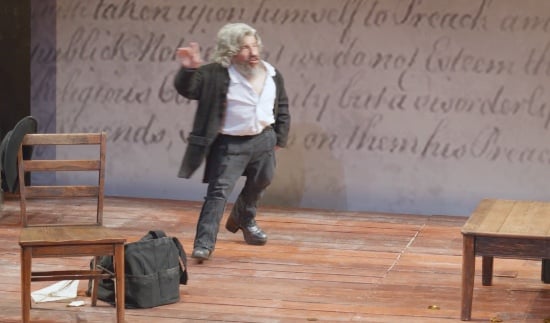
Jordan Snowden writes about the premiere of this documentary for the Pittsburgh Review.
Lay was a confrontational writer and speaker and an aggressively theatrical activist. He was an angry man who made other people angry. He was also a little person who lived in a cave north of Philadelphia (a cave that, according to Benjamin Franklin, held one of the best libraries in Pennsylvania). He was, in other words, impossible to ignore — even if his abolitionist message was, at that time, bewildering to most of his white contemporaries.
The documentary by Tony Buba and Marcus Rediker seems to argue that Lay was not so much forgotten by history as he was deliberately marginalized and erased. That makes sense to me. When pearl-clutching evangelicals were panicking that Jonathan Edwards was being “cancel-cultured” due to his egregiously sinful, God-denying and God-defying human trafficking, they rushed to defend Edwards with the standard canard “he was a man of his time.” Then, when I pointed out that Edwards was also a man of Benjamin Lay’s time, they dismissed Lay as an obscure, marginal, fringe figure whom no one took seriously. It seems contradictory when the same historians who tout George Whitefield’s friendship with Franklin as evidence of his prominence and influence turn around and shrug off Lay’s friendship with Franklin as meaningless. Franklin was Lay’s publisher and publicist, and Franklin was good at those tasks.
I just can’t believe Lay was unknown or passively ignored in his time. Lay was skilled and successful at forcing other people to pay attention to him. He may not have had as much talent at persuasion as someone like John Woolman did, but people knew who he was and what he had to say. If he was ignored, he was actively ignored — an act that involved choice and effort.
If historians of American Christianity want to convince me that it’s possible to speak of “Jonathan Edwards’ time” as a distinct epoch from “Benjamin Lay’s time,” then they’re going to have to show me that Edwards and the other theologians of the First Great Awakening somehow managed to remain oblivious to all of Lay’s headline-grabbing antics and prolific pamphleteering. I agree that they dismissed his arguments, but I suspect there’s also some record of them doing so. Let’s find that and give it a closer look.
In any case, again, it is enough of a problem for Jonathan Edwards that he was a man of his time. His most famous sermon — “Sinners in the Hands of an Angry God” — was delivered smack dab in the middle of the White Panic of 1741 and employs images almost certainly influenced by the pyres on the streets of Manhattan. White Christians in New York City burned dozens of Black slaves at the stake that summer out of fear of a non-existent conspiracy involving a “slave revolt.” The fear of such a revolt was ever-present because every white “man of this time” knew and understood that slavery was monstrously wrong, and that any humans subjected to it must be compelled to seek liberation and, perhaps, the vengeance they obviously deserved. 1741 is proof of this knowledge and understanding. It is proof that the ignorance of these “men of their time” is, in fact, vincible.
But even if we squint and stretch and strain to suggest Edwards could have been ignorant of the panic in New York and if we pretend that he could have easily ignored the defiantly attention-seeking Lay, there is still the matter of the four people (at least) who believed that slavery was sinful and wrong and whose opinions on the matter could not have been unknown to or ignored by Jonathan Edwards because those four people lived in his house.
Also too, note again how utterly disrespectful it is of Edwards himself to rush to defend his reputation against the recognition that he was as much of a damnable sinner as he insisted we all are. He was a Calvinist. Making him out to be some kind of exception to the doctrines of depravity and original sin that he himself believed and taught seems more like “cancellation” of the man than any attempt to account for his well-documented sins.
• A couple of weeks ago here we discussed various pedagogies of moral accommodation. David Dark’s language for this involves phrases like “We become what we stomach. We must therefore be very careful about what we stomach.”
That’s from this post, in which he shares a poem by Michael F Dubois that addresses the same ghastly presidential statement that prompted the post here. This is the beginning of Dubois’s poem:
A WHOLE CIVILIZATION WILL DIE TONIGHT
My son needs lunch, and I have
to put his backpack together,
but a whole civilization will
die tonight, so I’m wondering
if they’ve closed their schools.
Like, a snow day, maybe,
exceot instead of snow it’s
“keep your children home so
if you die, you die together” —
instead of “we’ll open back up
once the plows have cleared” it’s
“we don’t know if we’ll be here
tomorrow, hold your babies tight.”
Click over to David’s place to read the rest.
• Following up on another recent post here, Hannibal Hamlin* exegetes the Not The Bible passage preached on by Pete Hegseth, while discussing “The Trump Administration’s Casual Blasphemy.” Hamlin sorts out why Jules’ fake “Ezekiel” speech in Pulp Fiction sounds so jumbled and implausible to those actually familiar with the Bible, then discusses the true source of this pseudo-scripture in Quentin Tarantino’s script:
Tarantino surely had no interest in biblical accuracy or even logical coherence, just in giving Jules some grand, Bible-sounding language for the scene. He also didn’t write it himself, but lifted it from a 1973 Japanese B-movie, Kiba the Bodyguard, starring karate master Sonny Chiba, though it was only the American release that began with the (phony) quotation from “Ezekiel 25:17.” As at least one blogger has pointed out, though, it may be Jules, rather than Tarantino, who is borrowing from the martial arts movie. Or rather it could be both, in different senses, Tarantino taking the lines for his script, but perhaps imagining that it’s Jules who has adopted the speech from an action film he’s seen. But Pulp Fiction fans don’t care. It’s a slick (if gruesome) scene, and Jackson is at his ultracool best as Jules.
This idea that it is Jules, the character, who lifted these lines from a martial arts movie, saves the scene for me. That works far better than any reading of the scene that asks me to find his pre-murder recitation to be plausibly biblical because it’s just not — for all the many reasons Hamlin mentions. But the idea that a violent, recklessly harmful brute like Jules Winnfield would latch onto this speech because he “thought it was a cold-blooded thing to say to a motherf–ker before I popped a cap in his ass” is wholly believable and reveals something more about this vicious, casually lethal character — a character who has had so little exposure to the words of the Bible that he would be unable to recognize why the speech is such a failed pastiche.
This helps us better understand Jules Winnfield and it also helps us to better understand Pete Hegseth — another violent, recklessly harmful brute who also doesn’t care about the difference between the words of the prophets and a garbled quote from Sonny Chiba.
* The Ohio State professor, not the vice president from Lincoln’s first term who obviously never saw Pulp Fiction. (He probably never even saw Our American Cousin.)
I think I misspelled “Winnfield” in the previous post. Happy to correct that here and, while I’m at it, to correct the spelling from many years ago when I compared something to the golden light shining from “Marcellus’s briefcase.” That should’ve been “Marsellus.” OK, then.








 Ad-Free & Subscriber Log-In