

Pope Leo quoted the Bible in his Palm Sunday sermon on March 29.
Reuters’ reporter Joshua McElwee gave us those facts in his report from the service:
“This is our God: Jesus, King of Peace, who rejects war, whom no one can use to justify war,” Leo, the first U.S. pope, told crowds in brilliant sunshine.
“(Jesus) does not listen to the prayers of those who wage war, but rejects them, saying: ‘Even though you make many prayers, I will not listen: your hands are full of blood’,” he said, citing a Bible passage.
Well, two Bible passages, really, both from Isaiah.* The verse he quotes directly is Isaiah 1:15. Reuters didn’t offer the explicit chapter-and-verse reference there, but Vatican News did:
Pope Leo XIV went on to recall the prophet Isaiah’s words: “Even though you make many prayers, I will not listen: your hands are full of blood” (Is 1:15).
Those of us raised in white fundamentalist or white evangelical churches shouldn’t need some papist Catholic news outlet to identify the chapter and verse for us there. We are, after all, the Bible Christians. We are Bible-based and biblicistic. We are good Bereans, noble in character, who “examine the Scriptures every day” (Acts 17:11). We are Bible-memorizers and Bible-quoters. “Every promise in the book is mine,” we sing, “Every chapter, every verse, every line.” For us, it’s all about the Bible as the first word and the last word on any and every question.
We take great pride in that, ready and eager to go toe-to-toe against the calcified traditions and rituals and ornate theologies that have accreted around the simplicity of the text that we honor and elevate above all of that. We know that we know the Bible better than they do, so we know that our reliance on the words of The Word will always triumph over all of their earthly, human theologies and doctrines and dogmas.
And so it was darkly hilarious to watch white American evangelical leaders rushed to Twitter and in front of the cameras to proudly reveal that they cannot recognize the Bible when someone quotes it back to them.
Isaiah who? Never heard of him! Sounds “woke” — like one of those cultural Marxist hippies.
The Babylon Bee mocked the pope for daring to suggest that God will not listen to the prayers of those whose hands are full of blood, completely missing that they were responding to Isaiah, not to Leo. Allie Beth Stuckey — the “empathy is toxic” lady — said “There is absolutely no biblical basis … whatsoever” for the verbatim words of Isaiah 1:15. Steve Deace said the biblical passage quoted by the pope was “EXPLICITLY heterodoxical.”
I’m not a fan of any of those people, but I still cringed from the second-hand embarrassment of their basic Bible-recognition failure. They brought this humiliation on themselves, and they earned it, but it was still almost painful to watch. It was almost like with Malvolio at the end of Twelfth Night, when the pompous fool finally gets his comeuppance it’s so devastating that you start to feel sorry for him.
Still, though, I thought this was going to be a one-day story. Surely, after a half-dozen prominent public humiliations at the start of Holy Week, nobody else is going to repeat this mistake, right? I mean, even if other white evangelical leaders didn’t initially recognize the words in Leo’s sermon as being from the Bible, surely they noticed the multitude of others loudly pointing this out in response to that first round of Palm Sunday criticism. Maybe they didn’t see the stories about the sermon and immediately think, “Oh, he’s quoting from Isaiah 1:15,” but surely they’d have caught a glimpse of one of the many, many follow-up stories that said “American Christians Didn’t Recognize Isaiah 1:15 As Being From The Bible.”
And yet, no. Because here we are, more than two weeks after Palm Sunday, and this is still happening. Mike Johnson, the extravagantly Southern Baptist speaker of the House, just yesterday characterized Leo’s direct, verbatim quotation of Isaiah 1:15 as the pope “wading into political waters.”
It’s been weeks and these white American Christians still do not recognize the words of the Bible as the words of the Bible.
Johnson’s former Sunday school and VBS and Awana teachers must be mortified.
Part of the explanation here is that the passage Leo quoted is not one of the tiny handful of passages from Isaiah that white evangelical Americans would recognize. The “suffering servant” passages we Christians treat as messianic prophecies of Christ are familiar to them, and they used to buy and sell T-shirt with Isaiah 40:31 on them (“But they that wait upon the Lord shall renew their strength; they shall mount up with wings as eagles; they shall run, and not be weary; and they shall walk, and not faint”).** But most of Isaiah, like Amos, is just too woke. It all sounds too much like MLK. They avoid it, studiously.
As funny as the white evangelical declaration that Isaiah chapter 1 has “absolutely no biblical basis” may be, it’s still only the second funniest, and second-most-ridiculous story in the news right now about white evangelicals and the Bible they supposedly love so very much.
Here is the funniest: “Hegseth channels his inner Tarantino with fake Bible verse from Pulp Fiction.” (Brian Kaylor has a longer report and discussion of this.)
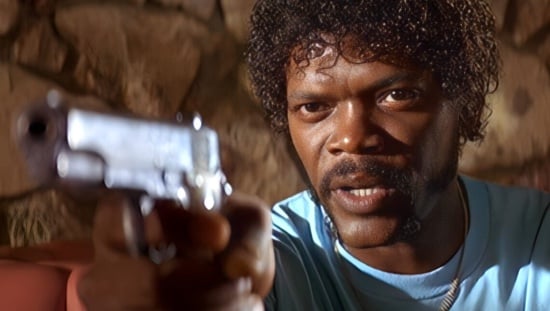
For those unfamiliar with the Quentin Tarantino movie Pulp Fiction, it features a hit man named Jules Winston, played (to the hilt) by Samuel L. Jackson. Jules likes to recite a terrifying Bible passage to his victims before killing them. As he explains in the movie, “I been sayin’ that shit for years. And if you ever heard it, that meant your ass. You’d be dead right now. I never gave much thought to what it meant. I just thought it was a cold-blooded thing to say to a motherfucker before I popped a cap in his ass.”
Jules says that this passage is from “Ezekiel 25:17” and what he recites does include some words that come from that passage in the Bible. But most of his “Bible quote” is not from the Bible. It’s something written by Tarantino and embellished by Jackson. It’s Bible-ish, a Bible pastiche that doesn’t quite work — too hodgepodge and too muddled. Ezekiel is a very strange book, but Jules speech doesn’t really sound anything like Ezekiel: “The path of the righteous man is beset on all sides by the inequities of the selfish and the tyranny of evil men. Blessed is he who, in the name of charity and good will, shepherds the weak through the valley of the darkness, for he is truly his brother’s keeper and the finder of lost children.”***
Good, respectable white evangelicals, of course, do not go to see R-rated movies. But when those of us who are not good and respectable white evangelicals first saw Pulp Fiction we tripped over Jules’ words in this scene. We heard all of that and thought: That’s very obviously not the Bible.
But apparently to Pete Hegseth and his fellow holy war-fighters at the Deus Vult Pentagon, that’s not so obvious.
Incidentally, the actual verse of Ezekiel 25:17 is a pronouncement of God’s judgment on a Philistine city on the Mediterranean coast. So it’s somewhat connected to what may be the third-funniest current news story about white evangelicals and the Bible.
That has to do with Greg Phillips, the MAGA man appointed by Trump to lead FEMA’s office of response and recovery. Phillips is a frequent guest on right-wing podcasts where he likes to tell stories — sometimes remarkable stories. Like, for example, the story he has told, repeatedly, about him teleporting 50 miles to a Waffle House in Rome, Georgia. Questioned about his claims of teleportation, Phillips doubled down on those claims. And he’s been loudly defending himself as a believer in supernaturalism now facing persecution from secularist liberals who deny all miracles.
And so some of his fellow MAGA evangelicals have stepped up to defend him from this ungodly persecution. How dare you question his belief in miracles?!?
Both Phillips and his defenders have invoked Acts 8:39 as a biblical basis for belief in supernatural teleportation. That verse reads: “When they came up out of the water, the Spirit of the Lord suddenly took Philip away, and the eunuch did not see him again, but went on his way rejoicing.”
“The eunuch” there refers to the man Philip the Evangelist just baptized on some random roadside, shortly after his dash through Samaria where he baptized sorcerers and prostitutes and anybody else he could find. The Ethiopian eunuch is, by the way, the first queer Black convert baptized into the early church. (And if you think that’s a misleading way of describing that, you haven’t read the book of Acts.)
It’s a stretch to read “the Spirit of the Lord suddenly took Philip away” as teleportation. The guy was in a hurry. Jesus had sent him to Jerusalem and all of Judea, and Samaria, and the uttermost parts of the earth. He had a lot of ground to cover, all while still checking in with his day job back in Jerusalem to make sure the immigrant widows weren’t being neglected.
But OK, sure, if they want to read that as “God teleported Philip away” I won’t argue. They’re reading about Philip, and having them reading about Philip is always a Good Thing.
Anyway, Acts 8 doesn’t tell us where the Spirit “took Philip away” to. All it tells us is that “Philip appeared at Azotus and traveled about.” Azotus is Ashdod, the same city that Ezekiel 25 proclaims God’s vengeance against.
Why was Philip in Ashdod, specifically? We don’t know. It doesn’t say. There was probably, like, a coven of Philistine witches who had begun feeding local orphans and so he was there to baptize them. You know, the usual Philip stuff.
* “King of Peace” also cites Isaiah, from Isaiah 9:6, a passage usually associated more with the Christmas season than with Holy Week: “For to us a child is born, to us a son is given, and the government will be on his shoulders. And he will be called Wonderful Counselor, Mighty God, Everlasting Father, Prince of Peace.”
The switch from “prince” to “king” there is good Easter theology, with many layers worth exploring. It’s bit jarring in terms of the liturgical calendar — noting the victory and vindication of the resurrection before the end of Lent — but hailing the Prince of Peace as the “King” of Peace could be a whole sermon in itself.
We Christians — me, Leo, Johnson, Hegseth, etc. — “interpret” Isaiah 9:6 as a passage about Jesus of Nazareth. That’s more of an appropriation than an interpretation, but that’s a whole other topic. The point here is that once you make that stretch, you’re also applying Isaiah 9:7-8 to Jesus, suggesting that from the first Easter Sunday onward, his reign of “peace” and “justice and righteousness” has already begun. That might not be what most American evangelicals are thinking as we sing the words of Isaiah 9:6 along with Michael W. Smith and Amy Grant at Christmastime, but Leo’s “King of Peace” asks us to remember that.
Leo also attributes the words of Isaiah 1:15 to Jesus, which is not who the author of Isaiah attributes these words to. This, again, is a thing that we Christians tend to do, projecting our Trinitarian theology back onto passages of the Hebrew Scriptures that were not written or intended to support Trinitarian theology. This is eminently orthodox and traditional and “conservative” as a Christian approach to the text, but not at all a literal reading or strict adherence to the text itself as originally written.
** Those T-shirts and inspirational posters with air-brushed soaring eagles were really popular except for between 2008 and 2016, because Barack Obama kept quoting that verse when people asked him to name a favorite Bible verse and, for white evangelicals, it was just another example of how that Black guy ruined everything.
Here in Philly, that verse has always been popular. Go Birds.
*** Timothy Christian School was not KJV-only fundamentalist, but the King James Version was our official translation. We were allowed to read the NIV or the Living Bible, but this allowance was meant to be supplemental to the reading and study of the King James, which is the translation we memorized huge chunks of for our weekly Bible memorization tests. (Real Bible Christians should be off book.)
We could get extra credit on those tests by memorizing longer passages, and so buy the end of the semester, some of us had built up enough extra credit to have plenty to burn and we’d play a game. We’d memorize the passage for the next week’s test in the NIV and then try to King James-ify it ourselves when we took the test. All of us fundie kids were much, much better at King James pastiche than this passage from Tarantino is.









 Ad-Free & Subscriber Log-In