

If we remembered that water takes its color from the vessel containing it, we would not interfere with the beliefs of others, but would perceive God in every form of belief. James Carse
Once a number of years ago, in the early days of a four-month sabbatical at an ecumenical institute, I presented an overview of my sabbatical project to my fellow institute resident scholars during our weekly scheduled seminar.
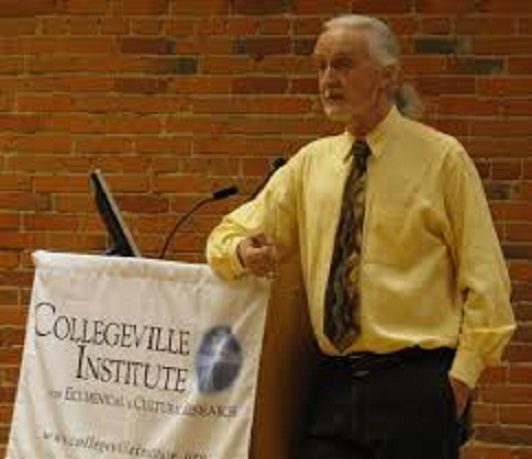
In its early stages, my project was an intended exploration of the difficulty of trying to life a life of faith with integrity when the Being one has faith in is remarkably absent and silent most of the time. I don’t remember much of the presentation (my project changed significantly over the following weeks), but I do recall that I said a lot about the importance of doubt, skepticism, and open-endedness in the life of faith. During the Q and A, a fellow resident who would turn out to be one of my best friends asked (with a bit of impatience, it seemed to me) “Vance, isn’t there something that a person has to believe with certainty in order to be a Christian?” I responded, in full philosopher mode, with another question: “I don’t know—is there?” I’m still wondering.
It is a natural human trait when attempting to build a belief system to draw boundaries, define terms, and clearly delineate standards of agreement or disagreement with others. This trait is particularly prevalent (and problematic) in the realm of faith and religion. In his essay “How Far We Are From God” (from his essay collection Breakfast at the Victory), James Carse tells a story from his time as a student at Yale Divinity School that illustrates the problem.
James and his fellow divinity student friend Bob are both Christians, but the details of their shared faith are frequently at odds. James was raised Presbyterian, and believes in a God he describes as “a distant, faceless entity you had somehow to find on your own . . . like the sky over Long Island Sound: gray, vast, cold, full of veiled threat.” James longs for an amazing, unmistakable experience of the divine, an experience that would let him know that he is one of the religious elite. “I wanted to be special among the citizens of faith. The certainty I longed for would, I thought, give my voice a discernible authority—a direct route to spiritual arrogance.”
Bob’s Episcopalian God, at least in James’ estimation, was remarkably laid back and chummy. “Bob’s God was always there to cheer you up . . . Bob didn’t seem to have to look anywhere at all. His God was always checking in with you. So you must wait. And God’s there, abounding in warmth.” While approaching James’ God required “dedication, sacrifice, and vigilance,” Bob’s deity was apparently happy with worship according to the Book of Common Prayer on a semi-regular basis. Bob’s God was an affable elderly aristocrat, “abounding in genuine warmth,” about as different from James’ distant, threatening deity as one could imagine.
Not surprisingly, believing in very different Gods led James and Bob to very different approaches to theology. James expects that everything should be reducible to logical and rigorous doctrine, if one expends sufficient time and effort; he professes that “I was impatient with Bob’s lack of theological earnestness.”
“You just can’t attach your faith to any old theology,” I argued. “You’ve got to have a theological context that will help you understand what your faith means and how to live by it. In fact, whether we realize it or not, Bob, our faith is already full of theological assumptions.”
To which Bob essentially responded, “Whatever,” or “Chill out.” James believes that the Bible is to be taken at face value, while Bob’s approach to Scripture is far less rigorous. So whose God is a closer reflection or representation of the real divine Being? James’ or Bob’s? Persons of faith, even ostensibly the same faith, have gone to battle—often literally and with deadly results—over just such disagreements.
I am reminded frequently on this blog of how touchy persons of faith can be when their favored understanding of God gets challenged. For instance, I suggested earlier this week that persons of Christian faith share a great deal in common with persons of other faiths, even with persons of no faith at all.
I wrote that an atheist could find much in the Sermon on the Mount in terms of guidance for living a moral life without committing to anything specific concerning God’s existence and nature, closing the essay by saying that “I believe that the values and moral commitments that are closely related to my belief in God are available to persons who are of a different faith than mine or of no faith at all.” I received several comments on my blog and on Facebook from Christians who were not amused, including the following (in non-edited form):
- If you’re so sure people don’t need religion to be ‘a fully moral person’ as you say then you’re your own inspiration and don’t need to cherry pick examples from a faith that comes with specific instructions which you don’t adhere to and obviously at a loss to understand . . . So what you have is a form of godliness that denies its power and entirely misses the point . . . You use the Sermon on the Mount as a guide on how to live a good human life which it’s not but the core principles of God’s Kingdom to come which is diametrically opposed to the world’s standards which if you’d read carefully you’d realize.
I responded somewhat snarkily (which I now regret—sort of), ending with
- I hope you’ll take the time to consider the possibility (likelihood) that Jesus’ mission was never to establish a religion in the first place. It was to show a way of life. Christianity is a very large tent, my friend–don’t become accustomed to thinking that your little corner is its entirety.
In an earlier post, in which, on a Sunday when the Gospel reading was the Beatitudes, I discuss how the beauty and familiarity of the text often disguises just how radical and earth-shaking what Jesus is saying actually is.
The very same commenter that I quoted above, who apparently looks regularly through my blog archives for heresy, posted this comment:
- Are you trying to turn liberalism into a religion along quasi Christian lines – seriously- the level of indoctrination is astounding and another reason to shut down the humanities disciplines at universities- including theology. . . And for the last time the Sermon on the Mount ‘beatitudes’ describe the principles of God’s Kingdom they’re not a pointer to Saul Alinsky or a humanist utopia- get it?
That one made me laugh, since “for the last time” and “get it?” were two of my father’s favorite conversation-stopping comments when he lost patience with me or my brother. I responded:
- Let me put it this way–I am a liberal because I am a Christian. Seriously. I love the “and for the last time” schtick–as if you are the final voice of authority. Get it?
I know nothing about the commenter, of course, nor does s/he know anything about me, other than what I reveal in my blog. I am sure, though, that neither of us has the last word on what counts as “Christian”; I am also sure that all Christians would do well to stop questioning the pedigree or motives of those who occupy a different part of the big tent.
One of the theological issues that James and Bob disagreed about was whether Jesus, while a human being on earth, was consciously aware that he was the Messiah. James said “absolutely yes,” while Bob thought “probably not.” Toward the end of his essay, James Carse—now several decades older and wiser than divinity school James—offers a perspective that all persons of faith should keep in mind when tempted to judge someone who does not entirely share their beliefs:
The fact is that there is no way of knowing for certain what Jesus thought of himself. The text is unclear. The best we can do is to develop an opinion but admit that support for it is ambiguous. Like all sacred texts, the Gospels have become a vast and patchy background against which we can do no more than project our experiential certainties and favored theories. What we see there is less the Gospels than the limitations of our own vision as it is profiled against their boundlessness.
As Carse suggests early in his essay, we should practice non-interference when engaging with the beliefs of others, choosing instead to “perceive God in every form of belief.”















 Ad-Free & Subscriber Log-In