

Regular readers of this blog know that Jeanne and I are incurable readers of mystery novels, preferably by authors who write continuing series that develop central and tangential characters from novel to novel. Our current obsession is the Bruno, Chief of Police series by Martin Walker. The series is set in a small town in southwestern France; the series is well-written, contains compelling characters, and introduces the reader to a cultural and culinary world that Jeanne and I are completely unfamiliar with. There are eighteen or nineteen novels in the series. I bought the first one for Jeanne for Christmas hoping that this would be a good series; the fact that she’s on novel twelve currently indicates that I was right.
I’m in the middle of The Children Return, book seven in the series (and Jeanne’s favorite so far). It has several plot lines, one of which involves Bruno discovering that his (fictional) little town of St. Denis successfully hid Jewish children secretly from the Nazis and the Vichy police during World War II. Bruno starts doing some research.
He read of the small village of Le Chambon, in the Aubergne highlands, whose pastor, Andre Trocme, organized sanctuary for some five thousand Jewish children in the remote woods and valleys.
“I know that town,” I thought as my eyes misted a bit. The town of Le Chambon was a centerpiece of one of the two or three favorite courses I have taught in my three-and-a-half decade career, a town that set a standard of moral excellence and goodness that I still find difficult to comprehend.
Along with a friend and colleague from the history department, I taught a colloquium entitled “‘Love Never Fails’: Grace, Freedom, and Truth during the Nazi Era.” five times in eight years before my colleague’s retirement three years ago. Each time we taught the course, after several weeks of immersion in the world of the Nazis, including Mein Kampf and Albert Speer’s Inside the Third Reich, students and professors alike were worn out by relentless exposure to human pain, suffering, and evil, as well a how these are facilitated by deliberate ignorance and evasion created through the choices we make.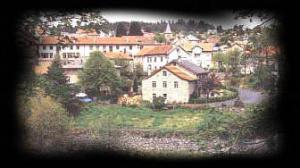
Fortunately, in the second half of the course we encountered a different sort of story altogether: Philip Hallie’s Lest Innocent Blood Be Shed. The subtitle of Hallie’s remarkable book is “The Story of the Village of Le Chambon and How Goodness Happened There.” It is, in many ways, more challenging and disturbing than being immersed in the depths of human depravity.
Hallie’s book is the little-known story of Le Chambon-sur-Lignon, a small and insignificant Protestant village in south-central France (about 250 miles east of Walker’s fictional village of St. Denis) that, during the later years of World War II, “became the safest place for Jews in Europe.” Between 1940 and 1943, the villagers of Le Chambon, with the full knowledge of the Vichy police and the Gestapo, and at great risk to their own safety and lives, organized a complex network of protection through which they hid and saved the lives of at least five thousand Jewish refugees—most of them women and children.
As a woman whose three children’s lives were saved by these villagers told Philip Hallie decades later, “The Holocaust was storm, lightning, thunder, wind, rain—and Le Chambon was the rainbow.” Hallie comments that “The rainbow reminds God and man that life is precious to God, that God offers not only sentimental hope, but a promise that living will have the last word, not killing. The rainbow means realistic hope,” a hope that was incarnated in Le Chambon.
It is a beautiful story, one that is virtually unknown in comparison to more familiar and dramatic narratives. Everyone who cares about the human spirit should read it—I dare you to make it through with dry eyes. My first question to the thirty-some students in the colloquium at our first class on this text was always “How did this happen?”
There is nothing special about Le Chambon—there are hundreds of similar rural villages throughout Europe. There were dozens of them within a short train ride of Le Chambon. Yet none of them did anything like what the Chambonnais did; indeed, many of them collaborated with the Vichy police and turned their Jewish neighbors and Jewish refugees in to the authorities as the occupying Nazis demanded. What made Le Chambon different? How did goodness happen here?
According to the Chambonnais in virtually every interview Hallie conducted, there was nothing special about what they did at all. After being described as a “hero” or simply as “good,” Magda Trocmé, wife of the village’s dynamic pastor André Trocmé, asked in annoyance
How can you call us ‘good’? We were doing what had to be done. Who else could help them? And what has all this to do with goodness? Things had to be done, that’s all, and we happened to be there to do them. You must understand that it was the most natural thing in the world to help these people. Who else would have taken care of them if we didn’t? They needed our help and they needed it then. Anyone else would have done the same thing.
I asked my students, “Is she right? How many think anyone else would have done the same?” Not a hand was raised—certainly not mine. So the question remains. How did this happen? How did goodness happen here? According to Hallie, the most important reason that goodness happened in Le Chambon is so simple and basic that it cannot be overlooked.
The Chambonnais believed one fundamental thing concerning human beings—that all human life, whether French, Jewish, or Nazi, is fundamentally precious and must not be harmed. Period. Many people, then and now, profess to believe this; the Chambonnais not only believed it—they acted on it. Consistently and regularly. Without questioning or equivocation. For such people, Hallie describes, “The good of others becomes a thing naturally and necessarily attended to, like any of the physical conditions of our existence. For certain people, helping the distressed is as natural and necessary as feeding themselves.” The villagers of Le Chambon were such people.
The source of this simple but powerful lived commitment depended on the person. For Pastor André Trocmé, on the one hand, his commitment to nonviolence and active goodness was rooted in his commitment to emulate Jesus and to take seriously, in a remarkably straightforward way, the message of the gospel. During his theological training, for instance, he was taught by his professors that the Sermon on the Mount is intended to be read as an allegory or as a standard set impossibly high so we can understand our sins and failures more clearly. André had no patience for such evasions. In a book written shortly after the end of the war, he asks
If Jesus really walked upon this earth, why do we keep treating him as if he were a disembodied, impossibly idealistic ethical theory? If he was a real man, then the Sermon on the Mount was made for people on this earth; and if he existed, God has shown us in flesh and blood what goodness is for flesh-and-blood people.
André’s wife Magda, on the other hand, had no patience for doctrine, religion, or any esoteric debate that might take her attention away from what was right in front of her. She did not believe that something was evil because it violated God’s commands. She believed that something is evil simply because it hurts people. A person’s need was the basis of her moral vision, not any sentimental love she might or might not feel for the person in need, and certainly not any calling to moral or religious excellence. There is a need and I will address it was her motivating energy. Simple as that.
As I worked through this story with my students the last time we taught this course, I realized with a new depth just how disturbing and shocking the story of Le Chambon is. “These people make me uncomfortable,” I told the students. “They let me know just how wide a gap there is between what I say I believe and what I actually do.” When the truth of what I profess is laid out in front of me in a way that I cannot ignore, I want to look away. I shift into philosopher mode—“This is idealistic, this won’t work in real life, real human beings won’t treat each other this way,” and so on.
My students were happy to be told this, because they were just as uncomfortable with the Chambonnais as I was and am. But goodness did happen there in the midst of some of the worst evil humans have ever manufactured. Real people created goodness in the midst of evil by actually taking what they believed seriously enough to do it. The best I can do is to make Hallie’s closing words in Lest Innocent Blood Be Shed my own and invite my students to come along.
I, who share Trocme’s and the Chambonnais’ beliefs in the preciousness of human life, may never have the moral strength to be much like the Chambonnais or like Trocmé; but I know I want to have the power to be. I know that I want to have a door in the depths of my being, a door that is not locked against the faces of all other human beings. I know that I want to be able to say, from the depths, “Naturally, come in, and come in.”












 Ad-Free & Subscriber Log-In